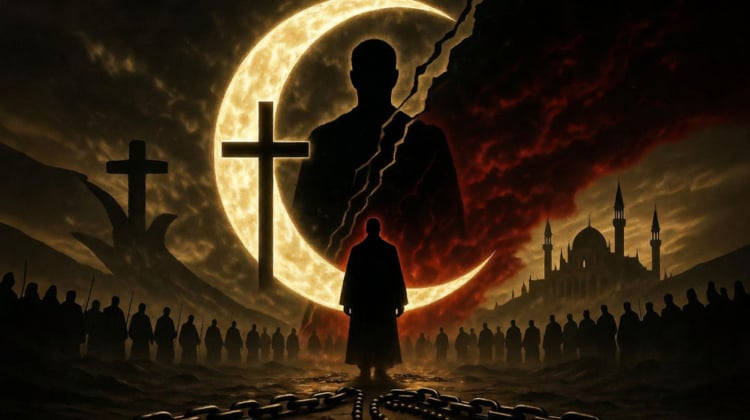
The origins of the dangerous myth of “Abrahamic Religions”.
When Pope Leo hails Islam and when western politicians praise Islam as an “Abrahamic religion,” they are not reaching back to an ancient Christian tradition but the relatively new twentieth century invention of a man whom Pope Pius XI had described as a “Muslim Catholic”.Traditional Christianity saw Islam as a pun for the sins of nations and Islamic rulers like Sultan Mehmed II as a “second Mohammed,” a “son of Satan” and a harbinger of the Antichrist.
One unlikely Christian ‘Islamist’ in the twentieth century helped change all that.
Louis Massignon was a French academic, intellectual, artist, officer, priest, gay man and likely spy, whose obsessive orientalism led him to spend a good deal of his time, occasionally at risk of his life, in the Muslim world, to advocate for its causes and to find spiritual meaning in Islam.
This was the era of ‘orientalism’ when dissatisfied wealthy western young men and women set off to find meaning in other cultures while often joining cults and engaging in sexual experimentation. Following the familiar pattern, Massignon’s travels in the Muslim world allowed him to experiment with Islamic mysticism and homosexual relationships. Along the way he developed an interest in Sufism, suffered a mental breakdown and became a scholar of Islam.
Such things were not all that unusual back then and Massignon had a number of Jewish contemporaries like Hugo ‘Hamid’ Marcus, a gay Jewish man who translated the Koran into German and was released from a concentration camp after the Nazis realized he was Muslim, Jacob ‘Israel’ de Haan, a gay poet who moved to Israel while trying to undermine its rebrth, and Leopold Weiss who changed his name to Muhammad Asad and became a spy for Saudi Arabia.
But Massignon developed a syncretic melding of Christianity and Islam that still retains a potent influence on the Catholic Church, Christianity and the West until this day. While Massignon returned to his mother’s Catholic faith, he credited a Sufi mystic with his spiritual transformation, describing him as a saint, and developed joint prayers and rituals with Christians and Muslims.
Massignon convinced Pope Pius XI to approve mutual intercessory prayers, earning the nickname of the ‘Catholic Muslim’, and pioneered the equation of Islamic concepts such as ‘Jihad’ with Christian ones. His most enduring one though was the depiction of Christianity, Judaism and Islam as comprising a unity of ‘Abrahamic religions’. Rebuking Christians as colonialists, he contended that “the Muslim, who believes in the equality of origin of the three Abrahamic religions, Israel, Christ and Islam, knows that they refer to the same god of truth.”
Like much of Massignon’s theology, the concept of ‘Abrahamic religions’ was not a Christian concept or for that matter a Jewish one, but an Islamic construct that allowed Muslims to claim primacy because in their teachings, Ishmael was the elder son who is taken by Abraham to build the foundation of Mecca, and whom Muslims claim was nearly sacrificed.
In actuality, Islam does not date back to Abraham or Ishmael, but to Mohammed who far postdated both Judaism and Christianity. The only connection between Abraham and Islam is that some Arabs (Adnanite Arabs including Mohammed) claim to be descended from one of Ishmael’s sons. Even assuming that this is true, Islam is not an ‘Abrahamic’ religion because a distant descendant of the patriarch’s concubine’s son created it 2,500 years later. Certainly not any more so than any of the other non Judeo-Christian religions held by Arabs before that.
Louis Massignon might have set out to create mutual understanding between Catholicism and Islam, to legitimize the displays of Muslim mysticism and piety that he encountered in his time in Cairo, oscillating between gay clubs and Al-Azhar’s Islamic scholarship, his time in Iraq and Algeria, but what he actually unknowingly accomplished was something fundamentally different.
Embracing ‘Abrahamic Religions’ licensed an Islamic theological primogeniture that made it the ‘elder brother’ to other religions. When Muslims talk about “Abrahamic religions”, what they are really doing is asserting the supremacy of Islam based on the lineage of the elder male, the same principle on which Islam’s caliphs were chosen (Mohammed had no living adults sons, so his successors were the fathers of his wives or the husbands of his daughters.)
This principle which once governed the political order of many of the kingdoms of Europe (and caused more than a few wars) may seem peculiar to their distant descendants, but establishing theological and political supremacy is a significant element in the Islamic conquest of Europe.
Massignon’s interest in Sufi mysticism largely blinded him to the political drives of Islam. Like many orientalists who attributed the conflicts between Islam and Europe to the Ottoman Empire rather than to the innate theological imperatives of Islam, he saw Arab Muslims as oppressed rather than the original conquerors and destroyers of Christianity in the Middle East.
The initial resurgence of post-war Jihadism in the Middle East was viewed by many European leftists as part of a global liberation movement to end colonialism. Ever the orientalist, Massignon was drawn to Gandhi, and despite the Indian’s leaders forced clashes with Islamic nationalism (which Gandhi had done his best to avert) viewed him as a model when Muslim terrorist groups began murdering Christians and Jews under French rule in Algeria.
In the 1950s, Massignon welcomed Muslims to France, denounced the French for their prejudice against Muslim mass migration and insisted, as later popes like Francis and Leo would, that Europe had a sacred mission to take in Muslims and “to love fraternally beyond their milieu and their relationships in time and space here below, within a community directed towards the universal.” --->READ MORE HERE



No comments:
Post a Comment