 |
| Bravodelnorte/Wikimedia Commons/CC BY-SA 4.0 |
‘[The International Emergency Economic Powers Act] IEEPA does not authorize the President to impose tariffs,’ the court ruled.
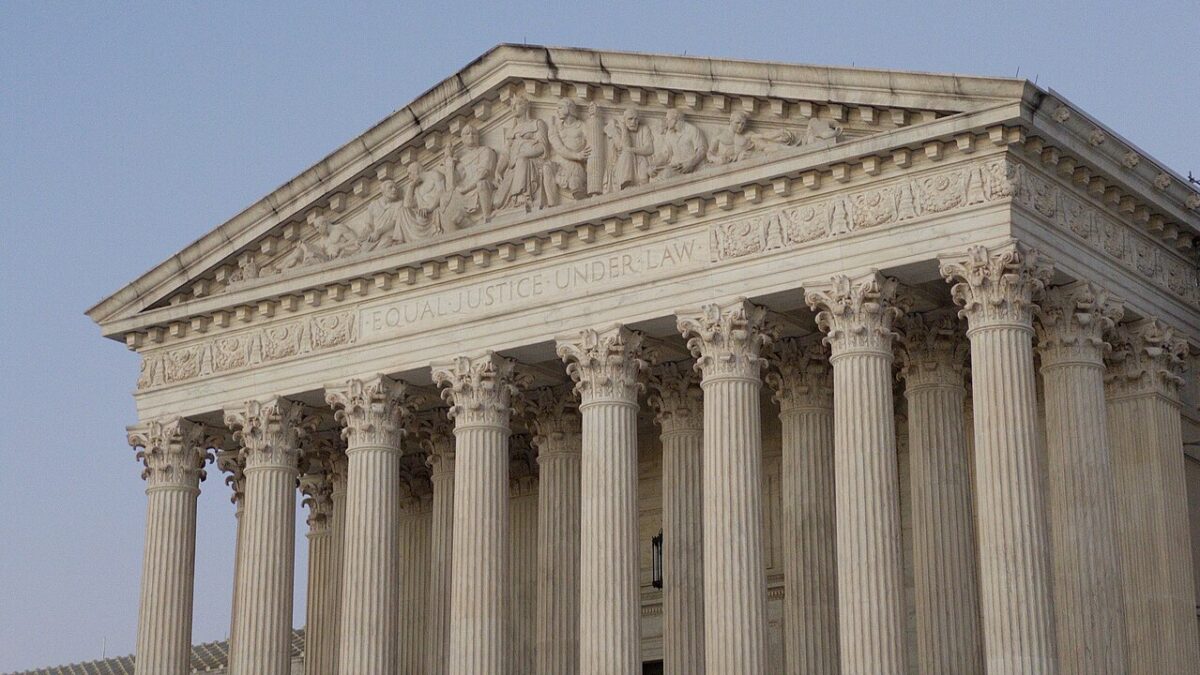
The U.S. Supreme Court ruled on Friday that President Trump’s imposition of tariffs under an emergency economics law is unlawful. The decision was 6-3, with Associate Justices Clarence Thomas, Samuel Alito, and Brett Kavanaugh dissenting.
“[The International Emergency Economic Powers Act] IEEPA does not authorize the President to impose tariffs,” the court ruled.
The ruling pertains to a pair of consolidated cases known as Learning Resources, Inc. v. Trump and Trump v. V.O.S. Solutions, Inc., which center around legal challenges to Trump’s use of IEEPA to impose tariffs on goods from foreign countries making their way into the United States. As The Federalist previously described, the president did so “in response to existing ‘unfair trade practices’ that lead to trade deficits, as well as to punish countries like China for failing to ‘blunt the sustained influx of synthetic opioids, including fentanyl, flowing from the [People’s Republic of China] to the United States.'”
Writing for the majority, Chief Justice John Roberts argued that Trump’s reliance on the words “regulate” and “importation” to justify his tariffs under IEEPA “cannot bear such weight.”
“Absent from [IEEPA’s] lengthy list of powers is any mention of tariffs or duties. That omission is notable in light of the significant but specific powers Congress did go to the trouble of naming,” Roberts wrote. “It stands to reason that had Congress intended to convey the distinct and extraordinary power to impose tariffs, it would have done so expressly — as it consistently has in other tariff statutes.”
The chief justice went on to argue that the administration’s reliance on the phrase “regulate … importation” “does not fill” such a “void,” and asserted that the court is “therefore skeptical that in IEEPA — and IEEPA alone — Congress hid a delegation of its birth-right power to tax within the quotidian power to ‘regulate.'”
“We do not attempt to set forth the metes and bounds of the President’s authority to ‘regulate … importation’ under IEEPA. That ‘interpretive question’ is ‘not at issue’ in this case, and any answer would be ‘plain dicta,'” Roberts wrote. “Our task today is to decide only whether the power to ‘regulate … importation,’ as granted to the President in IEEPA, embraces the power to impose tariffs. It does not.”
Associate Justices Neil Gorsuch Neil Gorsuch and Amy Coney Barrett each filed concurrences. Associate Justices Elena Kagan and Ketanji Brown Jackson each filed opinions concurring “in part and concurring in the judgement,” with Associate Justice Sonia Sotomayor and Jackson also joining the former’s opinion. --->READ MORE HERE

The Supreme Court ruled Friday that President Trump cannot use emergency powers to impose sweeping tariffs on foreign imports — leaving the White House facing the prospect of paying back tens of billions of dollars to traders.
In a 6-3 vote, the justices found that the International Emergency Economic Powers Act (IEEPA), which Trump used to apply broad, across-the-board levies — including a 10% baseline rate and additional tariffs on America’s three biggest trading partners over the shipping of fentanyl to the US — does not authorize the imposition of duties.
Chief Justice John Roberts wrote the majority opinion, joined by conservative Justices Amy Coney Barrett and Neil Gorsuch, as well as liberal Justices Ketanji Brown Jackson, Elena Kagan and Sonia Sotomayor.
In his opinion, Roberts noted that the “lengthy list of powers” articulated by the IEEPA does not include “any mention of tariffs or duties.”
“That omission is notable in light of the significant but specific powers Congress did go to the trouble of naming,” the chief justice went on. “It stands to reason that had Congress intended to convey the distinct and extraordinary power to impose tariffs, it would have done so expressly—as it consistently has in other tariff statutes.”
“Accordingly,” Roberts wrote, “the president must ‘point to clear congressional authorization’ to justify his extraordinary assertion of the power to impose tariffs. He cannot.”
The White House has pledged to use other legal avenues to impose tariffs, including Section 232 of the Trade Expansion Act of 1962 and Sections 201 and 301 of the Trade Act of 1974, if the high court did not rule his way.
The president has also floated the possibility of repackaging his IEEPA tariffs regime as licensing fees.
However, those methods are far more cumbersome and often restricted to certain types of imports or subject to expiration.
Among the levies affected by the ruling are the 10% baseline tariffs on all US trading partners that Trump announced on “Liberation Day” in April 2025. Also affected are duties of 10%, 25% and 35% on goods from China, Mexico and Canada, respectively, imposed in a bid to persuade those countries to crack down on fentanyl trafficking.
Tariffs of 25% imposed on nations that import oil from Venezuela, as well as an identical duty on India for importing petroleum from Russia, were also struck down — along with a 40% tariff on certain products from Brazil. --->READ MORE HERE
If you like what you see, please "Like" and/or Follow us on FACEBOOK here, GETTR here, and TWITTER here.



No comments:
Post a Comment