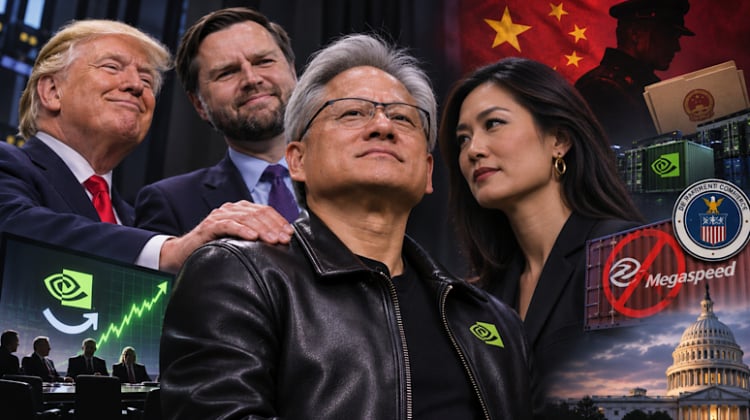
A disaster for corporate governance and a great power competition coup for China.
Markets have cheered the rapid and dramatic return of Jensen Huang, the highly visible, extravagantly wealthy, and recently ousted cofounder of American semiconductor and AI powerhouse Nvidia, to the CEO position he had held for decades. Earlier this month, Huang, a close ally of President Donald Trump’s, resigned as the CEO and president of the world’s second-largest company by market capitalization after it was revealed he had engaged in numerous extramarital affairs.
Among Huang’s trysts, most damningly, was a woman named Alice Huang (no relation), CEO of a Singapore-based tech company called Megaspeed. The U.S. government first investigated Megaspeed in 2024 for suspicions it was smuggling Nvidia chips to China without permission, and on Monday, November 23, Trump’s Department of Commerce formally added Megaspeed to the Bureau of Industry and Security’s infamous Entity List for discrete trade restrictions required by American national security.
Amazingly, something else even more notable happened on that very same day of November 23: Nvidia’s board of directors reinstated Huang as the computing conglomerate’s CEO and president. Huang’s phoenix-like resurrection would not have been possible were it not for the aggressive support, as well as the hands-on lobbying, of no less powerful a duo than the president and vice president of the United States themselves. President Trump and Vice President Vance, who was a creature of Silicon Valley before launching his political career, went out of their way to urge Nvidia to reinstate the disgraced CEO.
The intellectual tension, to say nothing of the national security tension, is staggering.
It has now come to light that around the same time Nvidia’s Huang was shacking up with Megaspeed’s Huang, the more prominent Huang was (successfully) lobbying President Trump to loosen previously existing export restrictions on certain types of AI chip sales to China. What’s more, we also now know that the less prominent Huang was in regular contact with Communist China’s Ministry of State Security—that’s a spy agency—from the spring of 2025 through this fall. That’s roughly the same period in which the Huangs were occasionallygetting their freak on.
Yet somehow, many who style themselves supporters of the administration cheered both embattled Commerce Secretary Howard Lutnick’s blacklisting of Megaspeed and Huang’s grand return to Nvidia. How one can square that particular circle isn’t quite clear. Regardless, the markets are cheering, and the most boisterous of MAGA enthusiasts are cheering too.
But I am not. Not to put too fine a point on it, but as I put it on X, “I prefer major American tech CEOs who don’t bang Chinese Communist Party spies while simultaneously lobbying POTUS to loosen export restrictions on advanced computer chips to China.” --->READ MORE HERE
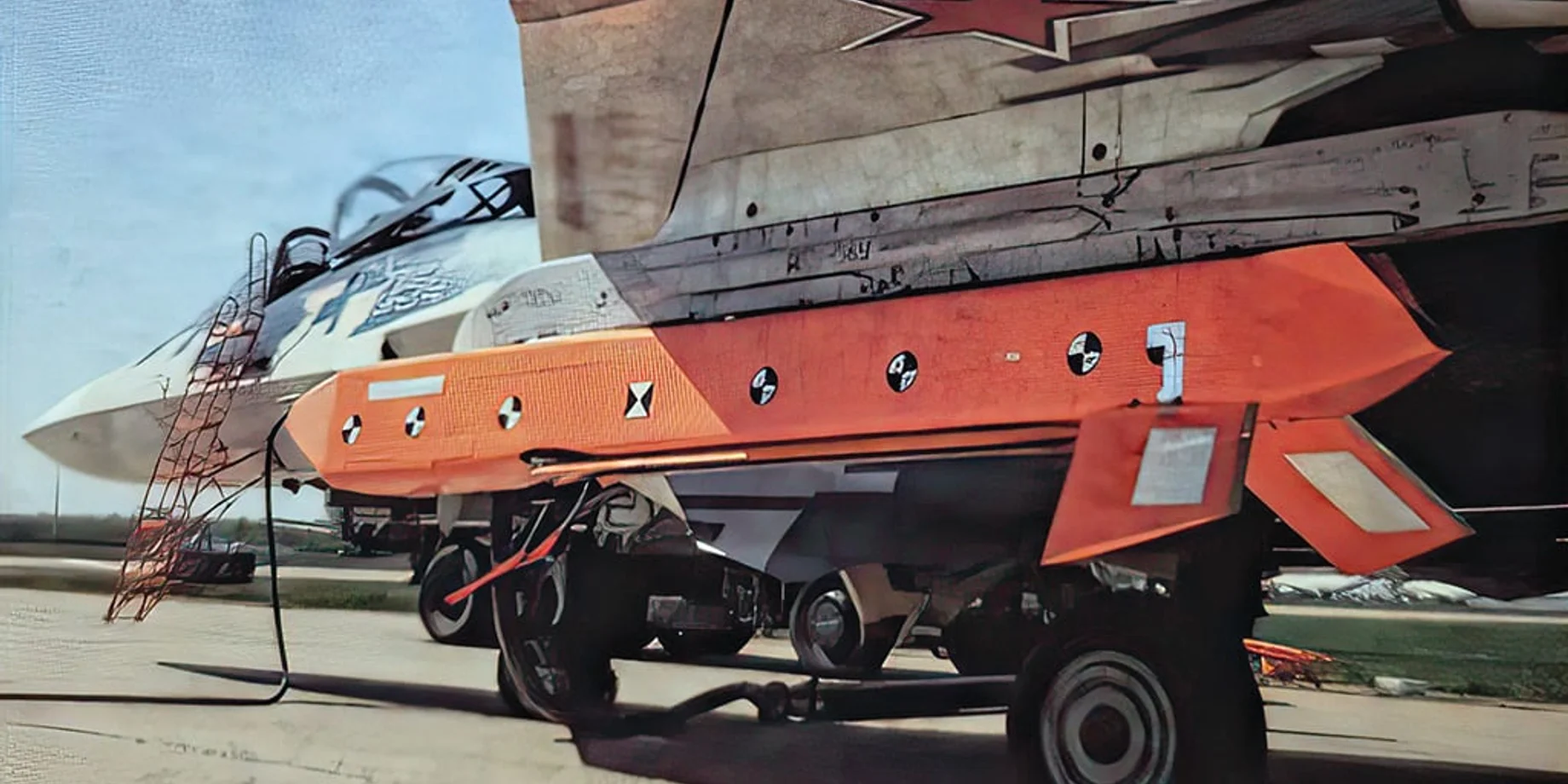 |
| An S-71M ‘Monochrome’ cruise missile. Photo: Sukhoi design bureau |
Russia is using civilian NVIDIA Jetson Orin computing modules in several types of strike weapons equipped with machine vision and artificial intelligence capabilities, ranging from Molniya and V2U drones to the Shahed-136 and the S-71M Monochrome air-launched missile.
This is evidenced by Ukrainian specialists’ analysis of Russian weapons and information obtained by The New York Times from Ukrainian military personnel and experts.
One notable case involved Russian Molniya drones, which the enemy tested in Zaporizhzhia between May and July 2026.
Ukrainian specialists found NVIDIA Jetson Orin mini-computers in their guidance systems. According to the analysis, the drones could not only use machine vision during the terminal phase of flight but also independently select a specific target to strike without operator confirmation.
During the July 6 attack, one of these drones was heading towards a petrol station in Zaporizhzhia. According to Ukrainian specialists, the operators designated an area or target for the attack, but once near the target, the drone independently identified a specific object to strike — likely propane tanks.
Three people were killed in the strike. According to experts interviewed by the NYT, this was the first documented case of civilians being killed by a Russian drone equipped with such an autonomous terminal target selection system.
The module examined was not encrypted, allowing Ukrainian specialists to analyze the uploaded terrain images and the software. They established that the system had been trained to recognize specific categories of objects, including petrol station infrastructure.
Unlike “last-mile” systems, in which AI merely helps a drone home in on a target already selected by the operator, in the tested Molniya configuration, a human was not involved in the final selection of the specific object to be struck.
NVIDIA in V2U and Shahed --->LOTS MORE HERE
If you like what you see, please "Like" and/or Follow us on FACEBOOK here, GETTR here, and TWITTER here.



No comments:
Post a Comment