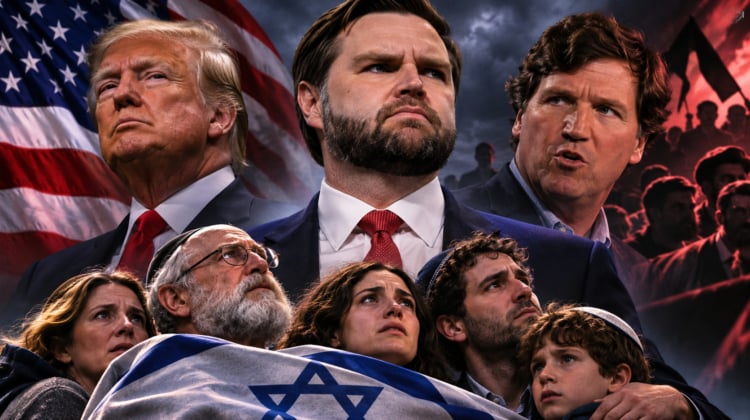
Is there any daylight between the veep and his friend Tucker Carlson?
In a now-viral X post the day after Republicans suffered their single worst midterm election massacre since the Watergate backlash election of 1974, Vice President JD Vance took—as he very often does—to social media. In an oddly detached tone better suited for a cable news pundit than the sitting vice president of the United States, Vance offered his own bit of speculation as to what made the GOP go down in flames like the Hindenburg.The veep cited a “pollster” and “one of the smartest people [he] know[s] in politics,” who Vance says he first pinged to elicit a pre-election prognostication. The Wall Street Journal reports that the purported smarty-pants appears to be Mark Mitchell, who was fired from the conservative-leaning Rasmussen Reports polling outfit for unstated reasons—but it might have to do with his not very thinly veiled “groyper” proclivities. Around the time last year that the monstrous Candace Owens accused me of somehow having foreknowledge of my friend Charlie Kirk’s horrific assassination, Mitchell complained that the “‘Tucker and Candace are Jew-haters’ people don’t like to use logic.”
Way to let the mask slip, Mark!
As for the discredited pollster’s high-ranking confidante, Vance, he cited his pollster friend’s alleged voter survey to surmise the top four reasons for Republican voters’ depressed turnout and/or outright abandonment of their party: “1) End the war”; “2) Focus on cost of living/inflation”; “3) Put America First”; and “4) Change our relationship to Israel.” Just in case the point was too subtle (and it wasn’t very subtle), Vance also added: “The reason we lost is the war,” and “everyone knows why we lost.”
He probably should have checked with his boss first. While conceding that the war might have been a factor—not the factor—in the midterm wipeout, President Donald Trump also made clear the day after the election (the same day as Vance’s post) that it was still worth it: “If I had to do it again, I’d do it again. Because long term, it’s the only answer. You can’t let Iran have a nuclear weapon.”
I called this earlier this year. Way back in March, I wrote: “The skeptics may shriek loudly. Let them do so. Because for Trump, a drastically improved national—and regional and global—outlook is more than justification enough.”
Does JD Vance agree with Trump’s assessment? He should say so, if he does. But he doesn’t, so he won’t. In this sense, Vance is little more than one of those Trump “skeptics” who “shriek loudly.”
The war in Iran undeniably was a factor in this election. It was, and remains, unpopular with the American people. That isn’t exactly surprising, either: The president never once held an earnest, primetime face-to-face Oval Office address with the American people to explain to us all what exactly the objectives and aims of the war were (are?). Was regime change an explicit goal? Was the idea to further cripple Iran’s ability to build a nuclear weapon, or to destroy its menacing ballistic missile arsenal? Perhaps the goal was simply to prevent Iran from ever taking the Strait of Hormuz hostage again?
None of us know the answer to this basic question of war aims, because the men in charge never bothered to explain it to us. Instead, all Americans saw gasoline prices spiking as the president waffled for months and months between fiery strikes and premature ceasefires, between blockades and Qatari-mediated attempts to broker a comprehensive off-ramp. The American people rejoiced at the demise of the terrible Islamist tyrant, Ali Khamenei, and then cried foul as the administration continued the dog and pony show, to unclear ends, while energy prices helped exacerbate affordability preexisting concerns.
Given the administration’s ham-fisted (at best) waging of the war against Iran and its refusal to try to sell the policy to the American people, it is no surprise that the policy proved unpopular with the voters. As I wrote earlier this month after the election, this lack of communication was “astonishing political malpractice”—especially for a putatively populist commander-in-chief.
But what about those preexisting affordability concerns? Those concerns began with the April 2025 rollout of the administration’s “universal” tariff policy, which proved overwhelmingly unpopular with the American people. They were deployed in reckless and indiscriminate fashion, crushed importers and exporters, and led to real inflation stickiness even as they had a (very) moderate positive impact on job reshoring. The affordability and cost-of-living spikes attributable to the Iran war simply compounded the existing bloated baseline spike in affordability from the “Liberation Day” tariff rollout. Maybe the American people didn’t vote for an extended and rudderless deployment in the Persian Gulf, but they didn’t vote for a trade war with Canada, either.
And that’s not even getting into the issue of corruption—a glaring problem that was conspicuously absent from Vance’s navel-gazing X rant, perhaps because he is famously close with the single guiltiest party of them all, Donald Trump Jr. The reality is that, for much of the past two years, elements of this White House and of this administration have been for sale to the highest bidder. The administration effectively admitted this when newly minted White House Chief of Staff Stephen Miller unveiled a ban on White House staffers accepting lobbyist meetings without prior approval. Roughly 90% of voters cited corruption as a major factor in their vote, and as a bloc these voters tilted heavily toward Democratic candidates nationwide.
That then takes us to the group of people that the vice president—much like his close friend and Nazi Party propagandist, Tucker Carlson—seems to have a bit of an uncomfortable obsession with these days: The Jews. The notion that the U.S.-Israel relationship was a major factor in depressing Republican turnout and undermining partisan loyalty in this election is a talking point of hacks, morons, ignoramuses, and low-rent bigots. As the Journal’s Kimberly Strassel—who, unlike Vance’s “smartest” pollster buddy, actually knows how to read exit polls—observed: “Exit polls show that of the 51% of voters who said our support for Israel was ‘too strong,’ only 19% of even that subset of respondents were Republican. The vast majority of GOP voters said our support for Israel was ‘just right’ or ‘not strong enough.’”
Not to put too fine a point on it, but there is zero intellectually honest case to be made that Israel, specifically—as opposed to the Iran war, more generally—was a meaningful factor in the election. It simply wasn’t, and there is no defensible way to suggest that it was. Vance says it was a top-four issue that contributed to the GOP’s rout, but available exit polls didn’t have the specific bilateral U.S.-Israel relationship listed as even a top-20 issue of concern for voters. Vance’s suggestion is hyper-online, brain-rotted Internet trolling posing as sophisticated, “truth-telling” punditry—laundered by the second-most powerful man in Washington, D.C. The vice president of the United States, whose close friend Tucker Carlson seems to want to incite pogroms against American Jews, has embraced the Weimar Germany-era “stabbed in the back” mythology.
This is appalling and exceedingly dangerous. But, as all our eyes begin to look ahead toward 2028, we must also ask: Why?
I have a theory.
Trump and Carlson have long been on an unavoidable political collision course, as the disgraced former Fox News star has descended further and further down the rabbit hole of paranoia, conspiracism, Trump-hatred, Jew-hatred, and general mental derangement. For years, Vance has tried to downplay this dynamic, laughing off Carlson’s grotesque ramblings as the sorts of thing that friends of good faith can agree to disagree on. But as Carlson only continued to escalate, such as his wild speculation this year that Trump might be the “Antichrist” over his handling of the Iran war, Vance’s triangulated dance has become an unsustainable one. --->READ MORE HERE



No comments:
Post a Comment