 |
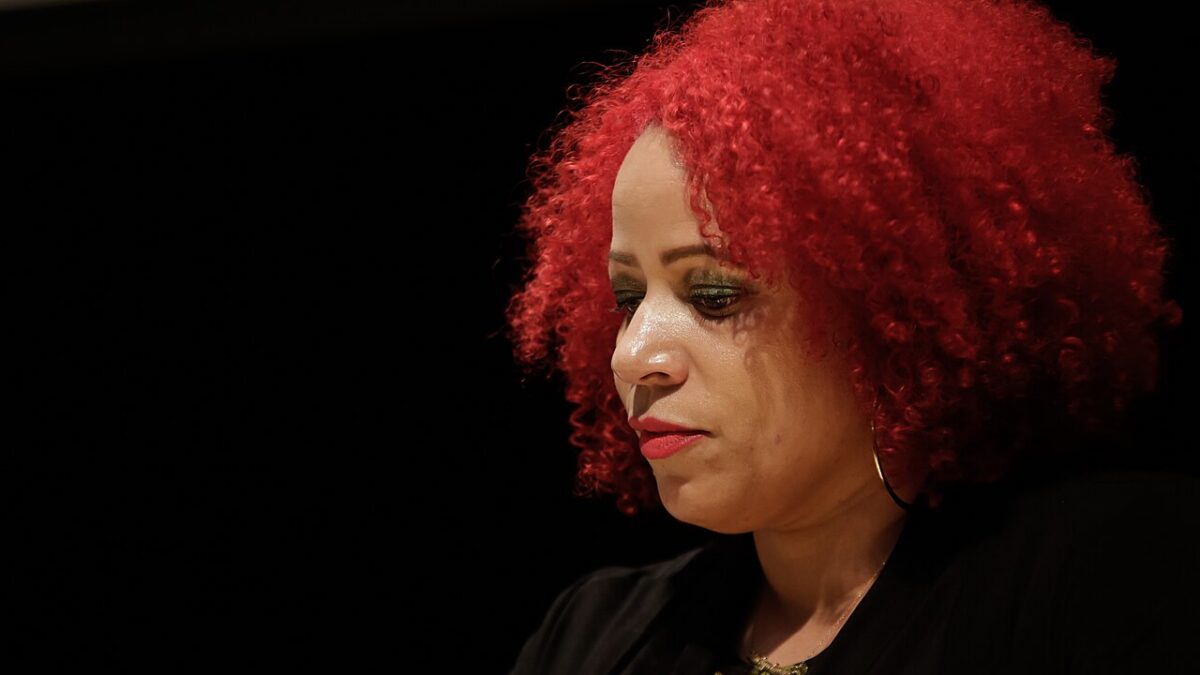
| Brazilian Assn of Investigative Journalism/Wikimedia Commons/CC By 2.0 |
Hannah-Jones’ ideology did not just ruin her own daughter’s academic potential by choice; it also poisons by force the educations of countless other students who attend the schools where the ideology has free rein
The failing school that race-grifter Nikole Hannah-Jones sent her child to used Hannah-Jones’ ahistorical 1619 Project as part of its curriculum, public records show.Hannah-Jones recently wrote an essay for The New York Times describing her daughter Najya’s educational experiences at a failing, predominantly black middle school in New York City, where she was sent for express racial purposes. While the essay focused predominantly on Najya’s inability to do math due to lack of preparedness from her middle school, the Urban Assembly Unison School, it notably left out the school’s use of the 1619 Project, which likely indicates it also failed to provide her with a sufficient historical education.
According to the 1619 Project’s website, Unison was part of the 2022 cohort of schools and teachers in the 1619 Project Education Network, which “allowed students to explore The 1619 Project themes in creative and innovative ways with performance tasks that included redesigned textbooks, student performance showcases, and designing memorials for their wider community.”
In 2022, Najya would have been in seventh grade and therefore a student at Unison for two years of the 1619 fabrications.
“Our project will encompass learning history through the power of narratives that shift from the deficit view to a more celebratory & centering of the many powerful contributions of Black people in America,” the Unison page on the 1619 website states. Hannah-Jones’ 1619 Project is prominently displayed on the school’s curriculum page.
The basic premise of the 1619 Project is that the true founding of America happened in 1619 when the first slave ships with Africans arrived. Everything that happened after that, including the American Revolution, was really for the express purpose of continuing the institution of slavery, as opposed to any grander purpose like freedom, liberty, and self-determination. It is an “antiracist” project that has suffered withering rebuttals from historians across the political spectrum for its numerous errors, but the race-essentialist lens that undergirds it goes far beyond the false telling of history.
The “antiracist” movement as a whole means curricula across subjects, school policies on discipline, and grading are all rearranged to coddle particular groups of students based on skin color, while ignoring everyone else. Unsurprisingly then, “antiracism” is the essential premise of Hannah-Jones’ essay, even though she tries not to admit it, and the “antiracist” elements described above were deeply embedded in the school she selected.
Unison, Hannah-Jones wrote, is “part of a cohort of themed public schools created to advance the economic and social mobility of low-income students and students of color through rigorous instruction and a focus on social-emotional learning.” The institution had a “food-justice club” and held multiple “Black History Month assemblies and spirit weeks.”
The racial programming appeared to work, as Najya herself, when looking for a more rigorous high school, said, “I’d never been in a school with white kids and don’t think I really wanted that,” but between it all, the true consequences of 1619-informed “antiracism” came out as well.
“Unison had eliminated homework because studies show that it does not have much impact on academic achievement, and that assigning it often sets up for failure students who are so academically behind that they cannot do the work on their own. Under the Unison system, students completed their assignments during class time where a teacher could guide and help if they got stuck. But for students like Najya, this practice proved absolutely harmful,” Hannah-Jones admitted. “She’d bemoan how the less experienced teachers struggled to manage their classrooms and would expend so much attention on the small number of kids acting out that they’d be unable to complete their lessons or help a student stuck on a problem. There were occasionally fights in the hallway.”
Instead of disciplining any children who acted out in class, teachers had to “refocus students and mitigate conflict” in real-time, meaning they had very little opportunity for actual class instruction. In the same sentence, Hannah-Jones claims that “this is good educational practice,” and then adds, “but kids like Najya, who were just trying to do their work, saw this treatment as deeply unfair.”
In reality such policies are unfair because not disciplining students deprives both misbehaving students and their more studious peers of educational consistency throughout the day. Like not assigning homework, or “equity grading,” there is no accountability or rigor during or outside the school day, and students in such schools often end up advancing years in school while remaining academically stunted. --->READ MORE HERE



No comments:
Post a Comment