 |
| Photo by Shawn Fleetwood |
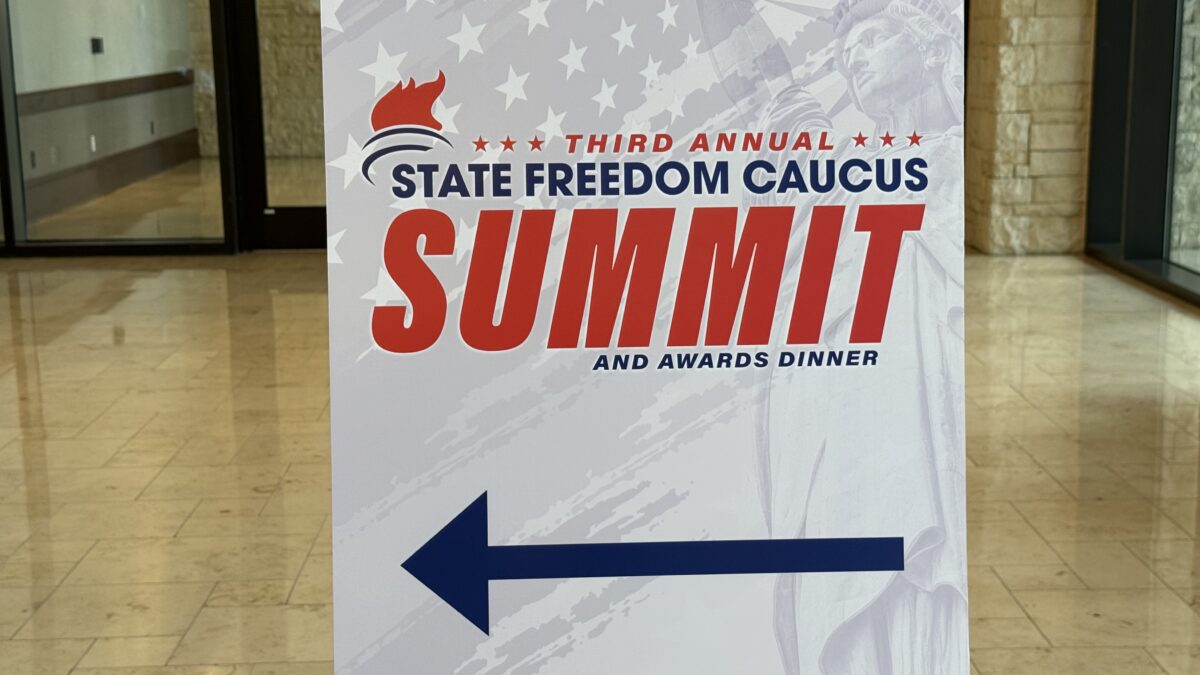
The State Freedom Caucus Network gathered in Dallas over the weekend for a summit to strategize on advancing an ‘America First’ agenda.
DALLAS, Texas — A common misconception throughout modern American politics is that, because a state is run by Republicans, it’s automatically conservative. But as has been shown time and time again, that could not be further from the truth.From the high peaks of Wyoming to the sandy shores of South Carolina, elected Republicans in many of the country’s supposedly “reddest” states routinely work against the interests of their own voters. Whether it be on redistricting or immigration, the establishment’s preference for the status quo is almost universally the same.
But rather than simply complain about the problem, the State Freedom Caucus Network (SFCN) is seeking to do something about it. Spanning 15 states and a growing number of state lawmakers, the organization and its members gathered in Dallas over the weekend for its third annual summit to strategize on how best to advance a true “America First” agenda for conservatives.
Several of the network’s members who spoke with The Federalist discussed the necessity of these freedom caucuses in spotlighting and combatting the “swamps” in America’s state capitals. While detailing the highs and lows of the past year, they also signaled what the future may hold for the network’s expansion in other states throughout the country.
“The biggest deceit in state politics is these red states where the voters are conservative, but the members of the legislature are not, and it’s for the very simple fact that I say over and over again, which is a Democrat knows he can’t get elected in a red state, so he puts an R after his name, gets elected, and then he governs like a Democrat,” SFCN President Andy Roth told The Federalist.
The Good
In order to map out a successful strategy for the coming legislative year, the SFCN had to conduct an analysis of its most recent work to see what went right and what didn’t.
Starting with the positives, Louisiana and Missouri’s freedom caucuses passed various measures cracking down on foreign influences in their respective states. The latter’s freedom caucus members also helped the Show Me State implement significant cuts to government spending.
In South Dakota, freedom caucus members helped lead the charge to pass the state’s version of the SAVE America Act, which requires documentary proof of citizenship when registering to vote. While speaking to The Federalist, the bill’s sponsor, South Dakota Freedom Caucus Vice Chair and State Rep. John Carley, noted the irony of U.S. Senate Majority Leader John Thune’s home state approving a version of the legislation that he and his Republican colleagues have continuously failed to pass.
It “was a good success not only for our state, but then it motivates both the federal [Congress] and other states to do the same,” Carley said.
One of those states was Arizona, where freedom caucus lawmakers successfully placed a version of the SAVE America Act on the state’s fall ballot in the form of a constitutional amendment proposal.
Election integrity was also one of the Wyoming Freedom Caucus’ legislative achievements throughout the past year. Since attaining an outright majority in the state House, the Cowboy State’s caucus members approved laws invalidating out-of-state driver’s licenses issued to illegal aliens, cracking down on non-English speaking commercial truck drivers, expanding school choice, and more.
Freedom caucus lawmakers even saw some success in Democrat-dominated states like Illinois.
State Rep. Brad Halbrook described the key role the Illinois Freedom Caucus played in stopping passage of an anti-homeschooling bill last year despite being a minority within the minority party. As The Federalist previously reported, critics argued that the controversial legislation — which generated major protests at the Illinois Capitol — attempted to “criminalize parents’ ability to homeschool their children in the Prairie State.”
“I think it helps us to have a platform, a kind of a lane to run in, if you will. We stay fairly united on our messaging and our votes … [and] I think it helps lead other members of the Republican caucus along … to move the conservative agenda forward,” Halbrook told The Federalist.
The Bad
This year hasn’t been without its downsides, however.
While set to grow their team’s ranks in the state House after the 2026 primaries, Montana Freedom Caucus members Jerry Schillinger (state representative and MTFC chair) and Bob Phelan (state senator and MTFC secretary) noted the immense difficulty of getting meaningful conservative priorities through the legislature’s most recent session. Both lawmakers pointed to a cabal of nine state Republican senators who colluded with Democrats to instead pass items such as “progressive” property tax reform. The Montana GOP formally censured the “Nasty Nine” over such antics last year.
“A tremendous frustration among conservatives [has been] that we were always the majority of the caucus in the legislature, but we could never really push the conservative agenda because of Democrats posing as Republicans — people [who] knew they couldn’t win as a Democrat in their district, so they run as Republicans,” Schillinger told The Federalist. --->READ MORE HERE



No comments:
Post a Comment