Migrants Invaded Ceuta Because A Court Encouraged Them. SCOTUS Just Did The Same Here:
What’s happening in Spain is a preview of what America can expect after our own Supreme Court’s birthright citizenship ruling.
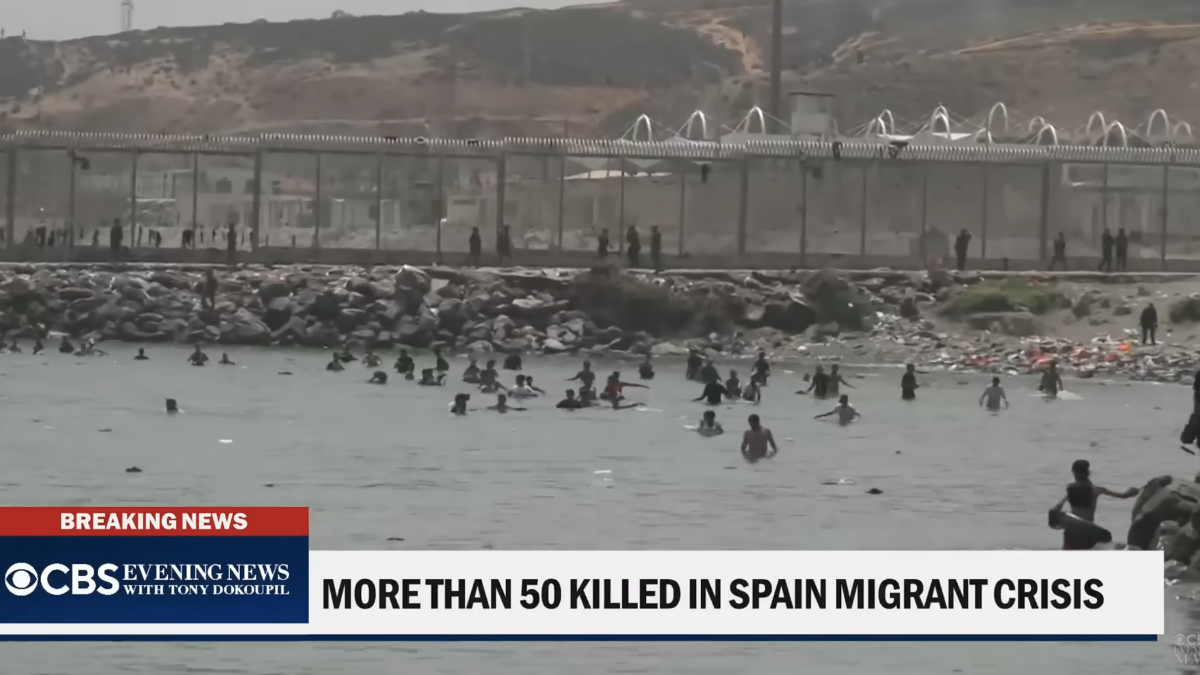
Some 60,000 tough young men from Morocco suddenly arrived in a small autonomous Spanish city located in northern Africa, many carrying cell phones in plastic bags to protect them from the water they crossed by inner tubes and swimming. This group of migrants is greater than the population of 95 percent of American cities and towns.
A recent pro-immigration ruling by the Tribunal Supremo, the Supreme Court of Spain, sparked this invasion, creating a lesson for our crisis of illegal immigrants in the United States. A week after our own Supreme Court’s disastrous decision in favor of illegals getting birthright citizenship, Spain’s Supreme Court ruled that migrants captured at sea cannot be immediately returned to their native country, known as a “pushback.”
Spanish Territorial Policy Minister Ángel Víctor Torres referred to the ruling as a factor contributing to unlawful invasion. He also said legal experts think the decision will allow eventual deportation of these illegal immigrants, but only after time-consuming legal processes are provided to each of the invading migrants.
The language of Morocco is Arabic. But Spanish is the language of the two Spanish territories bordering Morocco in northern Africa, named Ceuta and Melilla, such that many of the migrants cannot communicate with local officials. Ceuta is located on the African side of the Strait of Gibraltar, where the Atlantic Ocean meets the Mediterranean Sea, and residents receive their food via the 30- to 60-minute ferry ride from Spain. Melilla is located 250 miles eastward on the Mediterranean coast.
These migrants have overwhelmed local facilities and are sleeping on beaches with limited access to food or drinking water. Due to the court ruling, they must be admitted for processing in compliance with Spanish immigration rules, which takes time.
If released during this process, as many illegal immigrants in America have been, they may not show up for court hearings or appointments with immigration authorities. They can roam about for years, and have rights to migrate further into any European Union country once they are lawfully in Spain.
Social media are being blamed for spreading the word that if migrants swam or boated to Ceuta or Melilla, they would have a right to stay. This has been criticized as a misinterpretation of the court ruling, but the court did grant special “due process” rights to those who came by sea rather than by land. --->READ MORE HERE
Thousands of migrants remain in Spanish territory after border rush, death toll hits about 100: Ceuta official:
Juan Jesus Vivas told the European Parliament the crisis left reception centers in a state of collapse
Between 3,000 and 5,000 migrants remain in Ceuta after hordes of mostly military-aged men rushed into the Spanish enclave from Morocco late last month, Ceuta's president said Thursday.
While speaking from a video call during an extraordinary session of the European Parliament's Committee on Civil Liberties, Justice and Home Affairs, Ceuta President Juan Jesus Vivas also revealed around 100 people died during the surge.
Authorities estimate roughly 80,000 migrants rushed into the territory within a 48-hour period in late July.
Vivas called the border crisis an "invasion" and "one of the most difficult moments in the recent history of our city."
"According to the Dictionary of the Royal Spanish Academy, an 'invasion' should be understood in its second definition as the abnormal or irregular occupation of a specific place," Vivas said, according to a Fox News Digital translation of his remarks, which he gave in Spanish.
"That is precisely what occurred on July 30 and 31, when approximately 80,000 people — equivalent to the entire population of Ceuta — stormed into our city. This characterization, moreover, aligns with the statement made by the President of the Government of Spain, who on Friday the 31st, during his visit to Ceuta, stated that we were facing an attack, a violation of Spain's territorial integrity," Vivas continued.
Echoing previous claims from Spain's leftist President Pedro Sánchez and European Commission President Ursula von der Leyen, Vivas acknowledged roughly 75,000 of the migrants had returned to Morocco but added "under no circumstances does it allow us to claim that our city has returned to normal."
"Ceuta has not returned to normal because between 3,000 and 5,000 people who entered during those fateful days of July 30 and 31 still remain," Vivas said. "The reception centers for adult and minor migrants are in a state of collapse, turning the influx into a major humanitarian emergency." --->READ MORE HERE
If you like what you see, please "Like" and/or Follow us on FACEBOOK
here, GETTR
here, and TWITTER
here.




No comments:
Post a Comment