By separating the spatial effects and then measuring the indirect “spillover effects,” this research paints a clearer picture of immigration’s overreach into communities, theoretically spread over the whole country.
Immigration accounts for as much as 40 percent of U.S. rent increases as the housing affordability crisis continues to plague millions of Americans, according to a forthcoming study shared exclusively with The Federalist.The paper, “Immigration and Rent: A PUMA-Based Spatial Analysis,” will appear this fall in Cityscape magazine as part of a collection of works exploring the relationship between immigration and housing markets.
The research conducted by Dr. Jason Richwine, a resident scholar at the Center for Immigration Studies, found that the surge of immigration which started during the Biden administration has direct implications on the affordability of housing in America today.
His measurement of migration accounts for both legal and illegal immigrants. Although he noted that the exact amount of each within that percentage is hard to quantify as the word “immigrant” has become a gray area.
The Proof Is In The PUMA
Since 2020, home prices have increased by 54 percent nationwide and more than 50 percent in 73 of the country’s 100 largest metros, says Axios.
A recent Federal Reserve working paper found that unauthorized immigrant worker flows caused 30 percent of the total increase in house prices and 20 percent of the increase in rent.
From Dr. Richwine’s examination of data from 2013-2022, his findings attribute immigration to 40 percent of the real rent increase. His study takes into account the indirect “spillover effects” caused by immigration.
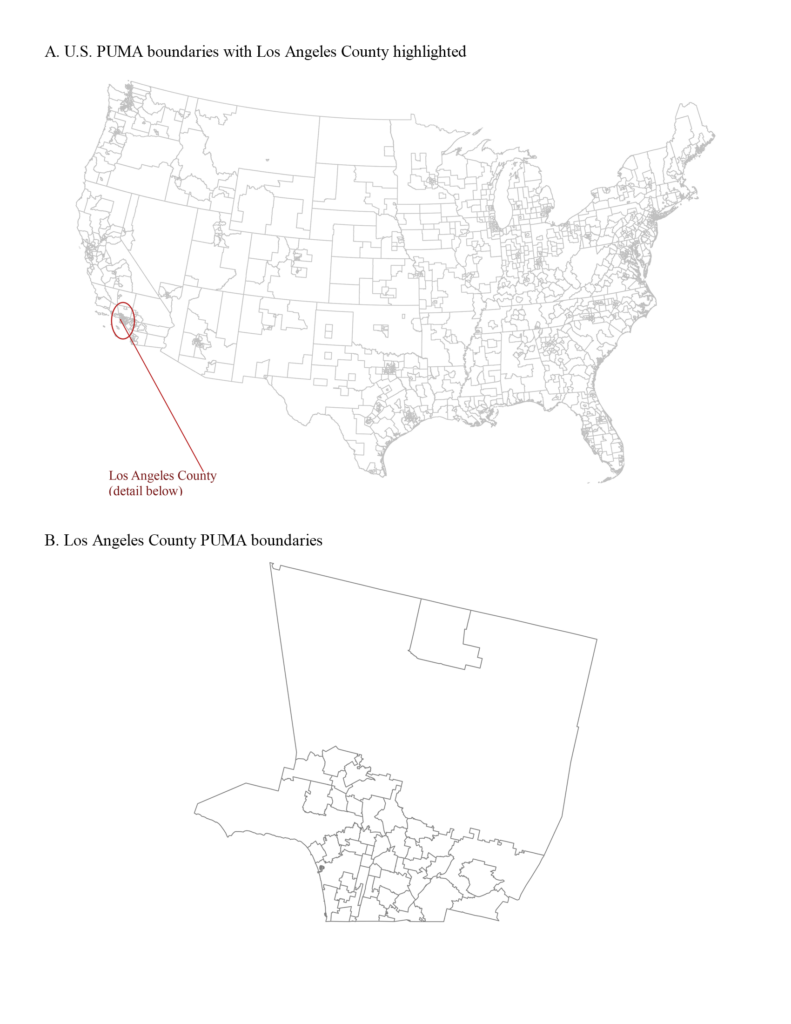
Dr. Richwine’s study uses a different kind of sample size called a PUMA (Public Use Microdata Area) — the smallest geographical unit available to researchers from the United States Census Bureau.
In past studies, a number of researchers observed a positive correlation between immigration and housing values using Metropolitan Statistical Area (MSA) spatial analysis. They estimated “an immigration inflow equal to 1 percent of a city’s population is associated with increases in average rents and housing values of about 1 percent.”
“You look at how much immigration is going up in a certain area, like a state or a county and then sees what the effect on housing is there,” Dr. Richwine said. “But the problem with that literature has been the fact that rent tends to be very much spatially correlated – if rent goes up in one county, its likely to go up in an adjoining county.”
Dr. Richwine calls this the “spillover effect.” By separating the spatial effects and then measuring the indirect “spillover effects,” this research paints a clearer picture of immigration’s overreach into communities, theoretically spread over the whole country.
“Taking all spillover effects into account, a simultaneous 1 percentage-point increase in immigration in all PUMAs is associated with an average increase in native rent of 1.46 percent,” Dr. Richwine’s abstract reads. “Along with a 0.65 percentage-point increase in the share of natives who are burdened by a high rent/income ratio.”
Based on these findings, for every 1 percentage point change in immigration, cost of rent went up by about 1.5 percent. Meaning, if there’s a 10 percent point change in immigration, then it would be a 15 percent increase in rent. When that rent goes up in one PUMA, it also causes rent to go up in surrounding PUMAs because of the way the markets are intertwined.
“Immigrants coming into one PUMA is kind of like throwing a little stone into a lake and you see the ripples coming away,” Richwine said. “Where the stone splashes are the direct effects, and the ripples are the indirect effects.”
The study find that those indirect effects spread over the whole country, making larger ripples near the adjacent PUMAs. These reverberations happen spatially when immigrants come to a large share of American geography.
“If we just had immigration to one PUMA, it wouldn’t really have a very large effect, but the fact is we have immigration coming to lots of PUMAs,” Richwine said. “And under the model, if you have immigrants coming to every PUMA, that’s like throwing thousands of stones into the lake all at once, and then all those ripple effects kind of interact with each other.”
In the city of Los Angeles alone there are 50 different measured PUMAs.
LA is a known immigration hub and sanctuary city, with 35 percent of the population of Los Angeles County being foreign-born. The current cost to rent is also 36 percent higher than the national average. Los Angeles also faces a historic housing crisis. In 2021, California mandated LA must add more than 450,000 housing units by 2029 to keep up with the current demand. However, the city has only issued permits for 81,306 housing units so far.
Biden’s Border Crisis --->READ MORE HERE



No comments:
Post a Comment