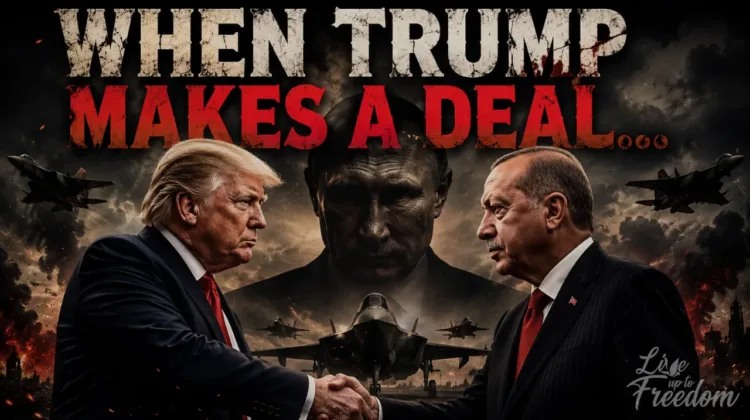
The "America First" irony.
On Tuesday, July 7, during talks in Ankara with Turkish President Recep Tayyip Erdoğan, President Trump announced that his administration will lift CAATSA sanctions against Turkey and consider restoring the country to the F-35 program.The F-35 is America’s premier, multi-million-dollar stealth fighter jet. Being in the program allows a country to buy, fly, and help manufacture the absolute pinnacle of Western air power.
To put this into perspective, the U.S. isn’t just preparing to sell planes to Turkey. It is preparing to hand over its most advanced stealth fighter technology after a six-year ban without requiring Turkey to give up the Russian S-400 missile systems that got them kicked out in the first place.
Those CAATSA sanctions were originally imposed because Turkey knowingly bought Russia’s S-400 missile defense system, completely ignoring repeated warnings from the United States and its NATO allies.
In 2017, the U.S. Congress passed the CAATSA law, which stands for the Countering America’s Adversaries Through Sanctions Act, to mandate penalties against any country that buys major military hardware from Russia.
That exact same year, Turkey signed a $2.5 billion agreement to acquire the Russian-made S-400. Washington spent the next two years warning Ankara that the purchase would carry serious consequences.
Turkey proceeded anyway. The first components arrived in July 2019, and within days, the United States removed Turkey from the F-35 program.
By December 2020, the Trump administration formally slapped CAATSA sanctions on Turkey’s defense procurement agency.
The issue was never simply that Turkey bought Russian weapons. The concern was far more dangerous.
The S-400 is designed to detect, track, and analyze aircraft. The Pentagon’s nightmare was that operating the S-400 right alongside the F-35 would allow Russia to collect valuable data on America’s premier stealth fighter.
Every flight, every radar return, every electronic signature could help Moscow figure out exactly how to detect and shoot down the aircraft in the future.
That was the Pentagon’s firm position in 2019. Then-Acting Defense Secretary Patrick Shanahan stated plainly that the F-35 and the S-400 “cannot coexist.” The security risk was considered too great, and Turkey was expelled.
So, before Washington wipes the slate clean and hands over the keys to America’s most advanced fighter jet, one obvious question deserves an answer:
What changed?
Turkey still possesses the S-400. This is not a minor detail; it is the entire legal and military basis for the original policy. If the S-400 posed an unacceptable security risk in 2019, and Turkey still owns that system today, then the security risk hasn’t magically vanished.
To fully understand the absurdity of the current situation, you have to look at what Turkey has actually done with the weapons. In 2020, Turkey didn’t just park the S-400s in a garage; it conducted live test firings, activating the Russian radar to track targets. Since then, Ankara has played a diplomatic shell game, claiming the system is merely sitting in “storage” at an undisclosed location.
But “storage” is a hollow geopolitical fiction.
Putting a missile system in a warehouse does not neutralize it. The S-400 remains fully operational. It can be rolled out, powered up, and deployed in a matter of hours.
The moment Turkey takes delivery of an F-35, the fundamental nightmare scenario returns: a NATO ally operating a Russian spy-magnet that can harvest the electronic signatures of America’s most prized stealth fighter.
Military experts have been clear on what a real solution looks like. To actually eliminate the threat, Turkey would have to completely destroy the system, ship it back to Russia under strict international supervision, or hand it over to the Pentagon to be dismantled for parts.
Ankara has refused to do any of that. They didn’t bend; Washington did. By lifting sanctions now, the Trump administration is effectively signaling that a “pinky promise” to keep the Russian missiles in storage is worth more than the integrity of America’s air defense secrets.
Consider what else has not changed: Recep Tayyip Erdoğan’s open hostility toward Western interests, his aggressive anti-Israel crusade, and his explicit obsession with rebuilding Ottoman-style dominance across the Middle East.
By moving to arm his government, the Trump administration isn’t just ignoring a Russian missile system; it is actively rewarding a leader who wants to tear down the modern regional map and replace it with a Turkish sphere of influence.
To look directly at the reality of who Washington is climbing into bed with, you only have to look at three undeniable truths: --->READ MORE HERE



No comments:
Post a Comment