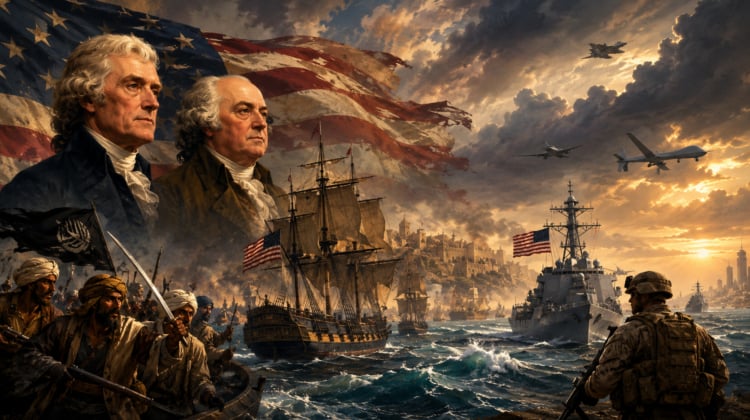
“We ought not to fight them unless we determine to fight them forever.” -John Adams
As America approaches its 250th anniversary, it’s also approaching the 242nd year of its ‘endless war’ with Islam which began when Morocco seized an American ship and then continued into the Barbary Wars and eventually into the modern age of Islamic terrorism.
Then – as now – there was a debate and differing voices over whether we should pay ‘tribute’ to Muslim states or, as Thomas Jefferson insisted, confront them on the battlefield.
“I confess, if our states could be brought to agree, in the measure, I should be very willing to resolve upon eternal war with them,” John Adams warned, invoking the forever war argument. “We ought not to fight them unless we determine to fight them forever. This thought is, I fear, too rugged for our people to bear.”
Jefferson and Adams had both been involved in negotiations with the pirate states and both came away concluding that Islam was the underlying motive for the attacks on Americans.
Jefferson and Adams both heard directly from the Tripoli ambassador that the aggression “was founded on the Laws of their Prophet, that it was written in their Koran, that all nations who should not have acknowledged their authority were sinners, that it was their right and duty to make war upon them wherever they could be found, and to make slaves of all they could take as Prisoners, and that every Musselman who should be slain in battle was sure to go to Paradise.”
“The precept of the Koran is perpetual war against all who deny that Mahomet is the prophet of God. The vanquished may purchase their lives, by the payment of tribute,” Adams wrote in a later essay. “The command to propagate the Moslem creed by the sword is always obligatory, when it can be made effective. The commands of the prophet may be performed alike, by fraud, or by force. The natural hatred of the Mussulmen towards the infidels is in just accordance with the precepts of the Koran.”
Unlike our modern leaders, neither Jefferson nor Adams were fooled regarding the nature of Islam or of Muslim countries, still Adams had signed the Treaty of Peace and Friendship with the pirates in Tripoli which asserted humiliatingly pleaded that “the government of the United States of America is not in any sense founded on the Christian Religion,-as it has in itself no character of enmity against the laws, religion or tranquility of Musselmen.”
The Muslim side however did not even bother recording this plea and went on attacking anyway.
In letters between the two men, rivals, friends and future presidents, Jefferson and Adams debated the question.
“Sacrificing a million annually to save one gift of two hundred pounds. This is not good economy,” Adams argued, but at the same time concluded that, “the policy of Christendom has made cowards of all their sailors before the standard of Mahomet. It be heroical and glorious in us to restore courage to ours. I doubt not. We could accomplish it, if we should set about it in earnest. But the difficulty of bringing our people to agree upon it has ever discouraged me.”
“The question is whether their peace or war will be cheapest? But it is a question which should be addressed to our Honor as well as our Avarice?” Jefferson asked. And went on to answer the question with the first Barbary War, the birth of the Navy and the Marine Corps.
But nearly two and a half centuries later, the central question of whether we should bribe our way out of conflict with Islamic states, (the Iran deal reportedly includes $300 billion for the terror state), or whether we are ‘rugged’ enough to accept that a war with Islam is endless.
America has been in conflict with one or other Islamic forces from the beginning of its existence until today. That is in a certain sense a ‘forever war’, but within three decades of Adams and Jefferson worrying that the problem of Muslim piracy was insurmountable, its power was broken.
In 1832, when Muslims in Indonesia attacked an American ship known as the Friendship, President Andrew Jackson sent a warship that circumnavigated the globe and whose Marines thoroughly defeated Po Mahomet and his men. And a second time again in 1838.
What lessons does that offer for America today and for the nation 250 years from now? --->READ MORE HERE
If you like what you see, please "Like" and/or Follow us on FACEBOOK here, GETTR here, and TWITTER here.



No comments:
Post a Comment