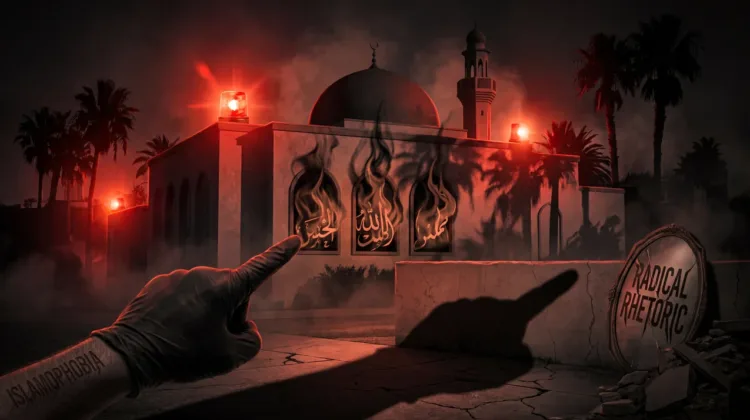
A familiar deceptive script.
When a mosque was attacked, advocacy groups rushed to blame “Islamophobia” in America. The rhetoric in their own backyard went largely unexamined — and much of the media seemed comfortable leaving it there.There is no excuse for murder. No justification for threatening children, and no defense for attacking a mosque. Those things should be stated plainly, and they are.
But they should not serve as a shield against harder questions — including questions about the ideological climate much closer to home.
In the days following the deadly shooting outside the Islamic Center of San Diego, officials of the Hamas-linked Council on American-Islamic Relations (CAIR)and allied activists moved quickly to establish a narrative: this was the product of “Islamophobia,” political rhetoric, and a cultural climate that had normalized hostility toward Muslims.
The narrative settled into place fast.
What did not arrive — not in local coverage, not in national pickup — was any serious examination of the rhetoric circulating within parts of the same activist and religious ecosystem directly connected to the story.
The omission repeated itself across outlet after outlet.
After a while, it stopped looking accidental.
A Verdict Before a Motive
Investigators had not yet established why the shooter acted when CAIR figures began explaining it publicly.
Zahra Billoo, executive director of CAIR’s San Francisco Bay Area chapter, was unequivocal: “There’s a lot of concern that our elected officials have been contributing to what got us here.”
She also noted, pointedly, that many of those now condemning the attack had stayed silent during what she described as Israel’s “genocide” in Gaza — folding a separate political grievance into a moment of grief before the facts of the shooting were even public.
CAIR national deputy director Edward Ahmed Mitchell went further: “Anti-Muslim hate is out of control in this country. This was the predictable result of it.”
CAIR’s Ahmed Rehab urged leaders to stand against “otherizing, dehumanizing hate mongering.”
Across interviews, the implication was basically the same: American political culture helped produce the violence. Elected officials bore responsibility. The climate made violence inevitable.
That may be true. Rhetoric can shape behavior, and the argument that hostile political language creates danger for vulnerable communities is not frivolous. But the people making that argument showed little interest in applying the same standard inward.
The Context No One Mentioned
Imam Mohamed Taha Hassane of the Islamic Center of San Diego is not a peripheral figure in this story. He has publicly championed CAIR’s activism, and appeared alongside CAIR representatives on multiple occasions. He also serves as a religious adviser to the Muslim Students Association at UC San Diego — an organization critics and researchers have long associated with Muslim Brotherhood activism in North America.
After October 7, Hassane delivered remarks that were not, by any reasonable reading, ordinary political commentary:
When people are occupied, then the resistance is justified. Resistance becomes a human right.
We cannot accuse somebody who is fighting for his life to be a terrorist.
This is not ordinary political rhetoric. It treats “resistance” as morally self-justifying, while pushing questions about violence and terrorism into the background.
Whatever one thinks of the underlying politics, that kind of rhetoric is not irrelevant to a discussion about terrorism.
None of it appeared in the coverage.
Viewers were presented with the imam’s community as a target. Never as a place where ideas that can lead to jihad activity were also in circulation.
Questions the Coverage Never Asked
The ideological context extends beyond sermons. Institutions connected to the activist ecosystem surrounding the Islamic Center of San Diego have also faced scrutiny over educational materials — specifically, textbooks that the Islamic Services Foundation, which has been associated with Islamic schools and curricula across the United States, has produced.
Some of the cited passages are notable. One textbook describes non-believers as “the worst of creatures” destined for hellfire. (That’s straight from the Qur’an, 98:6.) Another warns they “may be next.” A third frames Muslim decline as the consequence of abandoning jihad. --->READ MORE HERE



No comments:
Post a Comment