 |
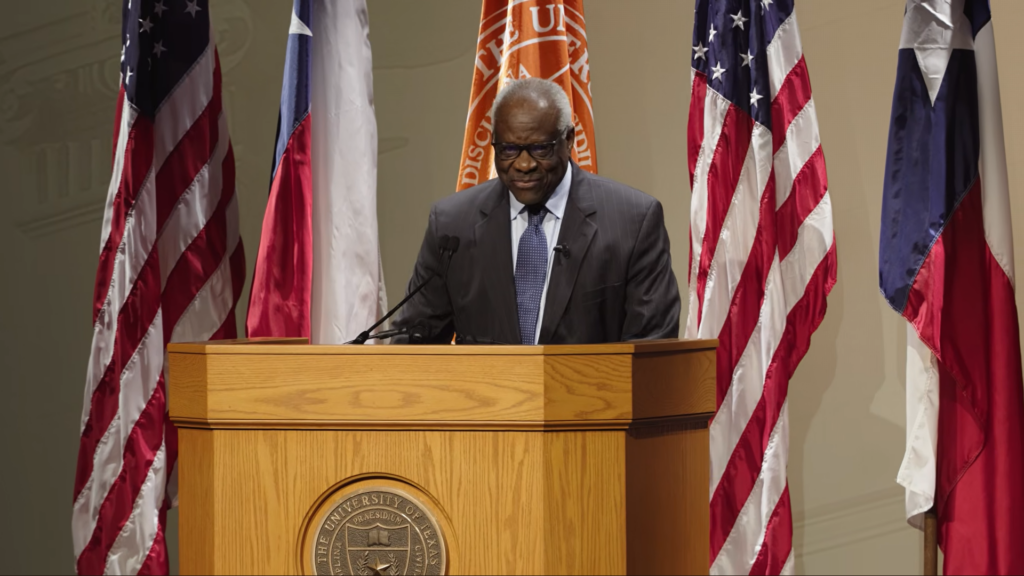
| The University of Texas at Austin/YouTube |
While his intellect and writing have become some of Thomas’ most defining qualities, they are but a few of the many reasons Americans adore him.
Justice Clarence Thomas has continued to leave a lasting legacy on the U.S. Supreme Court and American history writ large. And on Thursday, he did it once more.The 77-year-old Thomas hit a major milestone by becoming the second-longest serving justice in U.S. history. The Georgia native surpassed Justice Stephen J. Field for the record on Thursday, which came several days after overtaking Justice John Paul Stevens as the third-longest serving justice.
Thomas was sworn in on Oct. 23, 1991, and has served in his current position for more than 34 years. He would surpass Justice William O. Douglas as the longest-serving justice should he continue to serve until May 2028.
Thursday’s record marks a significant achievement for Thomas, whose life story is as remarkable as his career on the nation’s highest court.
The Bush 41 appointee was born into poverty in Pin Point, Georgia, at the height of segregation. As a young boy, his mother sent him and his brother to live in Savannah with their grandparents — both of whom would be instrumental in shaping the man America knows today.
While raised in the Catholic Church, Thomas would go on to fall away from his upbringing and Christian beliefs in early adulthood. Left scarred by the assassination of Martin Luther King Jr., he turned to left-wing orthodoxy and became a radical throughout his college years. It was only after returning from an unruly riot at Harvard Square in 1970 did he ask God to “take hate” out of his heart and begin his long “crawl” back to the faith.
In the years that followed, Thomas would work under Republican Jack Danforth during the latter’s time as Missouri attorney general and later as a U.S. senator. The Georgia native was ultimately tapped to serve as the assistant secretary for Civil Rights at the Department of Education, where he briefly worked before being appointed chair of the Equal Employment Opportunity Commission. President George H.W. Bush later appointed Thomas to the D.C. Circuit Court of Appeals, where he served one year before being nominated to SCOTUS in 1991.
Since arriving at the Supreme Court, Thomas has been instrumental in furthering an originalist approach to constitutional interpretation. That is, interpreting the Constitution as it was written at the time of its adoption and declining to “legislate from the bench” as past Supreme Courts have done (see Roe v. Wade).
Thomas’ concurrence in Printz v. United States (1997) in defense of Americans’ Second Amendment freedoms is stark example of how his jurisprudence set the stage for future originalist decisions. The reasoning he put forward in Printz was arguably foundational to the Supreme Court’s recognition of a personal right to “keep and bear arms” in its 2008 D.C. v. Heller decision. The Bush 41 appointee got the chance to further underscore this right several years later in his majority opinion in NYSRPA v. Bruen (2022), in which the court upheld Americans’ right to carry firearms outside the home for purposes of self-defense.
“The constitutional right to bear arms in public for self-defense is not ‘a second-class right, subject to an entirely different body of rules than the other Bill of Rights guarantees,'” Thomas wrote for the court. “We know of no other constitutional right that an individual may exercise only after demonstrating to government officers some special need. That is not how the First Amendment works when it comes to unpopular speech or the free exercise of religion. It is not how the Sixth Amendment works when it comes to a defendant’s right to confront the witnesses against him. And it is not how the Second Amendment works when it comes to public carry for self-defense.”
The justice also authored notable opinions in the Supreme Court’s recent SFFA v. Harvard (2023) decision that affirmative action policies are unconstitutional; the Dobbs v. Jackson Women’s Health Organization (2022) decision overturning Roe; and the U.S. v. Skrmetti (2025) decision upholding laws protecting minors from “trans”-obsessed weirdos. --->READ MORE HERE



No comments:
Post a Comment