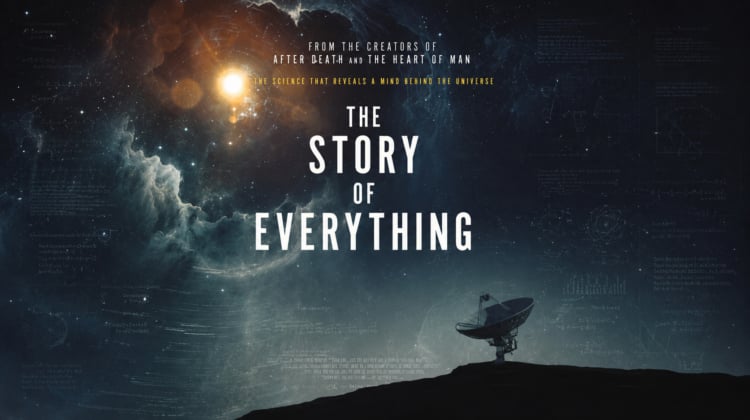
A new documentary argues that science supports the concept of a creator God.
The Story of Everything is a 2026 documentary addressing the question of whether or not science supports the possible existence of a creator God. Before I get too deep in the weeds of this review, let me say, I loved The Story of Everything. The Story of Everything is a polished, professional, engrossing documentary that any thinking person, including high school students, could enjoy. Please go see it in a theater if you can, and if you can’t, grab it up as soon as it appears in other formats. Its run is limited, and in the theater where I saw it, there was only one showing. Otherwise, I would have happily sat through this film three times. I was on the edge of my seat. I want a miniseries continuing the work of the documentary, complete with supplemental materials, including question-and-answer notebooks viewers can fill in to review, test, and reinforce all they’ve learned.The Story of Everything is not just a series of scientific talking heads, utterly fascinating and authoritative though these talking heads might be. It includes animations so unique, so valuable, and so engrossing I cannot wait to purchase the DVD of this film so that I can watch these animations repeatedly. The inner workings of the cell are depicted in minute detail. All lifeforms are made up of cells; those complicated little factories constitute our physical forms. Thanks to these animations, we can see ourselves as never before.
The Story of Everything travels from the microcosm to the macrocosm. The film includes gorgeous footage of life on planet Earth, from tiny hummingbirds to majestic blue whales. The film adjures the viewer to again take up the previously discarded awe of a child, and to be bowled over by the powerful mystery that is life. We are made up of billions of miracles occurring every second. We are part of a larger miracle we can never fully understand but can always be inspired by. This movie gave me chills and it caused me to tear up.
I love engrossing discussions of big ideas, and that’s what you get in The Story of Everything. I love finishing a film determined to do some research on ideas presented therein. Since watching The Story of Everything, I’ve been gorging on science podcasts. I’ve been asking questions I didn’t ask before, questions about why the carbon molecule shook Fred Hoyle’s worldview, and how the Hubble telescope does or does not support the Big Bang.
The Story of Everything is backed by the Discovery Institute. The Discovery Institute was founded in 1991. That fact is perhaps the only fact that everyone can agree on regarding the Discovery Institute. Opponents of the DI accuse it of being a cabal of demented masterminds determined to transform America into the dystopia depicted in A Handmaid’s Tale combined with a dash of Monty Python’s Spanish Inquisition, lead by a crack team of clerical terrorists including Grigori Rasputin and the albino monk assassin from The Da Vinci Code.
For its own part, the Discovery Institute self-identifies, on its webpage, as promoting the idea that science supports the concept of a creator God. They are open about seeing that belief as playing a role in the wider society. People who believe in a creator God, the Institute maintains, are more likely to live their lives in way that promotes personal and societal health and happiness, than those who do not.
Research tends to support the belief that the “actively religious” are healthier, happier, more socially engaged, and more charitable than those who are not; see a 2019 Pew study here and research on charitable giving here. Research also suggests that “religious service attendance” “protects against suicide attempts” (see here); whereas “religiously unaffiliated subjects” tend to show “significantly more lifetime suicide attempts.” Further, “subjects with no religious affiliation perceived fewer reasons for living [and] fewer moral objections to suicide … Religiously unaffiliated subjects had more lifetime impulsivity, aggression, and past substance use disorder” (see here).
The Discovery Institute is committed to societal change. The DI webpage states that the DI “promotes thoughtful analysis and effective action on local, regional, national and international issues” as part of dedication to “the reinvigoration of traditional Western principles and institutions and the worldview from which they issued.” They believe in Proverbs 23:7, “As a man thinks within himself, so he is.” For example, the DI believes that a renewed commitment to the Judeo-Christian tradition might lower the number of teen suicides. See here. The DI also promotes its own approach to the homelessness crisis. The DI approach emphasizes addressing mental illness and substance abuse.
I don’t usually give so many details about the backers of a film before reviewing a film, but I want you to be forewarned. If you do an online search for The Story of Everything, you will encounter posts by capital-A Atheists insisting that the film is cheesy anti-science agitprop. Here’s an example of the headwinds The Story of Everything faces. A few days ago, I was in a chat with friends. I mentioned my review.
“Chad” – not his real name – has a Berkeley physics PhD. Chad is smart, funny, and interesting. He’s also Christophobic. He had never heard of The Story of Everything. Even so, after I mentioned it, Chad immediately began ranting against it, not only without actually seeing it, but without having had any time to learn anything substantial about it. He accused the film of being white supremacist. He’s known me for decades and he knows I’m not white supremacist. There is no white supremacy in the film.
Chad self-identified as a “real scientist,” though his career was in advertising. Chad wrote me off as someone “indoctrinated from early childhood.” (I’ll address, below, Chad’s assertion about my “indoctrination.”) Chad insisted that no “real scientists” appear in the film. I mentioned that the speakers in the film have advanced degrees in their fields, and speak directly about their fields, not about disciplines in which they have not achieved success. Some occupy endowed chairs and have significant scholarly publications. This information did not interrupt Chad’s rant. He said that “smart” people can be very stupid. He went on and on and I just stopped reading his posts raging against a film he hadn’t heard of till I mentioned it to him, a film he had never seen.
Other online Christophobic, capital-A Atheists, like Chad, exhibit cultish behavior. See, for example, this Reddit Atheist discussion thread. Atheists reassure each other that refusing to see the film is an act of righteous civil disobedience. They then mock the film that they haven’t seen. Atheism does have a dogma, and that dogma demands hostility and fear instead of a courageous willingness to hear what others have to say. Atheists insist on straw man fantasies of anyone who doesn’t see the world exactly as they do. One posts, “Here’s why I’m avoiding it—look at the ‘cast,’ not a scientist among them.” This statement is false. Below I’ll mention just a few of the scientists who appear onscreen.
Is The Story of Everything propaganda for a Judeo-Christian worldview? I watched all eight parts of the 2023 Netflix documentary Life on Our Planet at least five times each. I have watched, so far, all four parts of the Netflix 2026 production The Dinosaurs at least three times each. Both of these Netflix miniseries proselytize heavily for a purely Darwinian worldview. They do not allow the viewer even simple curiosity about whether the hand of any God played any role in the origin of life or its flourishing on planet Earth. Netflix instructs viewers in how to interpret the striking visual imagery in the series. The series depicts “evolution” driving “Life’s extraordinary journey to conquer, adapt and survive on Earth.”
Netflix is marketing a counterfactual narrative. “Life” is an abstraction. “Life” is not a character that has a “journey” of “conquering.” Even just in the worldview of Darwinian evolution, there is no teleology. Further, only about 33% of Americans accept the concept of Darwinian evolution strictly through natural processes. Most believe in some form of evolution, but many believe that the process involved divine guidance (see here).
Netflix doesn’t produce only nature documentaries. It is committed to DEI in casting; see its hit series Bridgerton. Black, Asian, and Muslim (but, significantly, not Jewish) characters are depicted as nobility in an alternate-universe-version of Regency England. Netflix, if anything, has a higher social engineering profile than the Discovery Institute. Netflix donates large sums to the Democratic Party, it lobbies the government, it has deals with the Obamas, and its board includes Obama administration officials.
Of course I noticed Netflix’s heavy propagandistic hand inside the silken glove of magnificent depictions of volcanos, T-rexes, and mastodons. I sensed Netflix’s unspoken disrespect for the majority of Americans who feel wonder and curiosity about creation, and Netflix’s alliance with the minority of Americans who luxuriate in a sense of superior certainty and see only affirmation of their own Atheism when confronted by the mysteries of life on Esarth. I can benefit from the information Netflix presents and the series’ virtuosic visual recreations of extinct creatures while not swallowing Netflix’s rigid Atheism. If only folks like Chad were similarly self-confident, open-minded, non-dogmatic, and curious enough to buy a ticket to The Story of Everything.
There’s a clip of Carl Sagan in The Story of Everything. Sagan, ever so smug, declares,
“Here we are like mites on a plum and the plum is this little planet and it goes around an insignificant local star, the sun. And that star is on the obscure outskirts of an ordinary galaxy, the Milky Way, which contains 400 billion other stars. And this galaxy is just one of something like 100 billion other galaxies that make up the universe … the idea that we are central, that we are the reason there is a universe is pathetic. We have to simply come to grips with the real universe that we really live in and if some of our myth and some of our religion is inconsistent with it, it’s time to change the myth and the religion.”
Richard Dawkins says, “The universe that we observe has precisely the properties we should expect if there is, at bottom, no design, no purpose, no evil, no good, nothing but pitiless indifference.” Dawkins also says that “Faith is one of the world’s great evils, comparable to the smallpox virus but harder to eradicate.” Dawkins says that there is no evil, and then insists that faith is evil. Sagan insists that people of faith are “pathetic,” and then insists that his own faith triumph.
In these quotes we see that famous Atheist and agnostic scientists are not, contrary to their own press, all about scientifically proven truth, and they are as dogmatic as the aforementioned fictional albino assassin monk. One might ask, which worldview, the one of the Discovery Institute or the one promoted by Sagan, Dawkins, and Netflix, is more conducive to human individual and societal flourishing?
Ironically, prominent Atheist and agnostic scientists have, for some audiences, failed in their attempts to impose their orthodoxy. We now see the phenomenon of, as one book title puts it, Coming to Faith Through Dawkins: 12 Essays on the Pathway from New Atheism to Christianity. One new Christian and former New Atheist, Ayaan Hirsi Ali, denounced atheism as a an “unendurable” “self-destructive” “nihilistic vacuum” that inevitably creates a life without meaning, purpose, or solace. --->READ MORE HERE



No comments:
Post a Comment