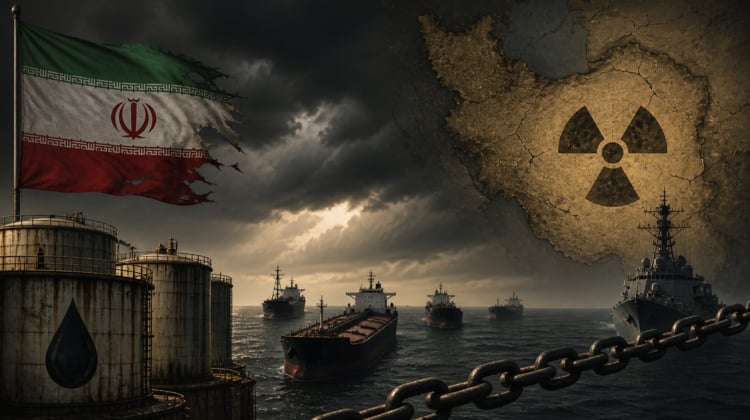
The squeeze is on.
The blockade of Iranian ports has led to a 90% drop in Iranian oil exports. Estimates are that the blockade is costing Iran $400 million a day in lost oil revenue. And Iran is no longer able to receive shipments of food and medicines from its traditional suppliers abroad, who are now blocked from using Iranian ports. How long can the Islamic Republic survive under such conditions?
Oil constitutes some 85 percent of Iran’s exports. And now, because of the blockade, none of that oil can now be shipped abroad. Iranians are now living meagerly on whatever reserves they may have saved from former years, a sum which is asymptotically approaching zero. And that American blockade that shows no signs of ending — certainly not until the Iranian leaders agree to hand over to a third party the 144 lbs. of uranium enriched to a level of 60% that Tehran possesses. Oil continues to be produced, and is now filling all the “parked tankers” floating just offshore in the Gulf and all the storage tanks on Kharg Island. But both are now filled close to capacity, with no end to the flow of oil from the wells in sight.
The blockade of Iran’s ports has put the Islamic Republic in the worst condition it has ever been. It can’t export the oil, which is now filling up both tanker ships and storage facilities on line, and they will be totally filled by mid-May. What then? Assuming the American blockade of Iranian ports remains in force, there will be no place to put the oil, and the government will have to halt its production. But that will have serious consequences for oil production in the future. When oil is no longer being pumped, it affects the quality of the oil in the wells.
Shutting off working wells can damage them in several ways. When oil cools, it can deposit paraffin wax and sediment which can clog the rock that holds the oil. Also, when extraction stops, the natural water table below the oil zone can rise, flooding the reservoir and permanently trapping the oil. Halting production can also cause pressure imbalances and corrosion. The costs of restarting production after all this can be prohibitive.
What can Iran do? In about a month, it will have run out of storage space for its oil. It is damned if it produces oil with no place to store it, and damned if it turns off the wells, and permanently damages them. There is no good answer. Iran has until mid-May to arrive at a deal on Trump’s terms, so that the blockade is called off and Iranian oil can again be shipped at rock-bottom prices to those hard-bargainers, the Chinese. --->READ MORE HERE
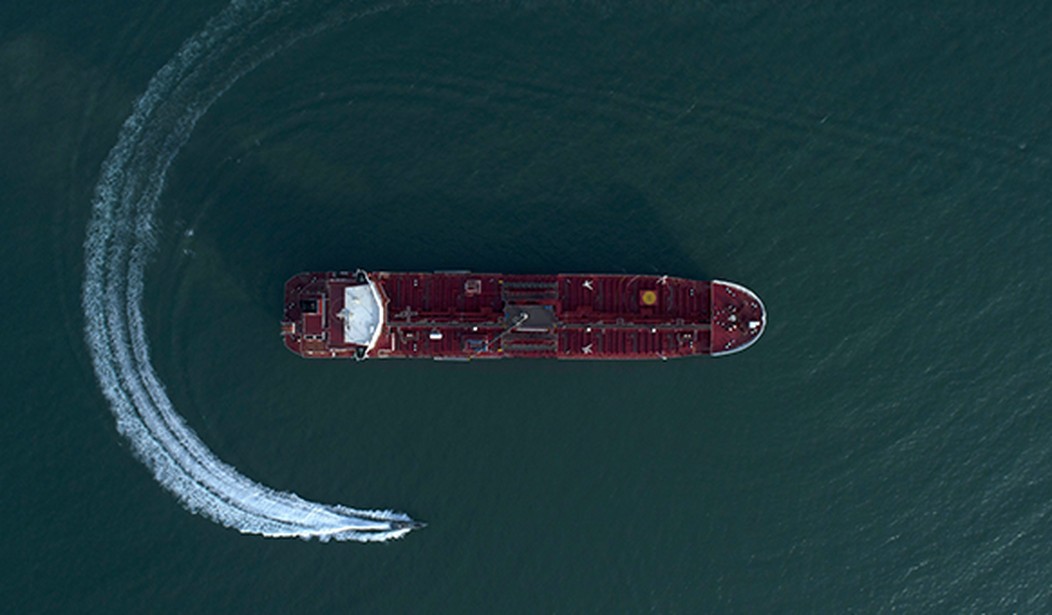
The United States’ blockade of the Strait of Hormuz is reportedly costing Iran $400 million per day, nearly $13 billion a month, as President Trump moves to strip the regime of its last remaining source of leverage in the conflict.
🚨 HOLY SMOKES. It's just been confirmed that President Trump is costing Iran $400 MILLION every single DAY — $13B PER MONTH — while the Strait of Hormuz is blockaded
— Eric Daugherty (@EricLDaugh) April 14, 2026
Checkmate.
"The Iranian oil blockade is probably the knockout punch...their economy is experiencing a… pic.twitter.com/G3TVKZZy5j
"The Iranian oil blockade is probably the knockout punch," Fox News' Will Cain said. "The Iranians are trying to outlast us. The longer the war goes on, the longer their regime can hold off a revolution. But their economy is experiencing a crippling depression. This blockade is costing the regime almost 400 million dollars a day. That's 13 billion dollars a month. Plus the Iranians can only store oil for about two weeks before they have to start shutting off wells. The Iranians can't outlast us."The blockade began on Monday as President Trump revealed that it would only affect Iranian vessels.--->READ MORE HERE



No comments:
Post a Comment