 |
| Joe Ravi/Wikimedia Commons/CC BY-SA 3.0 |
‘Section 2 of the Voting Rights Act of 1965 … was designed to enforce the Constitution — not collide with it,’ wrote Justice Alito.
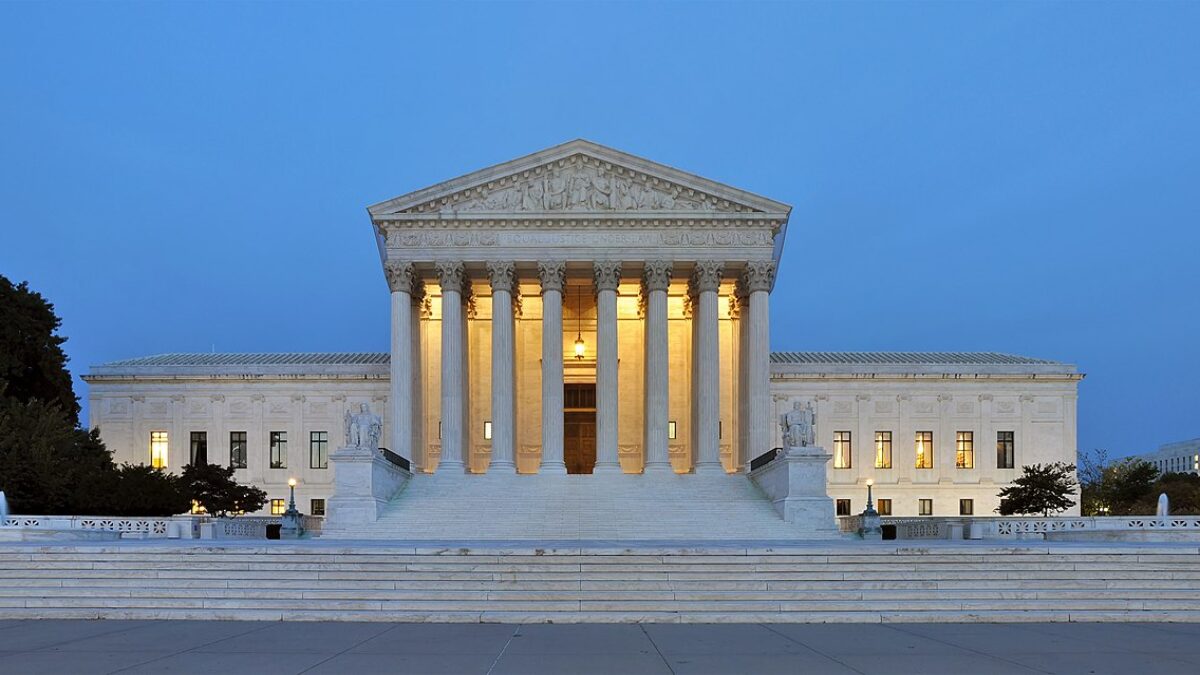
The U.S. Supreme Court released a bombshell ruling on Wednesday significantly curtailing states’ use of race in the redistricting process.
“Section 2 of the Voting Rights Act of 1965 … was designed to enforce the Constitution — not collide with it. Unfortunately, lower courts have sometimes applied this Court’s §2 precedents in a way that forces States to engage in the very race-based discrimination that the Constitution forbids,” Associate Justice Samuel Alito wrote for the majority (6-3).
Known as Louisiana v. Callais, the case centers around Louisiana’s creation of a second majority-black district in its most recent congressional map. The Pelican State added the second majority-minority district following a lower court order that said its original map — which only included one majority-black district — likely violated Section 2 of the Voting Rights Act (VRA).
The new map prompted a new lawsuit from a different set of plaintiffs, who alleged the creation of a second majority-minority district constituted an unconstitutional racial gerrymander. A different lower court agreed with these plaintiffs.
Writing for the majority, Alito said that the debacle presents a good vehicle for the justices to tackle “the long-unresolved question [of] whether compliance with the Voting Rights Act provides a compelling reason that may justify the intentional use of race in drawing legislative districts.” After examining the facts of the case and what the Constitution requires, he noted that the majority determined that, “Correctly understood, §2 does not impose liability at odds with the Constitution, and it should not have imposed liability on Louisiana for its 2022 map.”
“Compliance with §2 thus could not justify the State’s use of race-based redistricting here. The State’s attempt to satisfy the Middle District’s ruling, although understandable, was an unconstitutional racial gerrymander, and we therefore affirm the decision below,” Alito wrote.
Associate Justice Clarence Thomas authored a separate concurring opinion, which Associate Justice Neil Gorsuch joined. In noting his full agreement with the majority opinion, the Bush 41 appointee wrote that he “would go further and hold that §2 of the Voting Rights Act does not regulate districting at all.” --->READ MORE HERE

The Supreme Court struck down Louisiana’s congressional map Wednesday, finding the Pelican State unconstitutionally added a second majority-black House district in a major decision that is likely to pave the way for Republicans to make major redistricting gains across southern states.
Louisiana had been forced by a federal judge to create a second majority-black district in 2024 to comply with Section 2 of the 1965 Voting Rights Act (VRA), which restricts states from diluting minority votes.
The Trump administration and state officials challenged the new map, arguing it was a racial gerrymander in violation of the 14th Amendment, which guarantees all citizens equal protection under the law.
The high court agreed, with all six conservative justices voting to get rid of the 2024 boundaries.
However, the majority opinion by Justice Samuel Alito stopped short of finding Section 2 of the VRA unconstitutional, as many activists had feared.
Instead, the Supreme Court for the first time explicitly held that compliance with Section 2 can “provide a compelling reason for race-based districting” — but Louisiana’s situation did not meet that bar.
“In short, [Section 2] imposes liability only when the evidence supports a strong inference that the State intentionally drew its districts to afford minority voters less opportunity because of their race,” Alito wrote. “Not only does this interpretation follow from the plain text of [Section 2], but it is consistent with the limited authority that the Fifteenth Amendment confers.”
“Section 2 does not provide a compelling interest [in Louisiana] because the State did not need to create a new majority-minority district to comply with the Act,” he later added.
Alito’s ruling relied heavily on 1986’s Thornburg v. Gingles, which laid out four criteria for courts to determine whether a state needs to redraw its districts due to a Section 2 violation: Geographic distribution of minority voters, whether a district is “reasonably configured,” whether the minority group votes as a bloc, and the “totality of the circumstances.”
Wednesday’s opinion updated each of the four Gingles criteria to make it clear that plaintiffs have to account for partisan interests when alleging that a congressional map was an illegal racial gerrymander. --->READ MORE HERE
If you like what you see, please "Like" and/or Follow us on FACEBOOK here, GETTR here, and TWITTER here.



No comments:
Post a Comment