 |
| WPLG LOCAL 10/YOUTUBE |
SG Sauer argued that the law governing TPS bars courts from reviewing a president’s decision to designate or terminate TPS status for groups of foreign nationals.
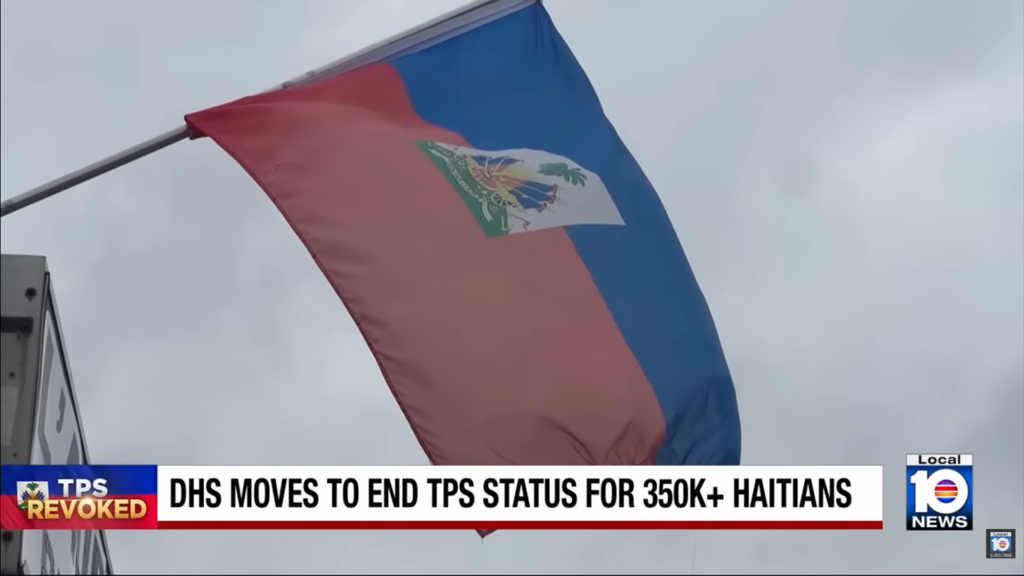
The U.S. Supreme Court is gearing up to effectively decide whether temporary status for hundreds of thousands of foreign nationals residing in the United States is actually temporary.The high court held oral arguments on Wednesday in a pair of consolidated cases known as Mullin v. Doe and Trump v. Miot, which center around Trump’s revocation of Temporary Protected Status (TPS) for approximately 6,000 Syrian and 350,000 Haitian nationals, respectively. Both groups of migrants are currently living in America under the TPS program, which may be used by the executive branch to offer temporary residency to foreign nationals from countries experiencing natural disasters, violent conflicts, and other “extraordinary and temporary conditions.”
The Trump administration’s efforts to end TPS for the aforementioned groups were halted by lower courts. This was done despite SCOTUS previously pausing similar injunctions in a separate TPS case involving Venezuelan nationals.
Arguing on behalf of the Trump administration, U.S. Solicitor General John Sauer contended that a provision within the Immigration and Nationality Act that governs TPS prohibits any form of judicial review “of any determination by the [DHS] secretary with respect to the designation or termination or extension of a designation of a foreign state for Temporary Protected Status.”
“That provision means what it says … [and] bars judicial review of both the secretary’s ultimate decision whether to designate, extend, or terminate, and of each antecedent step along the way to that determination,” said Sauer, who added that “even if [challengers’] claims are not barred [by judicial review], they are meritless.”
The solicitor general’s biggest pushback came from the court’s more outspoken Democrat appointees.
Associate Justice Ketanji Brown Jackson kicked off the inquisition by pressing Sauer on what, if any, executive actions regarding TPS are reviewable by federal courts. The Biden appointee’s back-and-forth with the solicitor general ultimately prompted Associate Justice Sonia Sotomayor to join the fray and pile on with questions about the scope of judicial review as it relates to the TPS program.
Sotomayor’s refusal to allow Sauer to respond one of her queries on the issue prompted Chief Justice John Roberts to interject and permit Sauer to answer. It was sometime after this exchange in which Sotomayor and Jackson referenced President Trump’s past “sh-thole countries” remarks to push the narrative that, as the former put it, “a discriminatory purpose may have played a part” in the administration’s decision to end TPS for the various groups in question.
Associate Justice Elena Kagan took a more sober-minded approach, pressing Sauer about his argument that “all the things that the statute says that the secretary is supposed to do in order to determine country conditions are unreviewable.” She also probed him about whether, under his view, the secretary is required to consult with relevant administration officials about a country’s conditions before taking specific actions on TPS, as well as the substance of that consultation.
Justices Sonia Sotomayor and Ketanji Brown Jackson invoke Trump's comments on "sh*thole countries" and "they're eating the dogs" as having some bearing on whether he can end temporary amnesty for Haitians.
— Breitbart News (@BreitbartNews) April 29, 2026
An increasingly exasperated Solicitor General John Sauer explains to them… pic.twitter.com/CQNwA2YzJTSauer also fielded questions from several of the court’s Republican appointees.
While Associate Justice Clarence Thomas asked if Congress possesses the power to limit TPS regulations if the executive “has constitutional authority to do this in a discretionary way,” Roberts questioned whether Sauer’s argument amounts to a “significant expansion” of the court’s holding in Trump v. Hawaii (2018). That was the case in which a majority effectively upheld Trump’s travel restrictions on several countries.
Meanwhile, Associate Justice Amy Coney Barrett pressed the solicitor general on respondents’ “procedural objection” argument and what “standards a court would apply when reviewing the sufficiency of the consultation” issue if the court were to rule against the government’s argument that the matter is not subject to judicial review. Associate Justice Brett Kavanaugh, on the other hand, asked Sauer to “explain the reasons why Congress would have barred judicial review as broadly” as he claimed. --->READ MORE HERE



No comments:
Post a Comment