 |
| Bohemian Baltimore/Wikimedia Commons/CC by-SA 4.0 |
The Trump admin seems to grasp a truth that its predecessors too often ignored: America is neither an abstraction nor a mere economic zone.
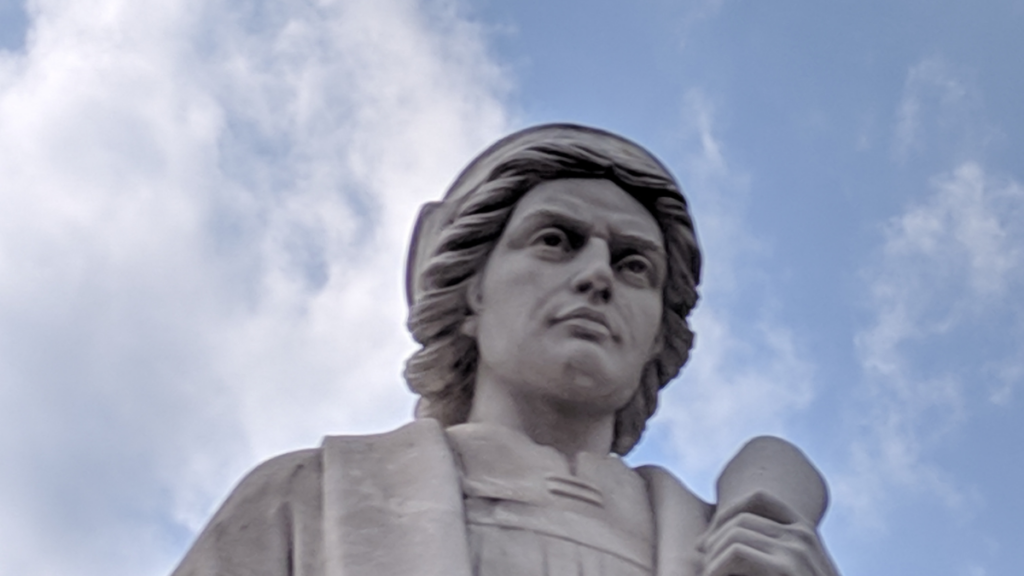
Then protesters dragged the statue of Christopher Columbus from its pedestal and cast it into Baltimore’s Inner Harbor during the sticky, iconoclastic summer of 2020, it was not merely an act of vandalism. It was an act of defiance, a performative anti-ritual that suggested a symbolic repudiation of civilizational inheritance.Further, it was a public declaration promulgated by a utopian left: The past itself was intolerable because it failed to meet the ever-changing moral standards of our relativistic contemporary cultural milieu. The Trump administration recently countered this public declaration by erecting a replica of the fallen Columbus statue in Washington, D.C. The move is not merely defiant; it signals America’s newfound will to revive its historical and cultural symbols.
This revival is much needed. After all, Baltimore’s Columbus wasn’t the only statue to fall in 2020, as similar scenes played out across the country during the so-called “Summer of Love.” But Columbus served as a prime target, given his supposed role in ushering in the cruelties of Spanish colonization.
In Philadelphia’s Marconi Plaza, left-wing activists (many apparently not from the neighborhood) marched in demanding the removal of a marble Columbus statue erected by many locals’ Italian immigrant ancestors in the 19th century as a symbol of their newfound place in American life. (Disclaimer: This author has relatives who live in the neighborhood.) Many of these activists, eager to evangelize in the name of that joyless pseudo-Puritanism we call “progressive ideology,” did so under the banner of “decolonization.” Now, who said irony was dead?
Further up in the Acela Corridor, a radical art collective with the backing of the Museum of Modern Art (MoMa) envisioned “re-imagining” the “Eurocentric version of history” that permeates New York City’s public domain. That “re-imagining” notably included replacing the eponymous statue in Columbus Circle with one of the Haitian revolutionary Toussaint Louverture. If one ever needs such a glaring example of the left’s divisive, zero-sum mindset, then look no further than radical activists masquerading as “artists” who sought to instrumentalize, if not outright weaponize, public sculpture as a means of demonizing and demoralizing European Americans.
Fortunately, the tide has begun to turn against the destructive left’s onslaught of aesthetic terrorism, for, after all, people do not forget. Certainly, the citizens of Marconi Plaza have not, having delivered President Trump one of his strongest vote shares within the city of Philadelphia. In its place rises a constructive right that seeks not only to preserve, but to build upon the accomplishments of prior, frankly more noble, generations. The Trump administration’s aforementioned decision to install a replica of the Baltimore Christopher Columbus just outside the Eisenhower Executive Office Building, steps from the White House, is perhaps the most succinct example of this phenomenon.
Such efforts reflect something far more significant than mere political posturing. They echo the observations of figures such as First Things editor R.R. Reno, who has argued that President Trump has helped usher in the opening salvos of a broader civilizational struggle. What we are witnessing is not simply a contest over policy, but a constructive reaction against decades of tepid proceduralism and sterile multiculturalism, a regime in which we are told to hold hands and sing “kumbaya” while the deeper bonds of culture, history, and shared meaning quietly erode.
The administration, for all its imperfections, seems to grasp a truth that its predecessors too often ignored: that America is neither an abstraction nor merely an economic zone, but, in the words of Vice President J.D. Vance, a nation defined by “a particular place, with a particular people.” Such a conception does not demand uniformity of opinion, nor does it deny the complexity of our past. Columbus, after all, will inevitably invite different reactions from different communities: An American Indian may view him quite differently than an Italian American would. Yet this tension is not a weakness, but a strength, for it invites not erasure, but reconciliation. --->READ MORE HERE



No comments:
Post a Comment