 |
| Donna Burton/CBP Photography/Wikimedia Commons |
Justice Alito posed a hypothetical scenario in which an lawful permanent resident leaves America for France, ‘shot somebody’ while in France, and then returned to the U.S., questioning whether he must be readmitted.
he U.S. Supreme Court held oral arguments on Wednesday in a high-profile case involving the removal of green card holders who commit crimes specified in U.S. immigration law.
In Blanche v. Lau, the justices considered the case of Muk Choi Lau, a Chinese national who was a lawful permanent resident (LPR) in the United States. Lau was charged with trademark counterfeiting in 2012 and left America while awaiting trial. Upon his return to the United States, immigration officials “declined to admit him outright and instead paroled him into the country pursuant” to a provision of the Immigration and Nationality Act, according to Oyez.
Lau ultimately pled guilty to the counterfeiting charge in 2013 and went on to challenge the U.S. government’s decision to parole him. The justices will decide the question of whether the government “must prove that it possessed clear and convincing evidence of the offense at the time of the LPR’s last reentry into the United States” to “remove an LPR who committed an offense listed in Section 1182(a)(2) [of the INA] and was subsequently paroled into the United States.”
Arguing on behalf of the Trump administration, Assistant to the Solicitor General Sopan Joshi contended that Lau had already committed a crime “involving moral turpitude” and was thus “eligible for parole and correctly charged with inadmissibility” upon his reentry into the country. He further argued that the government “proved [all of this] by clear and convincing evidence in [Lau’s] removal proceedings,” and that the “failure” by the Chinese national’s legal team “to establish his at-the-border clear-and-convincing evidentiary requirement dooms his case.”
Several of the high court’s Democrat appointees did not hide their apparent skepticism of the administration’s position.
Associate Justice Sonia Sotomayor repeatedly interrogated Joshi over his arguments surrounding removal proceedings for LPRs like Lau. At one point, her refusal to permit Joshi to answer her questions prompted Chief Justice John Roberts to interject and allow him to respond.
Associate Justice Ketanji Brown Jackson espoused fears of “a world in which a government that really is not interested in immigration and having immigrants here, living and working, could use this kind of thing to inappropriately parole people rather than admit them so that it depresses immigration.” Associate Justice Elena Kagan, on the other hand, pressed Joshi on possible effects his “clear-and-convincing evidence” argument would have on related removal proceedings. --->READ MORE HERE
 |
| Chip Somodevilla/Getty Images |
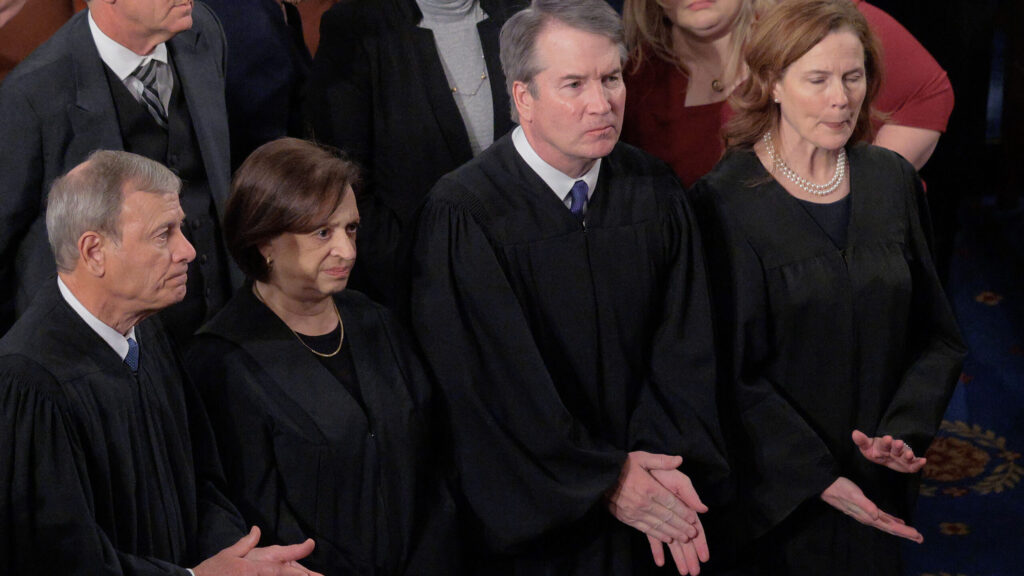
The Supreme Court will hear arguments on Wednesday regarding removal proceedings against an immigrant legally in the United States, charged with counterfeiting.
The case has the potential to affect the operations of Customs and Border Protection, Immigration and Customs Enforcement, and immigration courts, said Art Arthur, resident fellow in law and policy at the Center for Immigration Studies.
“If the Supreme Court affirms the 2nd Circuit, it will make it much more difficult for ICE and border agents to determine that a green card holder with a criminal offense coming back into the United States is inadmissible,” Arthur, a former immigration judge, told The Daily Signal. “This could potentially impact the capacity to keep terrorists out of the U.S.”
The case itself has an interesting backstory, as the plaintiff, Muk Choi Lau, a Chinese national, was charged with counterfeiting before leaving the country but was convicted after returning and being placed on parole.
The case is Blanche v. Lau, renamed for Acting Attorney General Todd Blanche after initially being Bondi v. Lau for former Attorney General Pam Bondi.
There are two key questions in the case, Arthur said.
“First, will immigration officers or immigration judges make a determination if a person is inadmissible?” Arthur said. “Second, the court will decide whether a parole decision is reviewable by the courts.”
Lau, a lawful permanent resident in the United States, was charged in May 2012 on New Jersey state charges for selling almost $300,000 worth of knockoff Coogi shorts, according to SCOTUSblog. --->READ MORE HEREFollow link below to a relevant story:
+++++ Supreme Court weighs green card deportation case — and a win for immigrants could make things worse+++++
If you like what you see, please "Like" and/or Follow us on FACEBOOK here, GETTR here, and TWITTER here.



No comments:
Post a Comment