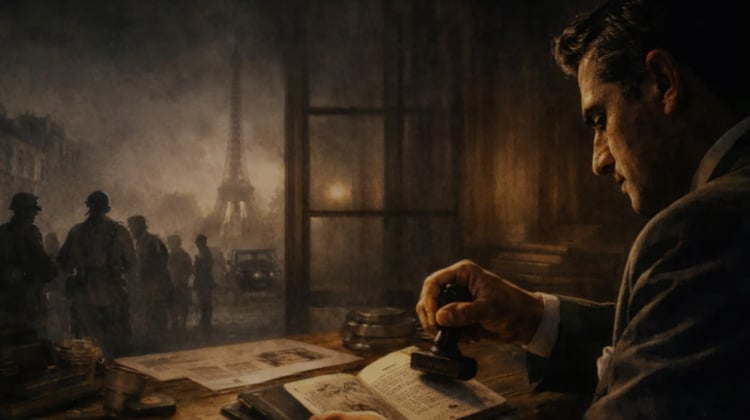
How an Iranian diplomat turned Nazi paperwork into a weapon and saved thousands during the Holocaust.
Tehran, 1914.
A child is born into a respected Iranian family, in a country that still carries the weight of empire in its bones and the memory of civilizations older than most nations on earth. His name is Abdol Hossein Sardari.
There is nothing in that moment that signals what his life will become, nothing that would lead anyone to believe that this boy, raised far from Europe, would one day stand in the middle of one of the darkest chapters in human history and quietly alter its outcome. He grows up educated, trained in law, disciplined in thought, and shaped by a world where systems, structure, and authority define how power moves.
By the time he entered diplomatic service, he was not a man of noise or attention, but one who understood how rules were written, how they were enforced, and more importantly, how they could be interpreted.
That understanding would become everything when history placed him in Paris in 1940, just as the city fell under Nazi control.
The transition was not loud at first. The streets still functioned, daily life appeared intact, but beneath the surface, a system began to take hold, one built not just on force but on classification. Registries were created, identities were examined, and paperwork became the foundation of survival.
For Jews, the process began with forms and declarations, but it quickly turned into something far more dangerous. Once marked, a person was no longer seen as an individual but as part of a category that the regime had already decided must be removed. Deportations followed, and from there, disappearance became routine.
Sardari remained in Paris even as the situation deteriorated, despite Iran itself having been destabilized and his diplomatic protection no longer being certain. Many in his position would have left, choosing safety over uncertainty, but he stayed and began to study the system unfolding around him.
What he recognized was something most people either did not see or did not dare to act on. The Nazi machine depended heavily on rigid definitions of race and identity, and those definitions, while enforced with brutality, were not as airtight as they appeared. They relied on interpretation, on documentation, and on the assumption that no one would challenge them from within.
Sardari decided to challenge them.
He approached the authorities with an argument that Iranian Jews should not be classified as Jews under Nazi racial law. He presented them instead as members of an ancient Persian group, distinct in origin and identity, a category that the regime had not clearly defined.
The claim was not historically accurate, but accuracy was not the point. The system he was dealing with was ideological, and ideology, when confronted in the right way, could hesitate. Nazi officials, deeply invested in their own theories of race, were forced to review, to question, and to delay making a definitive ruling. --->READ MORE HERE
 |
| photo credit: Wikimedia Commons |
Abdol Hossein Sardari and Hajji Yaakov Hay remind us of the immense power of the individual in the face of darkness.
On Holocaust Remembrance Day 2026, under the quiet skies of a ceasefire and while the State of Israel and Iran remain signatories to a historic agreement, the Israeli heart seeks anchors of humanity within the most harrowing pages of history.
Precisely at this moment, as the tense silence replaces the flames, we are called to look toward figures who transcended the boundaries of nation, religion, and enmity to save humanity itself. This day is dedicated to the memory of those who created light within the darkness, proving that even in the bleakest of times, the human spirit is capable of rising above hatred and fear.
We focus on two extraordinary heroes: the diplomat Abdol Hossein Sardari, rightly known as the “Iranian Schindler,” and, alongside him, in the heart of Tehran, the righteous man of hessed (loving kindness), Hajji Yaakov Hay, who built an anchor of life and rescue. Their stories, interwoven with one another, prove that even when all around is dark, there are individuals who refuse to surrender to despair and pour hope into many hearts.
Diplomatic ingenuity in occupied Paris: Courage against the machinery of destruction
Dr. Abdol Hossein Sardari was born in Tehran in 1895 to a distinguished Iranian aristocratic family; his mother was the niece of the shah. He grew up in the worlds of politics, culture, and diplomacy, possessing extraordinary talents: he was fluent in numerous languages, including French, English, and German, and was endowed with personal charm, wit, and a sense of humor that made him a central figure in the social life of Paris in the late 1930s.
He served there as a consul – a man of the world with extensive connections in government and diplomatic circles, but also a man of deep moral conscience.
With the Nazi invasion of France and the occupation of Paris in June 1940, most diplomats fled, leaving the city without clear instructions. Sardari, who remained as the sole senior representative, found himself facing a darkening and rapidly changing reality.
Thousands of Iranian Jews living in Paris began to face decrees, racial laws, and cruel persecutions. In contrast to many others who remained silent or collaborated, Sardari understood the true intentions of the Germans: total extermination. He did not stand idly by. He utilized his connections, his diplomatic status, and his brilliant legal mind to weave a web of trust and influence.
He conceived the “Jugutis” strategy – a complex racial-legal theory designed to undermine the fundamental premises of Nazi racial doctrine from within. He argued before the Nazi bureaucracy that Iranian Jews were not of the Semitic race, but rather “Iranians of the Aryan race” who had merely adopted the religion of Moses.
This brilliant argument, based on a distorted interpretation of the Nuremberg Laws, confused the machinery of destruction for many critical months. It allowed him to issue hundreds of forged Iranian passports to Jews and even extend protection to Jews who were not Iranian, acting in secret at immense personal risk. He succeeded in saving thousands of Jews from certain death. --->READ MORE HEREFollow link to a related story:
+++++The 'Iranian Schindler' who saved Jews from the Nazis+++++
If you like what you see, please "Like" and/or Follow us on FACEBOOK here, GETTR here, and TWITTER here.



No comments:
Post a Comment