 |
| St. Patrick's Cathedral NYC/YouTube |
Record numbers of Americans are converting to Catholicism this Easter. Why?
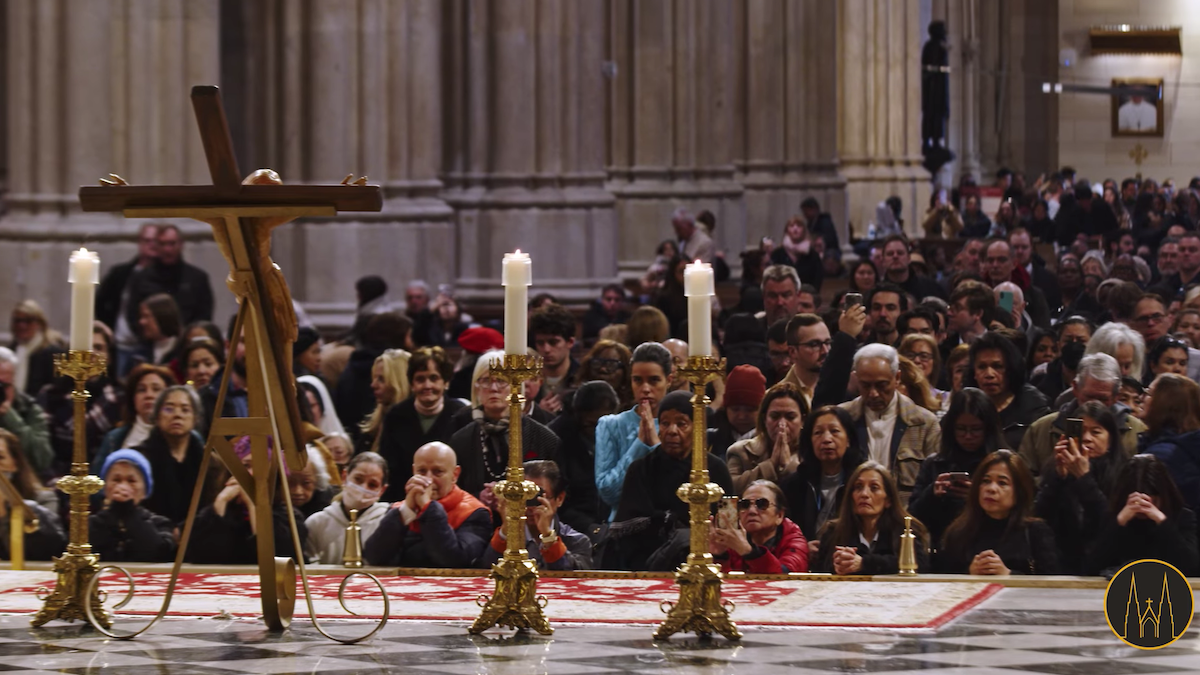
The flood of recent news reports, commentaries, and social media posts about the record-breaking numbers of Catholic converts this Easter has left little doubt that something is stirring in the soul of America. From Los Angeles to New York City, Catholic dioceses large and small will welcome more new members at Easter than they have in years, in some cases decades — in some cases ever.Most of the news coverage of this has focused on large, urban parishes in New York, Los Angeles, and Washington, D.C., and specifically on churches attracting disproportionate numbers of young people, especially young men. A recent piece in The Washington Post, purporting to explain “Why Catholicism is drawing in Gen Z men,” profiled St. Joseph’s Church in Greenwich Village, describing it as a place where 20- and 30-something men are looking for “truth, beauty, and, yes, girlfriends.” The Dominican-run St. Joseph’s also loomed large in an essay this week in The Atlantic about the religious renewal happening in Gen Z.
It’s understandable that corporate media outlets would zero in on this framing, in part because it offers a relatively straightforward narrative: young men, discouraged by a stagnant economy, isolated by technology, and frustrated with “wokeness” and a feminized mainstream society, are turning to the Catholic faith in what amounts to an act of cultural rebellion.
That is true as far as it goes, but it does not go far enough — and it misses much. For one thing, the Catholic renewal now underway is actually more pronounced in Catholic communities spread across America’s rural and suburban heartland than in its large coastal cities. And what’s driving this renewal isn’t primarily a spirit of rebellion among the youth, but a yearning among a broad swath of American society for truth, goodness, and beauty amid the ruin of modern life. It is above all a rejection of liberal modernity and all its broken promises, and the discovery of something real — the realest possible thing — in the Catholic Mass.
Because the Catholic Church is a single hierarchical body, it is actually possible to measure this to some extent. This week Hallow, the popular prayer app, released data showing a marked increase in the number of catechumens (unbaptized people preparing for full initiation into the Catholic Church) and candidates (baptized people who are entering into full communion through confirmation) broken down geographically, by diocese. The data, compiled from more than 140 of the 175 U.S. dioceses, confirm the news media headlines: the Catholic Church in America is indeed growing, its dioceses seeing on average a 38 percent increase in adult converts over the last year.
But the Hallow numbers also show something else. Dioceses experiencing the most dramatic increases (many of them well over 70 percent, a handful well over 100) are concentrated not on the coasts but in the American heartland — and a disproportionate number of them are smaller or somewhat rural dioceses. The Diocese of Duluth, Minnesota, is seeing an increase of 145 percent. The Diocese of Pueblo, Colorado, is up 105 percent. In Tulsa, 115 percent. In Omaha, 100 percent. In Pensacola-Tallahassee, 144 percent. And these are increases over 2025, which was itself a record year in many of these places.
Why is this happening? The bishops do not know. A recent story in The New York Times about this wave of new converts described American bishops as “confounded by what is behind it.” The piece quotes Cardinal Robert McElroy of Washington, D.C., acknowledging (rightly) that it is the work of the Holy Spirit. But beyond that, he says, “we are kind of stymied.”
An extensive report by The National Catholic Register, which conducted its own survey of new converts nationwide, quoted Father Armand Mantia, director of the Archdiocese of Newark’s OCIA (Order of Christian Initiation of Adults), the program that prepares converts to become Catholics.
“Last year, we had no idea where all the people came from then; 2025 eclipsed every year we had had up to then. We thought it might be an anomaly,” he said. “And then, all of a sudden, we had our rituals for 2026, and 2026 blew away 2025, which we didn’t think was possible.”
But it is no surprise that the bishops and prelates are confounded. Generally speaking, they tend to be out of touch and far more liberal, both theologically and politically, than the increasingly conservative American laity.
It is not just because they are older, most in their 60s and 70s, and committed to a vision of Catholicism shaped by the changes of Vatican II and the liberalization of Catholic life that came out of it. It is also because they were formed as priests in a post-Vatican II environment that embraced liberalism and modernity while eschewing tradition and older expressions of the faith. At the risk of oversimplifying, theirs is the Catholicism of Pope Francis, marked by a disdain for the Latin Mass, an embarrassment at ritual and hierarchy, a marked ambiguity on moral questions, and a willingness to compromise with liberalism and thereby change the Catholic Church. --->READ MORE HERE



No comments:
Post a Comment