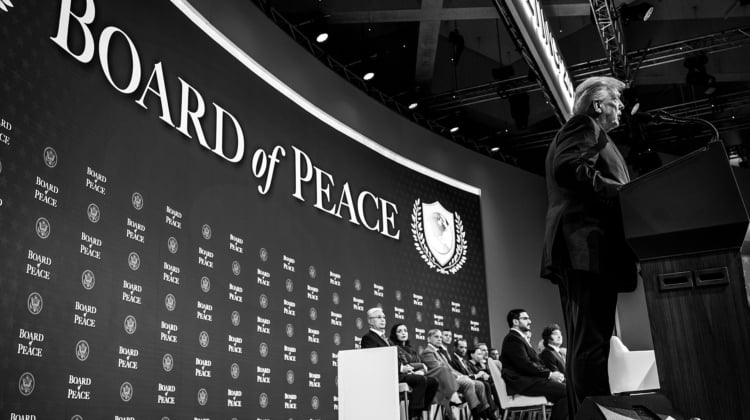
16 Muslim countries, 10 non-Muslim countries and $10 billion in taxpayer money
The problem with the United Nations wasn’t its blue color scheme: it was that globalism doesn’t work. The UN rebooted the already useless League of Nations and eventually expanded its membership to every third world dictatorship until the roster was so full of Marxist and Muslim countries (and Islamomarxist ones) that it had become an anti-American organization.President Trump is right to want to get away from the UN, but the best way to do that is by recognizing the globalist fallacies of building international organizations.
The first fallacy is that no global organization can do more for us than we can do for ourselves.
Every effort to recruit other countries into some global group ends up costing us more than we ever get from it. The initial $10 billion that President Trump has promised to the Board of Peace is already ten times more than members of the new group are expected to contribute. It’s a better ratio than our current spending contributions to the UN, but it’s better than going it alone.
What is the Board of Peace going to do that’s worth $10 billion to us?
“When you look at that compared to the cost of war, that’s two weeks of fighting, it’s a very small number. It sounds like a lot, but it’s a very small number,” President Trump argued.
President Trump deserves plenty of credit for wanting to bring peace, but international spending doesn’t actually buy our way out of wars. Just like social services spending doesn’t stop crime. Liberal fallacies applied to either domestic or international policy don’t hold up because they ignore the realities of human nature and the existence of evil. You just can’t buy evil off.
$10 billion is cheap in warfighting terms. But the whole reason we had one world war and then one cold war (that was even more expensive) is that international organizations don’t stop wars. The League of Nations failed to stop WWII. The UN has stopped nothing. At its most useful, in its early days, the UN coordinated military action, at its most useless, it tried to bring peace.
That takes us to our second fallacy: you don’t need an international organization to have peace.
Peace is pretty easy. International mediation of territorial or civil conflicts long predates globalism. The American Revolution was settled with the Treaty of Paris. The War of 1812 was settled with the Treaty of Ghent. Czar Alexander I had offered to mediate. King William I of the Netherlands ended up trying to arbitrate some of the leftover disputes from the treaties in 1831. Teddy Roosevelt won a Nobel Peace Prize by helping to settle the Russo-Japanese War.
Wars have been negotiated directly and arbitrated by various heads of state and diplomats long before globalists began pretending that internationalism had some magical way to stop them.
The problem is that most significant contemporary wars can’t be arbitrated away. What most of the above wars had in common is that they were not religious or ethnic, and both parties grew tired of fighting them once they realized that there was no grand victory waiting for them.
President Trump tried stopping the Russia-Ukraine war only to realize that you can’t stop a war whose participants want to keep fighting. And Gaza, the immediate trigger for the Board of Peace, is an Islamic war and can’t be stopped by any amount of international coordination.
How do you stop a war commanded by Allah and by the scripture and beliefs of Islam?
That takes us to the third fallacy of globalism. The UN was not entirely useless when it was made up of western and advanced nations who shared key values with us. Once the Communists and then Islamists took it over, it just became an international terror network.
The current membership of the Board of Peace consists of 16 Muslim countries and 10 non-Muslim countries. Only 5 of the members are western nations. And that’s being generous. Apart from a handful of countries like Argentina and Hungary, we have little in common with most of them. The list includes at least one Communist country, numerous dictatorships and a number of state sponsors of Islamic terrorism: including Qatar, Pakistan and Saudi Arabia. --->READ MORE HERE



No comments:
Post a Comment