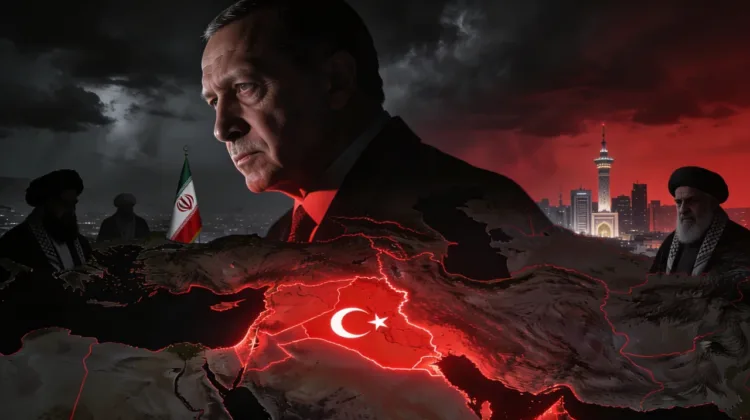
Blocking a pro-Western Iran at any cost.
In the face of the current war on Iran, Turkey has been unusually quiet. Beyond calling for an immediate end to the war, along with China and Russia, it intercepted an Iranian ballistic missile over its territory on March 4, and merely echoed unavailing calls for “diplomacy” rather than joining in the long-overdue strike on Iran aimed at crippling its advanced military capabilities. But now comes a more realistic report about Turkey, reflective of its identity. “Turkey’s Iran strategy: Preserve the mullah regime — or ensure its successor remains anti-Western,” by Abdullah Bozkurt, Nordic Monitor, March 8, 2026:
The Islamist government of Turkish President Recep Tayyip Erdogan has adopted a strategic approach toward Iran that prioritizes the survival of the clerical regime in Tehran. Should that objective fail, Ankara appears determined to shape any political transition in a way that prevents the emergence of a pro-Western or Israel-aligned government.
Recent developments reveal that Turkey’s Iran policy is not driven merely by regional diplomacy but by a deeper geopolitical calculation: maintaining an ideological and strategic axis that counters Western influence in the Middle East while protecting Erdogan’s own political positioning at home and abroad.
While the Erdogan government, joined by much of the co-opted opposition in Turkey, has ratcheted up anti-Israel rhetoric in the aftermath of attacks on Iran, it has deliberately downplayed the Iranian mullah regime’s unprovoked missile launch against Turkish territory. Government propagandists have even gone so far as to blame the incident on Israel, portraying it as a supposed false-flag operation despite offering no evidence to support the claim.
For Ankara, Iran’s stability is viewed as a national security interest. Turkish policymakers increasingly interpret attempts to take down terrorism-sponsoring mullah regime as part of a broader geopolitical struggle involving the United States and Israel. They frequently frame protests or internal unrest in Iran as movements influenced by foreign powers, echoing narratives long promoted by Iranian leaders themselves.
Turkey has been noticeably quiet about the war against Iran, as it tries to balance its Islamic supremacist ambitions while also cleverly navigating its NATO membership, which is key to keeping it well armed as a powerful global player.
Turkey is a detriment to the West and Israel. Consider: Turkish Present Recep Tayyip Erdogan has referenced Hamas as a “liberation organization,” hosted its leadership in Ankara, and granted themTurkish passports. Turkey and Qatar are well-known Muslim Brotherhood supporters. Turkey also supports Syria’s jihadist President Ahmed al-Sharaa, and has sought an increased partnership with Iran. It even considers the Taliban a friend. Erdogan also “hailed a massive pro-Palestinian rally in Istanbul on New Year’s Day as a ‘historic moment.’” He stated that “it sent a clear message that Palestine is not alone.” He threatened Israeli Prime Minister Benjamin Netanyahu, saying: “What this Pharaoh called (Israeli Prime Minister) Benjamin Netanyahu has done will not go unpunished, because he incurred the curses of countless oppressed people, from the young to the old.” As if that were not enough to wake up the West, the Begin-Sadat Center for Strategic Studies also states regarding the Islamic State’s short-lived caliphate in Iraq and Syria:
The ability of ISIS to become a functioning state so quickly is largely due to its relationship with President Erdoğan in Turkey.
ISIS has had strong connections to Turkey over the years, whether through its oil industry or through its willingness to shield wanted members of the Muslim Brotherhood. This “neighborly” relationship was essential to ISIS’s success, and it continues to be reflected in Turkish decisionmaking.
The Council on Foreign Relations points out that the Kurdish-led Syrian Democratic Forces (SDF) became the chief ally to the US against ISIS during the Syrian war, to gain a global reputation “as the most effective ground forces” against the group. While incurring thousands in personal losses, it reduced the group “to a fraction of its 2014 peak.” The United States trained Iraqi Kurds, backed Syrian Kurds with airpower, and armed them on the ground.
The US-Kurdish alliance enraged Erdogan, who viewed the US strategy against ISIS as “tantamount to backing the PKK,” a group that Turkey has outlawed, and with which Turkey has carried on a violent struggle. Despite the size and power of the Turkish military, “Kurdish militias have proven resilient and their fighters, if not their cause, have gained international recognition after successes against the Islamic State.”
Another success has been SDF management of the Syrian al-Hol ISIS camp. That is, up until the Turkish-backed installment of al-Sharaa, whose government launched an offensive against the SDF. As a result, over 23,000ISIS-linked prisoners escaped. Most were brides of ISIS jihadis and their children; many of these children went through jihad training as “Cubs of the Caliphate.” NBC News quoted SDF spokesperson Farhad Shami in the Kurdish news website Rudaw, saying “that around ‘1,500 ISIS militants — including both foreign and Syrian nationals — had been released’ by Damascus-affiliated armed groups from Shaddadi prison in southern Hasaka as well following fighting there.” The resulting dire implications for the region and also for many EU countries that maintain open-door migration policies is significant. Al-Sharaa also signed a constitutional declaration that mandates that the Syrian president must be Muslim, and it established the supremacy of Islamic jurisprudence, that is, the Sharia.
One can see a pattern emerge. The alternative to America’s alliance with Kurdish fighters that enraged Turkey during the Syrian war would have been to let ISIS rapidly proliferate regionally, and advance its mission toward a global caliphate, while Erdogan would have further exploited his “neighborly” relationship with ISIS, as described by the Begin-Sadat Center for Strategic Studies. Now, in the case of the current Iran war, Erdogan would rather maintain the status quo with the Islamic Republic of Iran’s mullahs, in order to continue building his own regional power base as he engages in “a deeper geopolitical calculation.”
Erdogan is ready and willing to exploit any and every opportunity for power. He did it with ISIS in the Syrian war. He did it to establish al-Sharaa as leader in Syria. He does it with the Muslim Brotherhood, and he’ll do it again by exploiting the war on Iran however he can. The most fundamental difference between Turkey and Iran is the crude modus operandi of the latter, which has become a hallmark of the regime. However, the key ingredient that both share is their ability to exploit Western interests to the hilt. Western leaders poured billions into the coffers of Iran because of a bogus nuke deal that was based on lies, Iran finally admitted. Meanwhile, Turkey continues to exploit NATO.
Follow link below to a relevant story:The Carnegie Endowment explains that a mega-shift in the geopolitical landscape, which the current war threatens to bring about, does not benefit Erdogan. This is particularly so if Israel’s long-term goal of eliminating the existential threat that the Islamic Republic poses is recognized. Israel’s goal is of critical importance not just for its own survival, but for American interests as well. Think of what will happen if Democrats win in the future. Iran possesses the most expansive missile arsenal in the Middle East, with the capability of striking parts of Europe. According to the Defense Intelligence Agency, Iran has space launch vehicles it could use to develop a militarily-viable Intercontinental Ballistic Missile “by 2035 should Tehran decide to pursue the capability,” especially since its systems “have nuclear-capable variants.” The anti-Trump activist media expectedly denies that Iran is seeking nuclear weapons, but given Iran’s rate of military progress, its nuclear ambitions are indeed plausible and even likely. Even after Operation Rising Lion in June, which targeted Iran’s nuclear infrastructure and ballistic missile capabilities, the operation failed to neutralize Iran as a threat. The regime’s resilience and will must not be underestimated. --->READ MORE HERE
+++++Turkey’s Iran strategy: Preserve the mullah regime — or ensure its successor remains anti-Western+++++



No comments:
Post a Comment