 |
Since coming to the United States 30 years ago from Mexico, Fernando Perez said U.S. immigration officers have stopped by his home numerous times, but he has never once answered the door.
“There are rules and I know them,” said Perez, speaking in a mix of English and Spanish in a Home Depot parking lot where he has routinely sought work as a day laborer from contractors and people renovating their homes.
Over the decades it has become common knowledge in immigrant communities across the country to not open the door for federal immigration officers unless they show a warrant signed by a judge. The Supreme Court has long held that the Constitution’s Fourth Amendment against unreasonable search and seizure prohibits the government’s forced entry into someone’s home.
As a result, immigration officers have been forced to adapt by making arrests in public, which often requires long hours of surveillance outside homes as they wait to nab someone walking to the street.
But an internal Immigration and Customs Enforcement memo obtained by The Associated Press states immigration officers can forcibly enter people’s homes without a judge’s warrant, marking a dramatic shift that could upend the legal advice given to immigrants for decades.
The shift comes as President Donald Trump’s administration dramatically expands immigration arrests nationwide under a mass deportation campaign that is already reshaping enforcement tactics in cities such as Minneapolis.
Perez said officers in the past would knock, wait and then move on.
“But if they are going to start coming into my home, where I am paying the rent - they are not paying the rent - that’s the last straw,” he said.
Most immigration arrests have been carried out under administrative warrants, documents issued by immigration authorities that authorize an arrest. Traditionally they do not permit officers to enter private spaces without consent. Only warrants signed by independent judges have carried that authority.
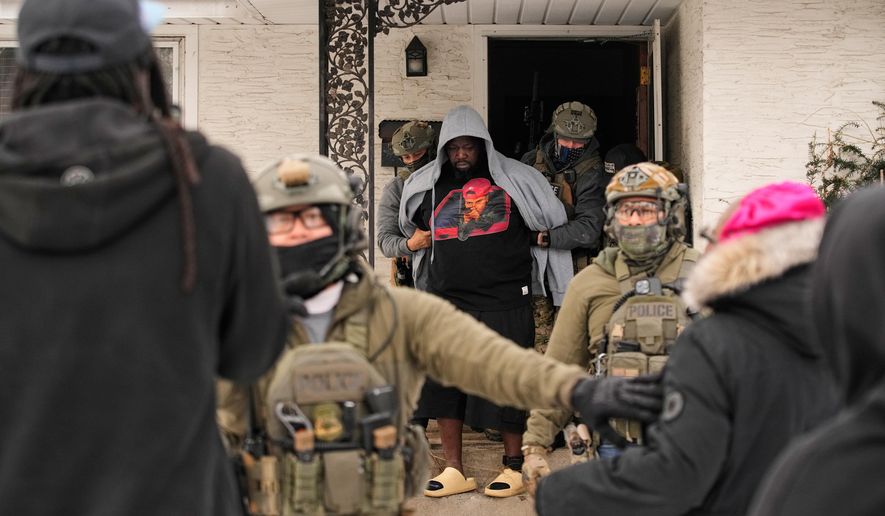
It is unclear how broadly the memo’s directive has been applied in immigration enforcement operations. AP witnessed ICE officers ramming through the front door of a Liberian man’s home in Minneapolis on Jan. 11 with only an administrative warrant, wearing heavy tactical gear and with their rifles drawn.
Democratic U.S. Sen. Richard Blumenthal of Connecticut is demanding congressional hearings on the ICE memo and calling on Homeland Security Secretary Kristi Noem for an explanation.
“Every American should be terrified by this secret ICE policy authorizing its agents to kick down your door and storm into your home,” Blumenthal said in a news release.
Supreme Court Justice John Paul Stevens wrote for the court in 1980 that the “physical entry of the home is the chief evil against which the wording of the Fourth Amendment is directed.”
For years, people have managed to evade arrest by skipping work and outings for days until agents move on. A senior ICE official once likened the surveillance experience to watching paint dry. --->READ MORE HERE
If you like what you see, please "Like" and/or Follow us on FACEBOOK here, GETTR here, and TWITTER here.



No comments:
Post a Comment