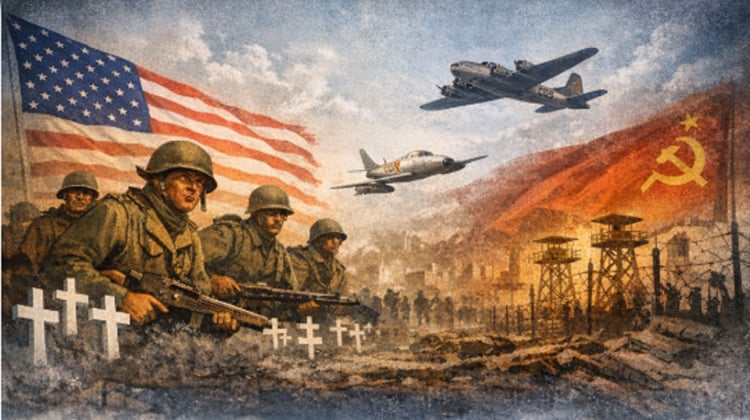
Without American sacrifice, would there be a free Europe?
When European leaders took the stage at the World Economic Forum this year, the language was familiar: partnership, shared values, transatlantic unity. What was conspicuously absent was memory. Not nostalgia, not sentiment—but memory. Because when it comes to America’s role in Europe’s survival, prosperity, and security, much of today’s European political class behaves as if history began yesterday.
That selective amnesia is now colliding with reality over a place most Europeans rarely think about at all: Greenland.
The uproar over American interest in Greenland—framed as aggression, arrogance, or neo-imperialism—reveals less about U.S. intentions than about Europe’s failure to reckon honestly with the unpaid debts of history. Greenland is not a conquest fantasy. It is a sparsely populated, strategically vital landmass sitting on the North American continent, commanding Arctic routes that will define twenty-first-century security. And for most of the modern era, it has been protected not by Europe, but by the United States.
That fact did not begin with recent geopolitical tensions. It began in World War II.
In 1940, Denmark collapsed under Nazi occupation. It did not liberate itself. It did not defend its overseas territories. When Denmark fell, the United States assumed responsibility for Greenland’s defense—not out of opportunism, but necessity. Washington understood something Europe seems to have forgotten: geography does not care about sentiment. Greenland mattered then for Atlantic security. It matters even more now.
And that was only one chapter in a much longer ledger.
Europe did not merely benefit from American involvement in World War II—it survived because of it. Hundreds of thousands of American servicemen died fighting across Europe, from Normandy to the Ardennes. Their graves still line the continent. After victory, the United States rebuilt former enemies instead of dismantling them, launched the Marshall Plan, and chose reconciliation over vengeance. Then, for nearly half a century, America stood watch against Soviet expansion, absorbing the costs of deterrence so Western Europe could rebuild, prosper, and debate philosophy rather than survival.
This was not a temporary favor. It was a generational commitment.
Against that backdrop, the current outrage over Greenland is striking. Here is a territory with roughly thirty-two thousand inhabitants, culturally distant from Copenhagen, economically reliant on external support, and strategically indispensable in an age of Arctic militarization. And yet, when the United States signals interest in ensuring its long-term security alignment, Europe responds not with discussion or gratitude, but with indignation.
The irony is difficult to miss. Europe has spent decades urging the United States to shoulder global security burdens—only to recoil when American strategic interests intersect with European complacency. The same leaders who warn about Russian aggression and Chinese expansion suddenly discover a fierce attachment to sovereignty when American power seeks to stabilize an obvious vulnerability.
This is not about “buying land.” It is about responsibility. --->READ MORE HERE
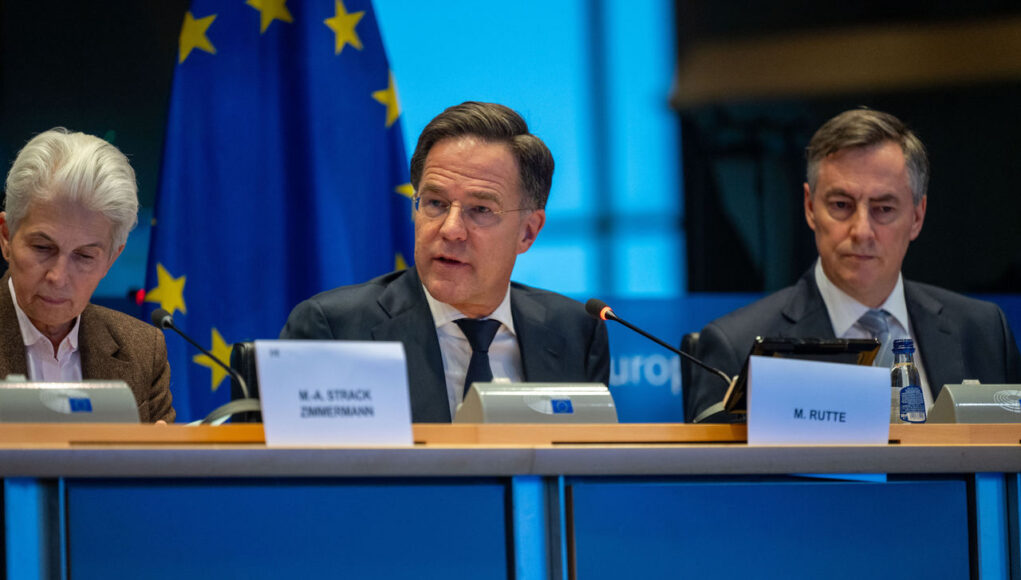
NATO Secretary General Mark Rutte has dismissed calls for a standalone European defence force, warning that Europe cannot defend itself without the United States and that attempts to go it alone would only weaken collective security.
Speaking in Brussels during a joint session of the European Parliament’s Foreign Affairs and Security and Defence committees, Rutte argued that talk of a separate “European pillar” risks confusion, duplication and strategic distraction. He said the concept was often poorly defined, cautioning that creating parallel military structures would complicate command arrangements and drain already stretched manpower.
“A European pillar is a bit of an empty word,” Rutte said, adding that proposals resembling a European defence force would duplicate NATO structures and make coordination harder. “You have to find the men and women in uniform on top of what is happening already. It will make things more complicated. I think Putin will love it.”
Instead, he said Europe and NATO should focus on a clear division of labour, with NATO leading on command and control, capability development and standard-setting, while the European Union strengthens resilience, industrial capacity, regulation and defence financing mechanisms. Rutte was also outspoken in his assessment of transatlantic dependence, rejecting suggestions that Europe could secure itself independently of Washington.
“If anyone thinks that Europe can defend itself without the US, keep on dreaming. You can’t. We can’t. We need each other,” he said.
He argued that even dramatically increased European defence spending would not close the gap, particularly in nuclear deterrence. “If you really want to go it alone, forget that you can ever get there with 5%. It will be 10%. You would have to build your own nuclear capability, costing billions and billions,” he said, warning that such a path would mean losing the US nuclear umbrella. Rutte also pushed back against claims that the United States is drifting away from NATO, insisting Washington remains fully committed to Article Five collective defence. --->READ MORE HERE



No comments:
Post a Comment