It’s Time To Cancel Our Subscription Culture Once And For All:
A new cancel culture is coming. Consumerism, bad customer service, and corporations beware!
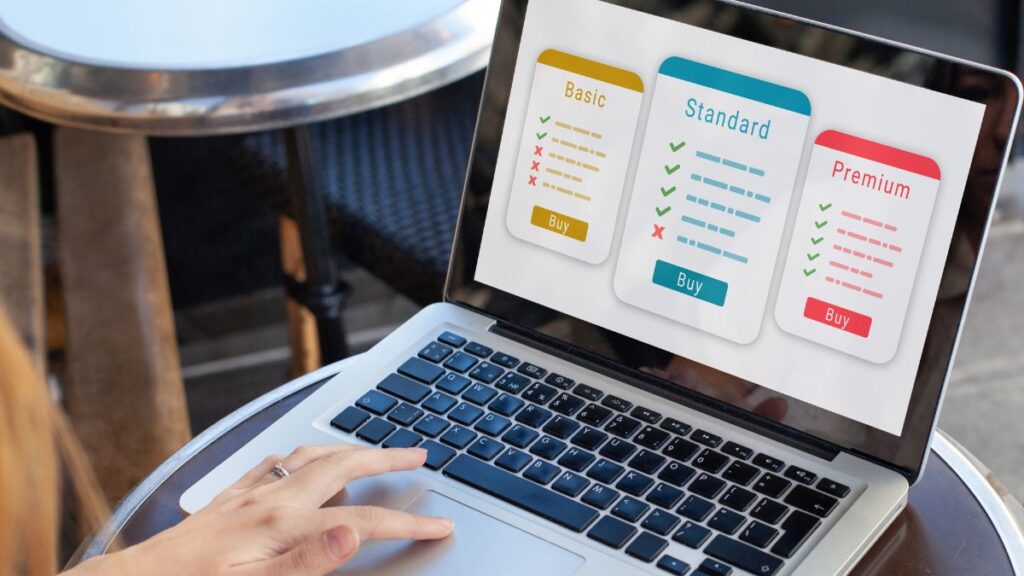
Society has a subscription problem, and I’m sick of it.
In 2009, Apple debuted the catchy, cultural truth-teller slogan “there’s an app for that.” Nowadays, there’s not only “an app for that,” but also an accompanying recurring fee you must pay to make most of them remotely usable.
Want to watch your favorite sports teams duke it out? Subscription. Want to listen to music? Subscription. Want to track your menstruation? Subscription. Want to unlock your vehicle’s special features? Subscription. Want vitamins delivered to your door? Subscription. Want to online date? Subscription. Want groceries or takeout delivered to your house? Subscription. Want to get those gains at your local gym? Subscription. Want to use that video baby monitor? Subscription. Want to see who is at your front door? Subscription. Want to read your favorite writers’ and authors’ musings? Subscription. Want to chat it up with artificial intelligence? Another subscription. Short on phone space to hold all of your apps and the subscriptions they require? Fret not, for there’s a subscription for cloud storage out there, too.
You get the gist. Regardless of the actual value of the service, the process for all subscriptions remains relatively the same: You pay a fee (one that almost assuredly will increase on a fairly regular basis) to use things deemed “extra” or “benefits.”
Some of these recurring fees are absolutely wasted on luxuries that the average American does not need on a daily basis. It’s also true that many sellers try to zhuzh up their monthly price by dubbing it a privileged tier, even though most of them are basic functions of the service. That’s like asking for a tip for just doing your job.
Take Amazon, for example. An estimated 196 million people pay to use the “prime” version of Jeff Bezos’ online storefront. One of the biggest pulls to paying more is free shipping. The catch, of course, is that anyone spending $35 or more on Amazon items (an easy feat to do with these inflated prices) also gets free and relatively fast shipping without the monthly charge.
Regardless of the means, the end consequences are the same. Not only does your budget take a big hit, but you’re doomed to a deluge of emails from sites you didn’t even know had your information and an even bigger list of logins that you must remember to maintain your access to the sites that you handed your information to. In this day and age, you own nothing because the things you own are useless unless you pay for the membership that activates them.
This method took the world by storm because it is profitable. Yet, consumers are tiring of it.
It’s at this time in the article when readers like you demand I use the power of free will and my fingers to cancel any pesky monthly dues and go on my merry way. But it’s not that easy. Canceling or unsubscribing can be a complicated, multi-step process that easily deters short attention spans from following through. Forgive me if I don’t have the time or energy to stay on hold for hours only to be answered by an AI robot or rando in a foreign call center that tries to convince me to do anything but cancel. --->READ MORE HERE
Subscription fatigue is real, and 2026 will be the breaking point for artists
Rising costs and locked-in tools are pushing creatives toward alternatives.
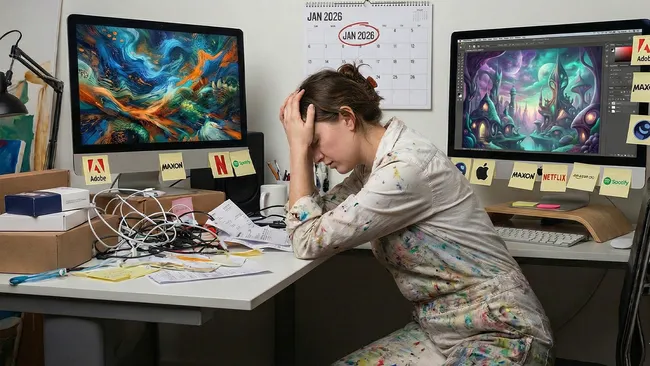
We've all been there. Hunched over the laptop at midnight, surrounded by cold tea and half-finished work, you check your inbox. Suddenly, the number of “your subscription is increasing” emails starts to feel overwhelming. Netflix wants more. Adobe wants more. Spotify wants more. Even the app that tracks how much water you drink wants £1.99 a month for “advanced hydration analytics”.
In short, your bank statement is starting to read less like a financial summary and more like a hostage letter. This is happened to a lot of creatives in 2025. And more and more of us are starting to snap.
The tide is turning
The clearest sign the tide is turning came recently, when Affinity announced that its entire suite would be free – editing, design, layout, the whole lot. No tiers, no catches, no “free for seven days and then we’ll silently charge you unless you decode our tiny grey opt-out button”. Just free.
Downloads exploded. Designers cheered. And software company executives everywhere experienced a sudden, collective shiver.
Of course, plenty of legacy tools have kept hiking their prices anyway, assuming we’d just keep nodding along. But with every increase comes a louder chorus of, “Hang on… do I actually need this?” And increasingly, the answer is a loud, confident "No"... because the alternatives have come on leaps and bounds.
Capable alternatives
Blender, once the slightly eccentric cousin of the 3D world, has evolved into a full-blown powerhouse used by studios and solo artists alike, despite being totally free. Krita, meanwhile, has grown into a capable painting tool without draining your wallet one iota. --->READ MORE HERE
If you like what you see, please "Like" and/or Follow us on FACEBOOK
here, GETTR
here, and TWITTER
here.



No comments:
Post a Comment