Here’s What Trump Means By Calling For ‘Peace Through Strength’:
Peace through strength, defined by ‘hard-nosed realism’ over the ‘utopian idealism’ of a bygone era, is poised to yield both a popular and durable American defense policy
“Peace through strength,” the phrase often used to define many presidents’ national security vision, is a catchy sound bite. The problem is that no one really seems to know what it means.
The Trump administration’s recent release of its National Security Strategy (NSS) finally provides the phrase some substance. Provoking a litany of fierce hot takes from both critics and supporters, the National Security Strategy reflects only the beginning of a larger sea change. The Trump administration is ushering in a shift away from “neo-Reaganite” primacy, which shackles the U.S. to the interests of the “rules-based international order,” and toward a model grounded in realism, in which America’s actions and policies are aligned in direct service to core national interests. The administration’s forthcoming National Defense Strategy (NDS), a document that translates the pillars of the NSS into concrete defense guidance, is poised to apply this strategic shift to American defense policy.
Secretary of War Pete Hegseth previewed the change to come at the Reagan National Defense Forum. Traditionally a venue reserved for the Washington national security establishment, rarely has the Reagan National Defense Forum provided a platform for alternative viewpoints. Yet in this year’s keynote address, Secretary Hegseth posited that peace through strength for President Trump means rejecting “utopian idealism” and embracing “hard-nosed realism.”
The secretary aptly harkened back to President Reagan’s Secretary of Defense Casper Weinberger and the principles that guided decisions on the employment of U.S. military power at the time. The Weinberger Doctrine maintained that U.S. military force should be a “last resort,” used strictly in support of “vital national interests” and only employed with “political and military objectives” defined. Reagan’s strategic vision, as the secretary contended, found grounding in realism.
U.S. defense policy has, post-Reagan and post-Cold War, been unfortunately captivated by the fleeting promises of the “unipolar moment.” Secretary Hegseth unapologetically called out these disastrous distractions — “democracy building, interventionism, undefined wars, regime change” — which have left the United States in a precarious position of underpreparedness to face the increasingly dangerous strategic environment of today. He further challenged the practice often used by opportunistic actors of invoking peace through strength as an umbrella term used to justify everything from endless wars to utilizing the U.S. military as a tool for democracy promotion and “nation building.”
It was a contrarian perspective for the Reagan Forum crowd to hear.
President Trump’s National Security Strategy deserves credit for — echoing the Reagan era — tightly defining the military’s purpose as “to protect our interests, deter wars, and — if necessary — win them quickly and decisively, with the lowest possible casualties to our forces.” If the National Defense Strategy succeeds in providing more depth to this principle, laying out the limits on the employment of force and the scope of deterrence activities, Trumpian peace through strength gains resilience. --->READ MORE HERE
Trump’s peace through strength in 2025: where wars stopped and rivals came to the table
Israel-Hamas ceasefire marked biggest diplomatic win, as Russia-Ukraine peace remains elusive
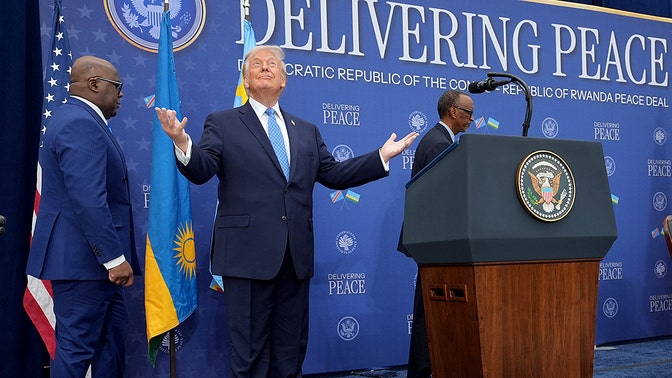
Donald Trump entered 2025 pledging to end wars and reorient U.S. foreign policy around what he repeatedly described as "peace through strength."
Throughout the year, Trump has cast his diplomacy as peace-focused, telling reporters, "We think we have a way of getting peace," and publicly arguing that his record merited a Nobel Peace Prize. The U.S. State Department echoed that framing in its year-end summary of diplomatic efforts, highlighting initiatives it said aimed to "secure peace around the world."
By the close of 2025, several conflicts saw impressive diplomatic progress, while others were still experiencing issues after years of hatred and violence.
Gaza (Israel–Hamas)
The most consequential diplomatic development of the year came in early October, when the Trump administration helped broker a ceasefire framework between Israel and Hamas. The agreement halted large-scale fighting after months of intense combat and enabled the release of all remaining hostages from Hamas’ Oct. 7 attack on Israel, except for the body of Ron Gvili, which remains held captive by Hamas terrorists.
The administration later cited the ceasefire as a central element of its 2025 diplomatic record. While the truce largely held through the end of the year, core issues including Gaza’s long-term governance, demilitarization and enforcement mechanisms remained unresolved, as well as rebuilding the enclave after the massive destruction and displacement. U.S. officials continued working with regional partners on next steps as fighting paused, as Israel's Netanyahu is expected to meet with President Trump next week for talks on Gaza and other issues.
Armenia–Azerbaijan
In August, Trump hosted the leaders of Armenia and Azerbaijan at the White House for a U.S.-brokered peace declaration aimed at addressing decades of conflict tied to Nagorno-Karabakh. The agreement focused on transit routes, economic cooperation and regional connectivity and was promoted by the administration as a historic step.
While the historic declaration was signed, implementation and deeper reconciliation is still ongoing.
Ukraine–Russia war
Ukraine remained the most ambitious and elusive peace target of Trump’s 2025 agenda. The year opened with Trump insisting the war could be ended through direct U.S. engagement and leverage over both Kyiv and Moscow. Diplomacy intensified in August, when Trump hosted Russian President Vladimir Putin in Alaska, a summit framed by the White House as a test of whether personal diplomacy could unlock a settlement.
In parallel, Ukrainian President Volodymyr Zelenskyy was received at the White House, where Trump reiterated U.S. support for Ukraine while signaling that any peace would require difficult compromises. U.S. officials explored security guarantees and economic incentives, while avoiding public commitments on borders or NATO membership...... --->LOTS MORE HERE
If you like what you see, please "Like" and/or Follow us on FACEBOOK
here, GETTR
here, and TWITTER
here.


No comments:
Post a Comment