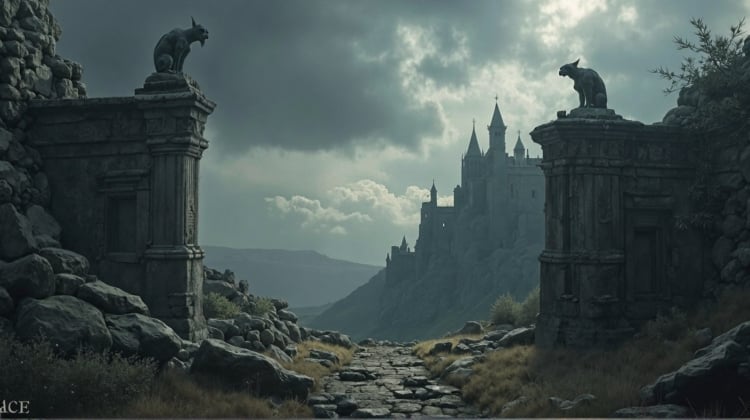
When the necessary medicine is seen as worse than the disease.
Western civilization arose in the 8th century B.C. Greece. Some 1,500 city-states emerged from a murky, illiterate 400-year-old Dark Age. That chaos followed the utter collapse of the palatial culture of Mycenaean Greece.
But what re-emerged were constitutional government, rationalism, liberty, freedom of expression, self-critique, and free markets – what we know now as the foundation of a unique Western civilization.
The Roman Republic inherited and enhanced the Greek model.
For a millennium, the Republic and subsequent Empire spread Western culture, eventually to be inseparable from Christianity.
From the Atlantic to the Persian Gulf and from the Rhine and Danube to the Sahara, there were a million square miles of safety, prosperity, progress, and science – until the collapse of the Western Roman Empire in the 5th century AD.
What followed was a second European Dark Age, roughly from 500 to 1000 AD.
Populations declined. Cities eroded. Roman roads, aqueducts, and laws crumbled.
In place of the old Roman provinces arose tribal chieftains and fiefdoms.
Whereas once Roman law had protected even rural people in remote areas, during the Dark Ages, walls and stone were the only means of keeping safe.
Finally, at the end of the 11th century, the old values and know-how of the complex world of Graeco-Roman civilization gradually re-emerged.
The slow rebirth was later energized by the humanists and scientists of the Renaissance, Reformation, and eventually the 200-year European Enlightenment of the 17th and 18th centuries.
Contemporary Americans do not believe that our current civilization could self-destruct a third time in the West, followed by an impoverished and brutal Dark Age.
But what caused these prior returns to tribalism and loss of science, technology, and the rule of law? --->READ MORE HERE
 |
| Photograph: Violeta Santos Moura/Reuters |
Since the Enlightenment, we’ve been making our own decisions. But now AI may be about to change that
This summer, I found myself battling through traffic in the sweltering streets of Marseille. At a crossing, my friend in the passenger seat told me to turn right toward a spot known for its fish soup. But the navigation app Waze instructed us to go straight. Tired, and with the Renault feeling like a sauna on wheels, I followed Waze’s advice. Moments later, we were stuck at a construction site.
A trivial moment, maybe. But one that captures perhaps the defining question of our era, in which technology touches nearly every aspect of our lives: who do we trust more – other human beings and our own instincts, or the machine?
The German philosopher Immanuel Kant famously defined the Enlightenment as “man’s emergence from his self-imposed immaturity.” Immaturity, he wrote, “is the inability to use one’s understanding without guidance from another”. For centuries, that “other” directing human thought and life was often the priest, the monarch, or the feudal lord – the ones claiming to act as God’s voice on Earth. In trying to understand natural phenomena – why volcanoes erupt, why the seasons change – humans looked to God for answers. In shaping the social world, from economics to love, religion served as our guide.
Humans, Kant argued, always had the capacity for reason. They just hadn’t always had the confidence to use it. But with the American and later the French Revolution, a new era was dawning: reason would replace faith, and the human mind, unshackled from authority, would become the engine of progress and a more moral world. “Sapere aude!” or “Have courage to use your own understanding!”, Kant urged his contemporaries.
Two and a half centuries later, one may wonder whether we are quietly slipping back into immaturity. An app telling us which road to take is one thing. But artificial intelligence threatens to become our new “other” – a silent authority that guides our thoughts and actions. We are in danger of ceding the hard-won courage to think for ourselves – and this time, not to gods or kings, but to code.
ChatGPT was launched only three years ago, and already one global survey, published in April, found that 82% of respondents had used AI in the previous six months. Whether deciding to end a relationship or who to vote for, people are turning to machines for advice. According to OpenAI, 73% of user prompts concern non work-related topics. Even more intriguing than our dependence on AI’s judgment in daily life is what happens when we let it speak for us. Writing is now among the most common uses of ChatGPT, second only to practical requests such as DIY or cooking advice. The American author Joan Didion once said: “I write entirely to find out what I am thinking.” What happens when we stop writing? Do we stop finding out?
Worryingly, some evidence suggests that the answer might be yes. A study by the Massachusetts Institute of Technology used electroencephalography (EEG) to monitor the brain activity of essay writers given access to AI, search engines like Google, or nothing at all. Those who could rely on AI showed the lowest cognitive activity and struggled to accurately quote their work. Perhaps most concerning was that over a couple of months, participants in the AI group became increasingly lazy, copying entire blocks of text in their essays. --->READ MORE HERE
If you like what you see, please "Like" and/or Follow us on FACEBOOK here, GETTR here, and TWITTER here.

No comments:
Post a Comment