 |
| Tim Evanson/Public domain/CC BY-SA 2.0 |
In 2026, millions of Americans turned to AI for guidance on down-ballot races, judicial candidates, and ballot initiatives.
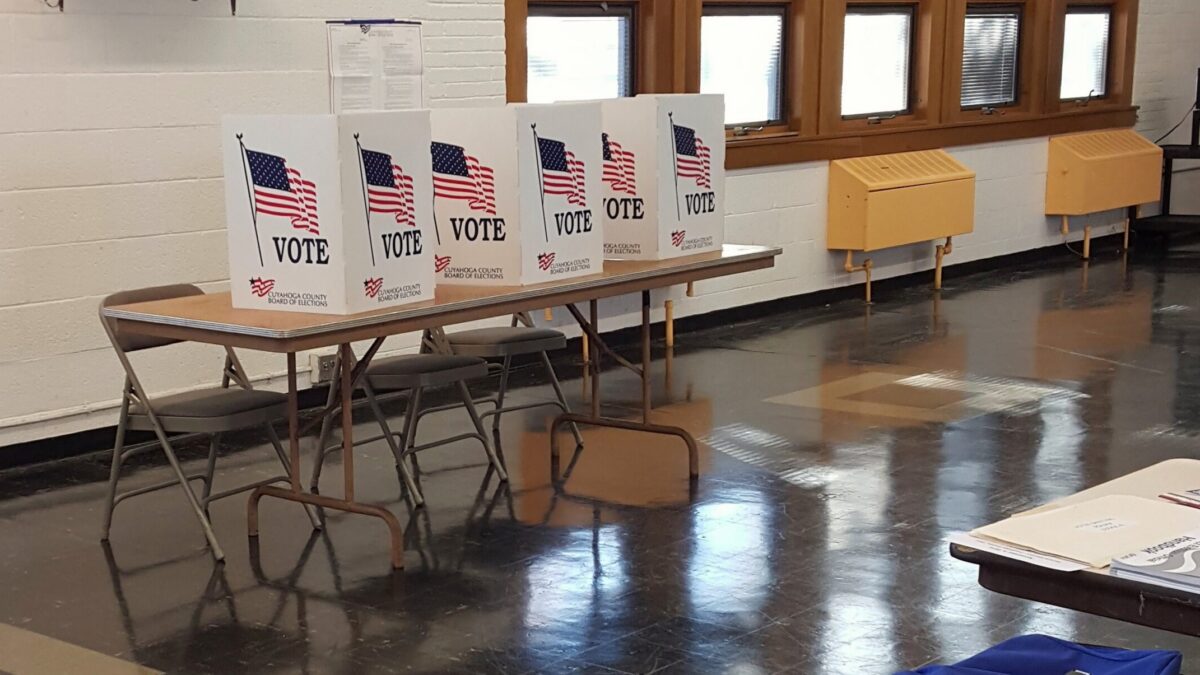
The 2026 election was consequential not only because of who Americans voted for, but how they decided to vote. 2026 was the year artificial intelligence entered the voting booth, and we have only begun to grapple with how much influence it may have had.I saw AI’s impact firsthand. During Florida’s early voting period, I spoke with a relative who said she had voted for Byron Donalds and Ashley Moody. However, for the down-ballot races, she told me she used Grok, Elon Musk’s AI model, to help her decide how to vote. Another relative, in West Virginia, used ChatGPT to help him vote on local ordinances and state law amendments. Another used Claude to help with judicial picks.
My inner circle was not alone. According to an October 2026 survey commissioned by the National Conference on Citizenship, 25 percent of American adults reported using AI chatbots to learn about local candidates or ballot measures as they decided how to vote. The same percentage reported using AI to research candidates for Congress or governor. A separate Pew Research Center survey found that 8 percent of American adults were using AI chatbots for election information, and 40 percent of those users sought suggestions about their voting choices. Importantly, both surveys were conducted weeks before Election Day, and research suggests people may not always be forthcoming about their AI use. AI’s actual role in the 2026 election may have been considerably greater than the early numbers suggest.
Americans have long relied on voter guides and political endorsements to help make sense of their ballots. But AI presents something fundamentally different: personalized political advice from algorithms with biases that may influence the recommendations provided, often without voters realizing it. That matters as the country turns toward 2028 — and it presents an election-law problem our traditional rules do not neatly address.
Florida law specifically requires certain mailed political voter guides to display prominent sponsorship disclaimers. Federal rules likewise require information about who paid for covered campaign communications, including qualifying paid internet advertising. Those rules do not apply to every voter guide or require political advocacy to be unbiased. But where they apply, voters are told who is speaking. An ordinary, independently generated chatbot response to a private question generally carries no comparable election-law disclaimer.
AI’s Bias
That distinction would matter less if the advice were reliably neutral. But studies have shown that different AI models carry considerable political biases. In an October 2026 study of 479 congressional and gubernatorial races with a major-party candidate from each side, a Cornell Tech researcher repeatedly instructed two search-enabled AI models to select a candidate. Among responses naming a Democrat or Republican, OpenAI’s GPT-6.1 Sol selected Democrats 97 percent of the time. By contrast, Grok 4.7 selected Republicans 92 percent of the time. The models also emphasized different issues and retrieved and relied on different sources.
To be clear, these findings do not establish that AI chatbots expressly told Americans how to vote in the 2026 election. The researcher tested the underlying AI models through tools that allow developers to interact directly with AI systems — rather than through the apps most people use. The consumer apps declined direct requests to select a candidate. However, when consumer apps were asked instead to judge debates between candidates, ChatGPT favored Democrats in eight of 10 tests, while Grok favored Republicans in nine of 10. While the study does not establish what advice voters received in last week’s election, it suggests that two voters seeking guidance on the same candidates could receive very different advice depending on which AI system they consulted.
Can the Law Regulate AI Voting Advice?
That possibility raises a question election law is only beginning to confront: What happens when potentially biased political advice comes not from a campaign advertisement or voter guide, but from an AI chatbot that voters independently consult?
Lawmakers have already begun addressing AI’s role in elections. According to the National Conference of State Legislatures, 31 states have enacted laws regulating AI-generated political deepfakes, generally through disclosure requirements or prohibitions on deceptive campaign material. But an AI chatbot responding to a voter’s questions is something different. Existing election laws offer little guidance on how to address political influence arising from the chatbot’s own recommendations. --->READ MORE HERE

No comments:
Post a Comment