 |
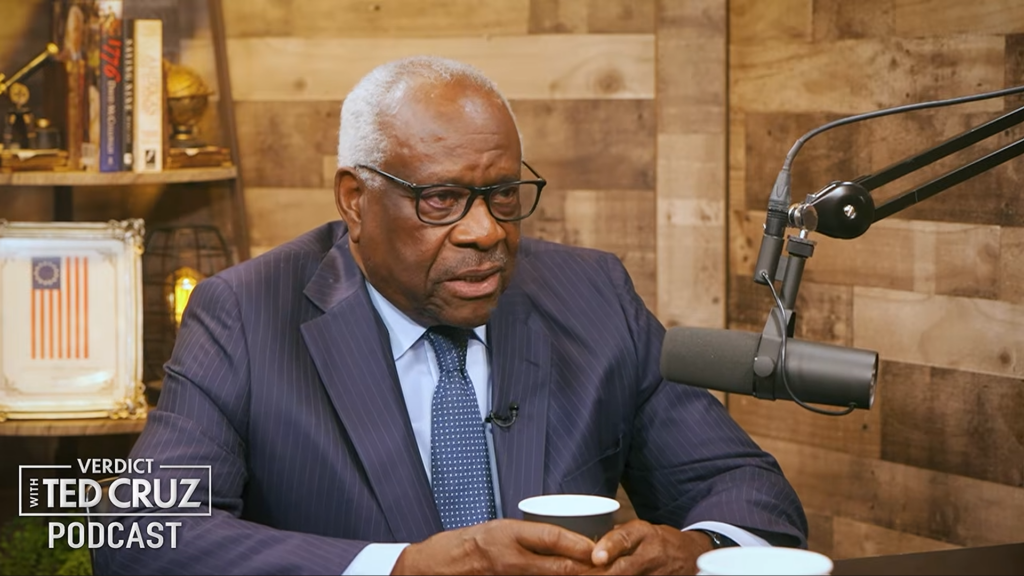
| Verdict with Ted Cruz/YouTube |
The Federalist has compiled five of Thomas’ greatest opinions to commemorate his 35 years on the nation’s highest bench.
It may not be hard to believe, but Supreme Court Justice Clarence Thomas just hit yet another major career milestone.The Bush 41 appointee marked 35 years on the high court on Friday, which comes months after he became the second-longest serving justice in U.S. history. Should he continue to serve through May 2028, Thomas would become the nation’s longest serving justice.
[READ: Leftists Tried To Stop Clarence Thomas From Going Further. They Failed Miserably]
Since joining SCOTUS, Thomas has authored numerous opinions upholding the Constitution and defending Americans’ God-given rights. And while there are too many to list in one article, The Federalist has compiled five of Thomas’ greatest writings to commemorate his 35 years on the nation’s highest bench.
New York State Rifle & Pistol Association Inc. v. Bruen
The Second Amendment’s right to “keep and bear arms” is a core liberty guaranteed to all law-abiding Americans. And in Bruen, Thomas made sure New York’s gun-grabbers knew it.
Writing for the majority, Thomas upheld Americans’ right to carry firearms outside the home for purposes of self-defense. In doing so, he affirmed that the Second Amendment is not some “second-class right” to be trifled with, but one that garners equally as much value and respect as the others guaranteed by the Constitution.
“We know of no other constitutional right that an individual may exercise only after demonstrating to government officers some special need,” Thomas wrote. “That is not how the First Amendment works when it comes to unpopular speech or the free exercise of religion. It is not how the Sixth Amendment works when it comes to a defendant’s right to confront the witnesses against him. And it is not how the Second Amendment works when it comes to public carry for self-defense.”
[READ: The Best Lines From The Supreme Court’s Takedown Of New York’s Unconstitutional Gun Licensing Scheme]
Students for Fair Admissions v. Harvard
Throughout his judicial career, Thomas has regularly championed the notion that all people, regardless of race, should be treated equally under the law. So, it wasn’t exactly surprising when the senior justice signed onto the Supreme Court’s Students for Fair Admissions v. Harvard decision finding affirmative action policies to be unconstitutional.
Thomas also authored a concurring opinion in the case to drive home the point that affirmative action — which was devised to end discriminatory admissions decisions against black Americans — is now being used to discriminate against those who don’t check universities’ preferred diversity box (that is, white and Asian Americans). Trading discrimination for discrimination, he said, is completely untenable and wrong.
“Racialism simply cannot be undone by different or more racialism. Instead, the solution announced in the second founding is incorporated in our Constitution: that we are all equal, and should be treated equally before the law without regard to our race,” Thomas wrote. “Only that promise can allow us to look past our differing skin colors and identities and see each other for what we truly are: individuals with unique thoughts, perspectives, and goals, but with equal dignity and equal rights under the law.”
[READ: The 15 Best Zingers, Maxims, And Mic-Drops From Clarence Thomas’ Harvard Concurrence]
Kelo v. New London
Thomas has never shied away from standing up for the little guy — especially when the law is on his side.
In Kelo v. New London, the Supreme Court upheld New London, Connecticut’s use of eminent domain to seize several homeowners’ private property to build a new Pfizer facility. The property owners alleged that the use of eminent domain violated the Fifth Amendment’s taking clause, which states that “private property [shall not] be taken for public use, without just compensation.” They more specifically reasoned that the seizure was unlawful because it was designed to benefit a private developer and not the general public.
In addition to joining the principal dissent, Thomas authored a solo dissent blasting the high court for “stray[ing]” from the clause’s “original meaning.” He further underscored the harmful impact the ruling would have on the nation’s poorest communities.
“Allowing the government to take property solely for public purposes is bad enough, but extending the concept of public purpose to encompass any economically beneficial goal guarantees that these losses will fall disproportionately on poor communities,” Thomas wrote. “Those communities are not only systematically less likely to put their lands to the highest and best social use, but are also the least politically powerful. If ever there were justification for intrusive judicial review of constitutional provisions that protect ‘discrete and insular minorities,’ … surely that principle would apply with great force to the powerless groups and individuals the Public Use Clause protects.” --->READ THE REST OF THE CASES HERE

No comments:
Post a Comment