 |
| KRQE/YouTube screenshot |
Securing 60 feet of federal dirt with the same trespassing law that protects Fort Bliss is not martial law.
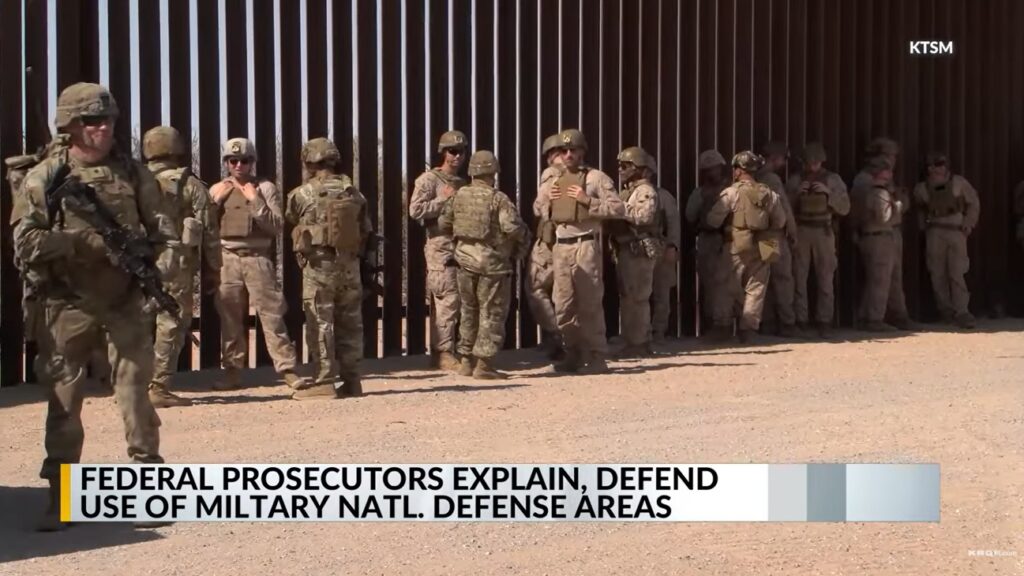
On Friday, the Justice Department’s Office of Legal Counsel told the Pentagon it can chase illegal border crossers a few extra steps past a property line before losing the authority to grab them. That is the entire controversy in a sentence, and if you read the coverage this week, you’d think the Army was about to start running immigration checkpoints in Topeka. Deputy Assistant Attorney General William Hyde wrote that troops arresting trespassers just outside a National Defense Area does not violate the Posse Comitatus Act, given the “military purpose of a commander’s traditional protective power” over federal installations. I graduated from Marine Corps Officer Candidates School, and no officer I served with needed a law review article to explain that a commander secures his own perimeter. That’s basic doctrine, not a novel legal theory.Here is the background the wire stories skip. On May 27, 1907, President Theodore Roosevelt reserved a 60-foot strip of land running along the Mexican border in California, Arizona, and New Mexico. He did it to stop opium smugglers and customs cheats, and to give federal officers a patrol corridor Congress hadn’t gotten around to funding properly. That strip is called the Roosevelt Reservation, and it has sat there quietly for over a century. Last year the Trump administration transferred segments of it, plus adjoining federal tracts, to Defense Department control and started calling the results National Defense Areas. There are now six of them across Arizona, California, New Mexico, and Texas, and Friday’s opinion lets the military designate more. The Pentagon has rotated in more than 20,000 troops to support the border mission since the effort began, a number that sounds like an occupation until you remember it’s spread across roughly a third of a 2,000-mile line and includes engineers, logistics staff, and surveillance crews, not just riflemen standing at checkpoints.
Simple Legal Mechanics
The legal mechanics are simpler than the outrage suggests. Two federal statutes do the work: 18 U.S.C. § 1382 makes it a crime to enter a military installation for an unlawful purpose, and 50 U.S.C. § 797 punishes willfully violating a Defense Department security regulation. Both are misdemeanors. Neither statute cares whether the trespasser is a smuggler, a drunk hiker, or an illegal alien. If you’re on Defense Department property without authorization, you’re trespassing, the same way you would be at Camp Pendleton. Add a Title 8 immigration charge if the trespasser also happens to be here unlawfully, and you have the full menu prosecutors have been using since April 2025, when the first charges started landing.
Point one, and the one that gets buried: this is not the military conducting civilian law enforcement. It is a base commander protecting his fence line, which the Posse Comitatus Act has never touched. The Posse Comitatus Act bars troops from acting as a national police force, not from securing the property they have been assigned to guard. Nobody accused the Marines at Yuma, Arizona, of violating the act when they kept trespassers off the bombing range there before this whole thing started. Reclassifying a border strip as Defense Department land and then applying the same rule that already governed every other military installation in the country is not a constitutional innovation. It is bureaucratic housekeeping with better optics.
Point two is the part that should embarrass the critics rather than the administration. Border Patrol logged roughly 2 million apprehensions in fiscal 2023 and 1.5 million in fiscal 2024. In fiscal 2025 that number fell below 240,000. This year, with two months still on the clock, it’s tracking near 81,000. You can credit the National Defense Areas, the asylum reforms, or the simple fact that word travels fast when the price of a border crossing has gone from a wrist slap to a federal trespassing charge. Whatever the mix, the policy is producing the outcome it was designed to produce, and a lot of the same voices who spent four years demanding “root causes” solutions are now furious that a solution actually arrived.
Precision Not Blunt Military Force
Point three: Civil libertarians at the ACLU and legal scholars at Just Security have raised exactly that concern, noting that some of these zones run for hundreds of square miles and that hikers, ranchers, and hunters near the border could stumble into a federal case without ever seeing a warning sign. That is not a frivolous complaint. In May of last year, a federal magistrate in Las Cruces dismissed trespassing charges against 98 people arrested in the first National Defense Area in New Mexico, and an El Paso magistrate followed with a similar ruling days later, both because the government couldn’t prove the defendants had any way of knowing they had crossed into a restricted zone. --->READ MORE HERE

No comments:
Post a Comment