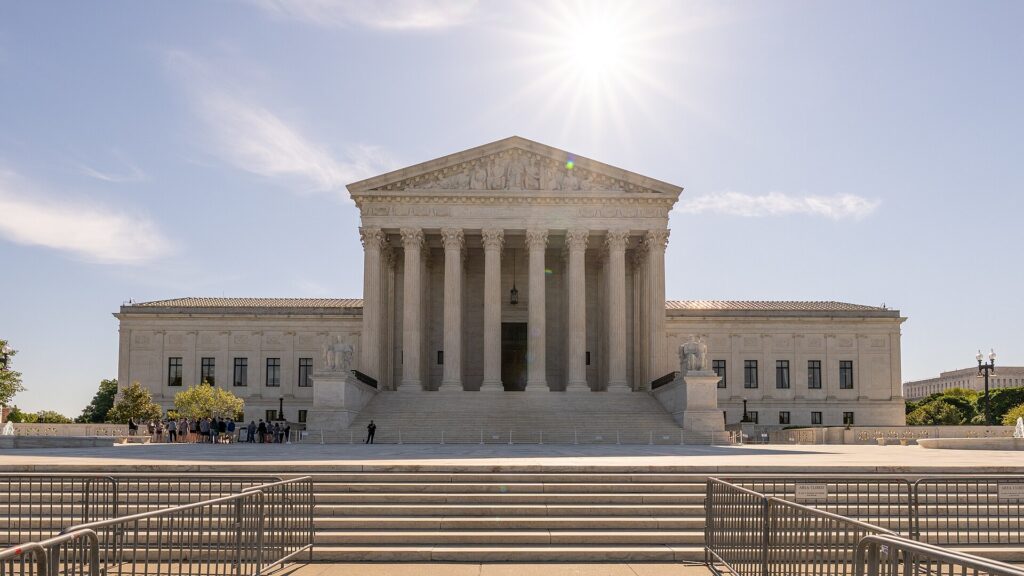
 |
| Ajay_Suresh/Wikimedia Commons/CC BY 4.0 |
Here is a breakdown of the biggest legal battles set to be argued before the Supreme Court during its 2026-2027 term
Another summer has come and gone, which means that the U.S. Supreme Court is gearing up for yet another blockbuster term.Like those before it, this year’s docket is piling up with cases touching on some of the biggest policy issues in American society. From religious liberty to parental rights, here is a breakdown of the biggest legal battles set to be argued before the high court during its 2026-2027 term.
Suncor Energy Inc. v. County Commissioners of Boulder County
This case dates back to early 2018, when the city of Boulder and Boulder County Commissioners sued three Suncor Energy businesses and the Exxon Mobil Corporation.
According to Justia, the Colorado officials alleged that these entities’ “fossil fuel activities contributed to climate change, causing harm to Boulder’s property and residents.” They furthermore “sought damages for public and private nuisance, trespass, unjust enrichment, and civil conspiracy, claiming that the [companies] knowingly contributed to climate change while misleading the public about its impacts.”
The oil companies’ repeated efforts to have the case moved from state to federal court were rejected by a federal district court and the 10th Circuit Court of Appeals. The Boulder County District Court also dismissed the companies’ request to dismiss the case, “rejecting their arguments that Boulder’s claims were preempted by federal law, including the Clean Air Act (CAA) and federal common law.”
The Colorado Supreme Court sided with the city and commissioners in May 2025. The Centennial State’s highest court ruled that Boulder’s claims were not preempted by federal law and permitted the lawsuit to move forward.
The energy giants petitioned the U.S. Supreme Court to take up the case in August 2025. They asked the justices to address the question of whether “federal law precludes state-law claims seeking relief for injuries allegedly caused by the effects of interstate and international greenhouse-gas emissions on the global climate.”
SCOTUS agreed to take up the matter in February 2026. In addition to considering the question presented by petitioners, the court will also determine whether it “has statutory and Article III jurisdiction to hear th[e] case.”
[READ: SCOTUS Takes Up Oil Companies’ Challenge To Colorado City’s Climate Lawfare]
Oral arguments are scheduled for Oct. 5, 2026.
Viramontes v. Cook County and Grant v. Higgins
Viramontes v. Cook County
This case’s origins can be traced back to 2021, when resident Cutberto Viramontes filed a lawsuit challenging Cook County, Illinois’ ban on the possession and transfer of AR-15s and similar semiautomatic firearms (so-called “assault weapons”). He argued that the prohibition violated his Second and 14th Amendment rights.
The U.S. District Court for the Northern District of Illinois sided with Cook County in spring 2024, with the 7th Circuit Court of Appeals following suit in June 2025. In doing so, the lower courts pointed to a 2023 7th Circuit ruling on a series of state and municipal laws banning “assault weapons” and large-capacity magazines that they said warranted dismissal of Viramontes’ challenge.
Viramontes filed a petition with SCOTUS in August 2025, in which he asked the justices to consider the question of whether the Second and 14th Amendments “guarantee the right to possess AR-15 platform and similar semiautomatic rifles.”
Grant v. Higgins
Dating back to June 2023, this case deals with a similar challenge to Connecticut’s “assault weapons” ban. Much like in Viramontes, the Grant plaintiffs alleged that the state’s restrictions on AR-15s and similar semiautomatic rifles unlawfully infringed on their Second Amendment rights. They also sought a preliminary injunction blocking the law’s enforcement.
The district court rejected this request in August 2023. As described by Justia, the lower court argued that plaintiffs did not show a likelihood of success on the merits of their Second Amendment claim and that they “failed to demonstrate that the regulated weapons and magazines were commonly used for self-defense.” The court further ruled that “the state’s restrictions were consistent with the nation’s historical tradition of regulating unusually dangerous weapons.”
Plaintiffs appealed the decision to the 2nd Circuit Court of Appeals, which affirmed the district court’s ruling in August 2025. In petitioning the Supreme Court several months later, they asked the justices to address whether the Second and 14th Amendments “guarantee the right to possess semiautomatic rifles that are in common use for lawful purposes, including the most popular rifle in the country, the AR-15.”
After months of consideration, the high court agreed to take up Viramontes and Grant consolidated in late June 2026 and answer the question presented in the former.
A date for oral arguments has not been announced.
[READ: Legal Specialists Preview Upcoming SCOTUS Cases On ‘Assault Weapons’ Bans]
St. Mary Catholic Parish v. Roy
This case’s origins can be traced back to 2020, when Colorado voters approved a ballot measure authorizing the establishment of a state-funded “universal” preschool program. The Colorado General Assembly subsequently codified the program into law, with participating preschools — both public and private — set to receive funding beginning in the 2023-2024 school year.
As part of the program, however, participating schools are required to sign a nondiscrimination agreement, which “mandates that preschools offer equal enrollment opportunities regardless of characteristics such as race, religious affiliation, sexual orientation, gender identity, income, or disability,” according to Justia. This prompted plaintiffs — two parents, two Catholic parishes, their preschools, and the Archdiocese of Denver — to challenge the mandate’s legality under the First Amendment. They argued that the requirement unlawfully infringes on their sincerely held religious beliefs — specifically those centered around sexual orientation and so-called “gender identity.”
The U.S. District Court for the District of Colorado largely ruled against the challengers in June 2024. Per Justia, the lower court rejected their First Amendment claims, denied their request that an injunction be issued blocking the requirement’s enforcement, and dismissed the archdiocese for lack of standing. The court did, however, bar Colorado from “enforcing the nondiscrimination requirement as to religious affiliation for as long as a congregation preference existed, a ruling not challenged on appeal.”
The plaintiffs suffered another loss upon appeal to the 10th Circuit Court of Appeals. In agreeing with the district court, the 10th Circuit ruled in September 2025 that the state’s requirement is a generally applicable law that “does not target religious status or use.” The appellate court further “rejected the plaintiffs’ expressive association claim” and “concluded that the requirement is rationally related to the legitimate government interest of ensuring equal access to preschool,” according to Justia.
With nowhere left to turn, St. Mary Catholic Parish and its co-plaintiffs petitioned the Supreme Court to consider their case in November 2025. In doing so, they asked the court to address three questions: “Whether proving a lack of general applicability under Employment Division v. Smith requires showing unfettered discretion or categorical exemptions for identical secular conduct;” “Whether Carson v. Makin displaces the rule of Employment Division v. Smith only when the government explicitly excludes religious people and institutions;” and “Whether Employment Division v. Smith should be overruled.”
As Federalist Editor-in-Chief Mollie Hemingway described in her bestselling book, Alito, the high court’s Smith ruling permitted Oregon “to deny unemployment benefits to a Native American worker who was fired for using peyote, a controlled substance, even though his use was for religious purposes.” Hemingway noted how the decision “represented a change in how the Court evaluated laws that incidentally impinge on someone’s exercise of his religion,” with the court effectively “holding that the First Amendment does not require religious exemptions from a ‘neutral general law of applicability.’”
The justices announced in April 2026 that they would take up the St. Mary case. They did not agree to address the third question of whether Smith should be overruled, however.
Oral arguments are scheduled for Nov. 3, 2026.
[READ: SCOTUS To Decide Whether Colorado’s ‘Universal’ Preschool Program Can Exclude Catholic Families]
International Partners for Ethical Care, Inc. v. Ferguson
This legal dispute traces back to 2023, when Washington state amended its laws governing parental notification for runaway children. As described by The Federalist Society, these changes “delay[ed] notification and reunification of a runaway child with his or her parents if that child claims to be receiving or requests” so-called “gender-affirming treatment” — aka “care” that promotes transgenderism.
According to Oyez, a group of parents whose children suffer from gender dysphoria filed a lawsuit challenging the laws not long after their enactment. They argued that the statutes “violated their constitutional rights to direct their children’s upbringing, refuse medical treatment on their children’s behalf, raise their children consistent with their religious faith, and speak freely on matters of gender.”
The district court dismissed the challenge in May 2024 over an alleged lack of standing to bring the suit. A panel for the 9th Circuit Court of Appeals subsequently upheld this verdict in July 2025 and later denied plaintiffs’ request to rehear the case en banc (a hearing by the full court) in December 2025.
The plaintiffs petitioned SCOTUS to take up their case the following month. They asked the justices to address, “Whether parents have standing to challenge a law or policy that deliberately displaces their decision-making role as to ‘gender transitions’ of their children, and in so doing creates present and likely future impediments to their ability to parent their children as they deem best for them.”
The Supreme Court agreed to hear the case for its next term in late June 2026.
A date for oral arguments has not been announced.
Wassily v. Blanche --->LOTS MORE HERE

No comments:
Post a Comment