 |
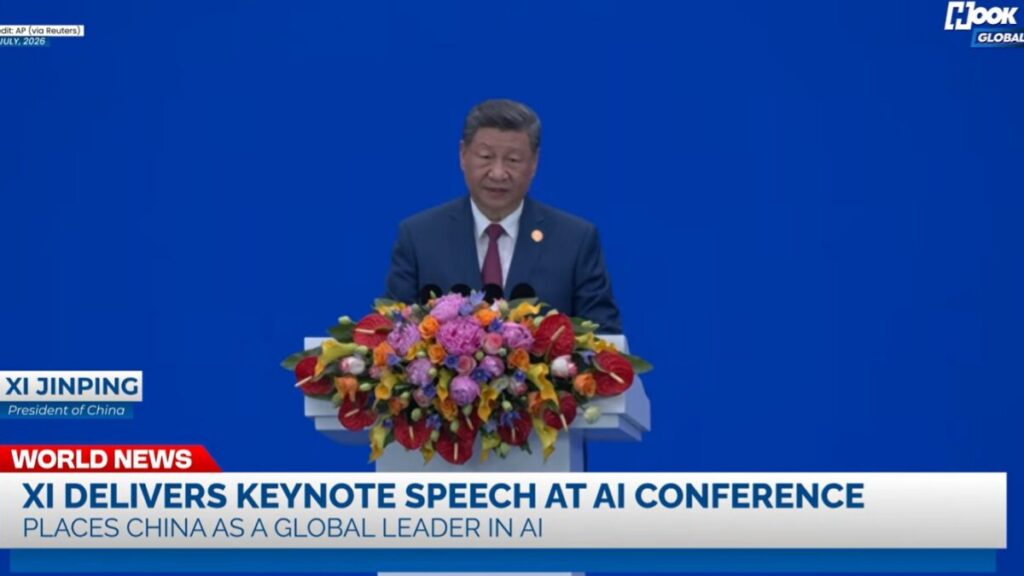
| Hook Global/YouTube screenshot |
Each time the U.S. has sought cooperation from the CCP on major issues, the CCP has used those opportunities to advance its own interests
Amid growing concerns about artificial intelligence, some in the United States are urging the Trump administration to cooperate with China on AI safety for humanity’s benefit.In a recent interview, OpenAI CEO Sam Altman stated that Trump and Xi would deserve the Nobel Peace Prize if they agreed that “no one should be taking a certain level of risk with the development process of this [AI].”
Former Secretary of State Hillary Clinton made a similar suggestion in an MS NOW interview and reiterated it on X. The Trump administration, she said, has “a huge opportunity to enlist China in the effort to rein in AI when President Xi visits.” While Altman may not fully understand the Chinese Communist Party (CCP), Clinton, given her extensive government and foreign policy experience, should have known better. Each time the United States has sought cooperation from the CCP on major issues, the CCP has used these opportunities to advance its own interests at the expense of the United States. Let’s look at some examples from the past two decades.
Bill Clinton’s So-Called ‘Win-Win’
In 2000, President Bill Clinton strongly supported granting China permanent normal trade relations and entry into the World Trade Organization (WTO), describing it as a “win-win” that would bring prosperity to the United States and political liberalization to China. More than 25 years later, China has become a more powerful authoritarian regime with a deteriorating human rights record and now challenges U.S. global leadership on multiple fronts.
Economically, China implemented certain scheduled tariff reductions and service phase-ins, but has not fulfilled the market-oriented commitments expected by WTO members. Critics and U.S. trade representative compliance reports note that Beijing maintained or reinstated barriers related to intellectual property theft, forced technology transfer, industrial subsidies, and restricted access in key service sectors. These practices have cost American businesses billions of dollars.
The “China shock,” referring to the economic disruption caused by China’s rapid export growth to the United States after joining the WTO in 2001, contributed to a significant decline in the U.S. manufacturing sector. Between 2001 and 2007, the United States lost 1 million manufacturing jobs and about 2.4 million jobs overall. Many regions have yet to recover. This outcome did not reflect the “win-win” scenario that was promised.
Assurances to Obama, Trump, and Biden
This was the beginning of a series of unfulfilled commitments. In 2015, Xi assured then-President Obama that China would not militarize the artificial islands it had built in the South China Sea. However, three years later, Gen. Joseph Dunford, chairman of the Joint Chiefs of Staff, noted that China had militarized those artificial islands with “10,000 foot (3km) runways, ammunition storage facilities, routine deployment of missile defense capabilities, aviation capabilities, and so forth.”
China also made commitments to both the Trump and Biden administrations that it would limit exports of fentanyl and its precursor chemicals during the U.S. fentanyl crisis. While Beijing placed some substances on a controlled list, enforcement has been inconsistent. A 2024 congressional report found that companies producing fentanyl chemicals continued to receive export tax rebates, and U.S. reports indicate China remains a primary source of chemicals used by Mexican cartels. A 2025 ProPublica investigation also identified links between Chinese groups and illegal marijuana operations in the United States. These findings have raised concerns that the CCP may be deliberately facilitating the flow of drugs such as fentanyl and marijuana into the United States.
Competing on AI --->READ MORE HERE

No comments:
Post a Comment