“Typical African songs and dances filled the cathedral.”
Last year, former Bishop Rafael Zornoza Boy of the Diocese of Cádiz y Ceuta marked World Migrant and Refugee Day in the Cathedral of Cádiz under the theme that “migrants are missionaries of hope that widen our hearts.”According to the diocese website, “numerous migrants living in the diocese, who carried the flags of their countries of origin. Typical African songs and dances filled the cathedral, symbolizing the cultural richness and diversity that coexist in the diocesan community.”
Bishop Zornoza Boy urged parishioners to “attend to all who come without distinction and without discrimination” and the “Diocese of Cádiz and Ceuta renewed their commitment to the reception, respect and integration of migrants, recognizing in them a living testimony of Christian faith, hope and fraternity.” This was the longtime position of the diocese which in 2022 had relayed the message of Pope Francis that thanks to migrants “we have the opportunity to know better the world and the beauty of its diversity.”
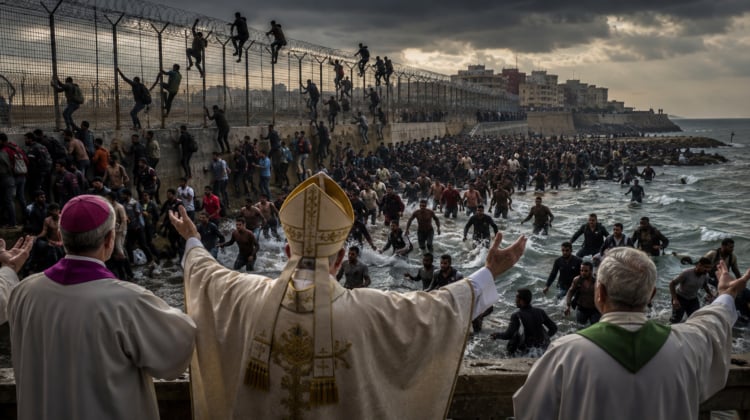
After the recent mass invasion of Ceuta by tens of thousands of Moroccan Muslim migrants, the Diocese announced “that all collections taken this weekend in Ceuta’s parishes will be allocated to the Diocesan Office for Migrants. The funds will be channelled through the San Antonio Migrant Assistance Centre.”
Father Fernando Redondo Pavón, the director of the Migration Department of the Spanish Bishops’ Conference, acknowledged that governments have the power to “control borders”, but emphasized that the Church wants to “put the emphasis on the humanitarian question.”
Father Pavon demanded the “dignified treatment of migrants in all circumstances”, denied that the Sanchez proposal for the mass legalization of 500,000 migrants had anything to do with the crisis and warned against using the invasion to “criminalize migrants,” or “generate fear.”
The cleric argued that the mass legalization “has been very positive and was necessary.”
Father Pavon had earlier ‘lauded the diversity and vitality immigrants bring to Spanish society, including to the Catholic Church.’
Bishop Xabier Gómez García, who heads the Migration and Interculturality for the Tarraconense Episcopal Conference, vocally denied that the proposed legalization of 500,000 migrants by the Sanchez government, supported by the Catholic Church in Spain, or the recent ruling by the Spanish Supreme Court allowing migrants who arrive by sea to claim asylum, had anything at all to do with the invasion.
Bishop Garcia argued that he did not “find it credible to attribute this avalanche to a ruling of the Supreme Court or to the regularization in force in Spain, which responds to specific profiles and is not indiscriminate”, but instead appeared to blame right-wing Sanchez opponents, “those who play with social fear or those who turn the suffering of others and fear into electoral profit.”
Rather than questioning mass migration, he claimed that the migrants supposedly drowned in the invasion “all have a name and a face” and urged continuing to welcome migrants.
A front page article at L’Osservatore Romano, the official newspaper of Vatican City, also grumbled that “Spain approaches the important 2027 elections and the ‘invasion’ of Ceuta once again attests that the issue of migration remains too often a tool to be used for political purposes.”
Rather than acknowledging the threat of mass migration, the Catholic Church’s hierarchy in Spain remained committed to portraying migration as a holy and transcendent phenomenon, defending the migrants, denying that the mass legalization of 500,000 migrants might have served as a magnet, and instead blaming the ‘right-wing’ or a third party.
While the Moroccan government clearly engineered the invasion, as L’Osservatore Romano noted and as some clerics in Spain broadly hinted at, without actually naming the culprit, none of it would have been possible without the decision by the Sanchez government and the Catholic Church to welcome migrants, promise them legal status and offer them aid.
The Spanish Bishops’ Conference and the Jesuit Refugee Service had been among 84 Catholic organizations which, along with the ruling Sanchez regime, Islamic Commission of Melilla and the Communist Party, had championed the mass legalization of 500,000 illegal migrants, gathering the signatures for the petition and making the case to the general public.
While Morocco deserves the blame for organizing the invasion, the last time it did so in 2021, only around 10,000 Moroccans crossed the border. Why did so many more Moroccans cross the border this time around? The vastly expanded invasion numbers weren’t because of Morocco, but because the Moroccan migrants had been given ample reason to believe that they would be allowed to stay.
Figures in the Catholic Church in Spain have gone to great pains to try and distinguish the mass migration now in Ceuta from past migrations, arguing that the migrants are not really migrants because they’re coming from North Africa rather than Africa, that the migration was orchestrated by third parties and that the invaders should in no way detract from ‘real migrants’.
But at the same time migrant activists within the Catholic Church in Spain have insisted on feeding the current waves of migrants and demanding that their asylum claims be processed.
Pope Leo’s distinction between migrants and migrant traffickers, an argument also taken up by some of these same figures in the Catholic Church in Spain, is another meaningless distinction. --->READ MORE HERE

No comments:
Post a Comment