 |
| AFP via Getty Images |
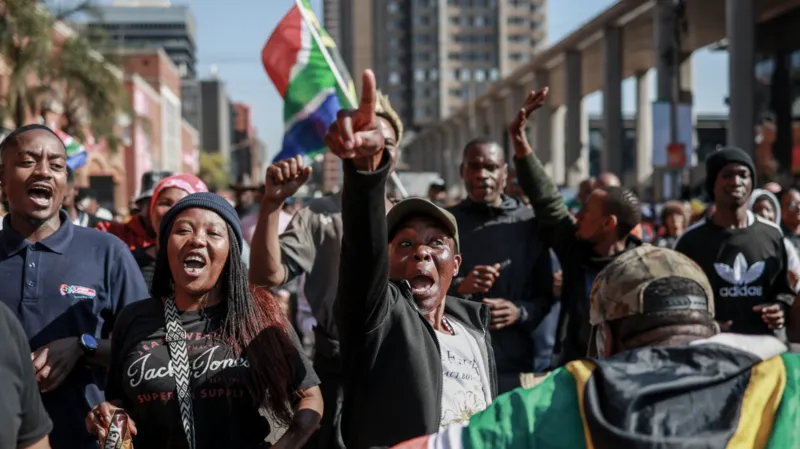
Thousands of people have marched in South Africa's main cities to demand that all undocumented migrants leave the country.
Police officers - backed by private security guards - have been deployed because of fears that protests could turn violent. Anti-migrant groups had set Tuesday as the deadline for undocumented migrants to leave.
Many foreigners have already fled to escape violence and intimidation. South African police say 25,000 have been repatriated so far. Most are from other African countries.
One undocumented Malawian told the BBC he was "happy to be going back" but "heartbroken" to be leaving behind four young children.
The Ministry of Police said the protests had largely been peaceful across the country, with isolated incidents of looting.
However Police Minister Firoz Cachalia confirmed that the army was deployed "on a contingency basis" in parts of Johannesburg as well as Durban.
Police also confirmed the arrest of three people in Hillbrow, a suburb in Johannesburg with a high migrant population, after two people were injured during protests.
According to police, the trio "opened fire at protesters who were passing through the street" and the marchers retaliated by "torching the suspects' vehicle". Among the injured was a 17-year-old.
Some protesters threw bricks, breaking the windows of some homes in Yeoville, another suburb where many African migrants live.
Shops in the city centre were closed, while police visibility is high on major streets.
In a neighbourhood in Germiston, about 15km (nine miles) from Johannesburg, demonstrators went to homes, evicting residents they suspected were foreign nationals and handing them over to police officers, insisting they check their documentation, local media report.
Police said they had arrested five people for the alleged looting of a foreign-owned shop in Johannesburg's biggest township, Soweto.
About 10 people were also arrested for looting in KwaZulu-Natal province, while a woman was arrested for assaulting a police officer and a man for "intimidation" following reports of a foreign national being beaten up, police said.
Businesses in central Durban, the main city in the province, were also shut.
Protesters handed over a memorandum listing their demands to government officials in Durban and Johannesburg.
The leader of anti-migrant group March and March, Jacinta Ngobese-Zuma, said they would protest every Thursday for the next six months to force the government to "get rid of" undocumented migrants who were still in South Africa.
A demonstrator - who is part of another anti-migrant group, Operation Dudula - told the BBC they would "push the police" to arrest foreigners who are not legally in the country.
President Cyril Ramaphosa met some of the protest leaders on the eve of Tuesday's marches to defuse tensions.
He has repeatedly warned demonstrators to act peacefully, while also accepting the need for immigration reforms. --->READ MORE HERE
What is the West waiting for?
What has been called ‘possibly the biggest mass migration story you have never heard of’ might be just weeks away from reaching boiling point.Over the last month, illegal aliens in South Africa have experienced a range of street violence from resentful locals, including murders. Stick- and whip-carrying members of groups and political parties like Operation Dudula (meaning “to force out”) have reportedly engaged in door-to-door intimidation and on-street demands for proof of nationality, on top of conventional public protests. Around the fourth such anti-migrant flare up in two decades in South Africa, thousands of victims, mostly from Ghana, Nigeria, Malawi and Mozambique, have voluntarily departed home as a result, many apparently responding to a June 30th-deadline set by groups like Dudula to get out of the country.
Perhaps most striking, at least for readers of this site, has been the South African government’s response. Instead of the denial, ridicule, new anti-protest laws or uphelpful allegations of xenophobia, which people of the West would usually hear, President Cyril Ramaphosa of Nelson Mandela’s African National Congress party stated those on the street expressing their concerns “deserve to be heard, and they deserve to be addressed.” Those frustrated in the poor townships about unregistered “spaza” shops, or small grocers run by illegal aliens, for instance, also deserved to be listened to. He then publicly introduced a raft of new reforms, many of which, if forcefully implemented, would go far in dealing with the country’s illegal alien problem, including:
- Prison sentences for employers hiring illegal workers;
- Stamping out identity theft by requiring biometric data registration;
- Speedier deportations by closing loopholes, etc.;
- Playing tougher with source countries.
Elsewhere, he has stated that he wants South Africa to redraft its United Nation commitments against deporting refugees (the so-called principle of non-refoulement under immigration law); something that is quite a move for a long-time darling of the UN and affectionately called the “Rainbow Nation.”
Compare this with the recent filmed event in Northern Ireland of a Sudanese national (a “fast-tracked” refugee, it turned out, who merely had to fill out a 10-page form) attempting to behead a man with learning problems in the middle of the street—It’s since been reported the victim was blinded as a result of the unprovoked attack. Like the mainland UK, similar and increasingly common occurrences in Northern Ireland (as well as the Irish Republic) have led to street protest as well as violence, all of which was met with your typical elite performative outrage, a swift crackdown on protesters, and without even a voiced contemplation of immigration reform. As one UK commentator—and the source of my opening paraphrase— recently articulated well, after the charge against the Sudanese attacker was made: “Political leaders condemned the violence that followed. Yet if condemnation is the only response leaders have after such incidents, the public will increasingly sense that official institutions are more comfortable denouncing the reaction than confronting the conditions that produced it.”
This does not seem to be happening in South Africa, where the violence against illegal immigrants (mostly visa-overstayers, not border-invaders) has been far, far worse, and spurred on by economic pressures, not heinously violent, migrant crime.
The South African far-left, however, has linked black anti-illegal alien violence generally to something called “Afrophobia”, which, one subscriber to the term informs, is a “psycho-social state reflecting on the black South Africans’ sense of self, stemming partly from the psychological effects of apartheid.” Whites make them do it, in order words. --->READ MORE HERE
If you like what you see, please "Like" and/or Follow us on FACEBOOK here, GETTR here, and TWITTER here.

No comments:
Post a Comment