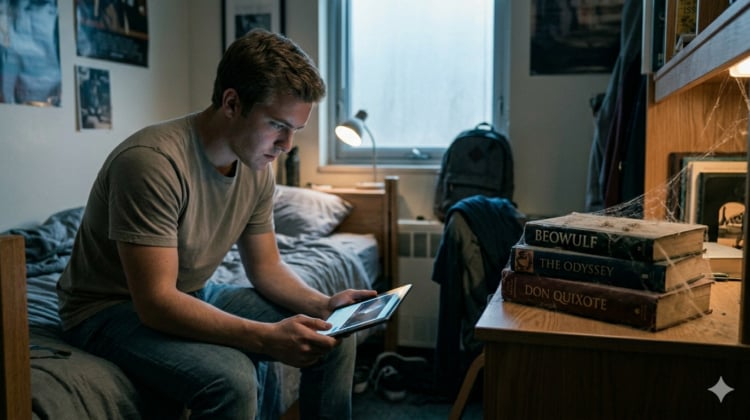
“We are reaching a crisis point.”
Before I left California for higher ground in Texas almost three years ago, I taught a Great Books course, among other subjects, to teenage boys in our homeschooling community there. I chose action-packed classics centered on the theme of heroism, which I hoped they would find irresistibly compelling and inspiring: books like The Epic of Gilgamesh and Beowulf that were of easily digestible length – or so I thought. Knowing that even homeschooled boys are notoriously reluctant to sit for long stretches of reading, I assigned only selections from works that are much longer, like Homer’s Odyssey and Cervantes’ Don Quixote.
The boys were very engaged during class discussion, but getting them to do a significant percentage of the reading – much less all of it – was a challenge, to put it mildly. And these were, as I said, homeschooled kids, meaning they were a cut above the average public school-educated boys, but outside of class their attention spans were still prey to all the cultural distractions that afflicted their non-homeschooled peers: digital screens, sports, their own boyish restlessness, and a pervasive pop culture focused on the now, the new, and the what’s next.
My personal experience seemed to be troubling confirmation of a decades-long trend not only of declining interest in the humanities, but of declining ability to appreciate and engage with classic literature.
As Isaac Saul noted recently in Tangle, “In recent years, articles about Gen Z reading less or being unable to read have abounded, as have investigations into declining literacy rates among Gen Z, backed up by a plethora of studies.” Saul concludes that we have “an American generation in a full-blown literacy crisis.”
“The End of the English Major” in The New Yorker in 2023 featured college English professors and students around the country, including English majors themselves, “talking about the unimportance of the degree and professors glibly discussing students’ declining interests and abilities in their subject.”
UC Berkeley’s student newspaper The Daily Californian reported recently that many faculty members in the school’s humanities department are slashing the amount of reading they assign because the students simply can’t – or won’t – handle the workload.
Carlos Noreña, for example, a Berkeley history professor specializing in ancient history, noted that the amount of reading he could assign while expecting students to read a “substantial” portion of it has dropped over the past 20 years. When he began teaching at UC Berkeley in 2005, Noreña would assign 100 pages per week for an upper division course, with the expectation that students would read 75 to 80 pages. Twenty years later, Noreña said he plans to assign only about 35 pages a week for the course he plans to teach this coming fall semester. “We are now reaching a crisis point where if the number [of pages] goes down further, it’s unclear to me whether my discipline of history can really be taught,” Noreña told The Daily Cal. [Emphasis added]
Some UC Berkeley faculty told the newspaper that they are increasingly assigning excerpts of longer works, as I did, rather than having students read entire books. American History professor Mark Brilliant said the number of books and pages he assigns have shrunk over the 22 years he has taught at the school. The earliest version of the History of California and the American West course he teaches required seven full books, but in the most recent version he assigned only excerpts, “acquiescing to my sense of — and complaints about — the amount of reading assigned, though those complaints, curiously, haven’t gone away as I’ve shrunk the number of pages assigned.” --->READ MORE HERE
 |
| JACKF-Getty Images |
As Gen Z ditch books at record levels, students are arriving to classrooms unable to complete assigned reading on par with previous expectations. It’s leaving colleges no choice but to lower their expectations.
One shocked professor has described young adults showing up to class, unable to read a single sentence.
“It’s not even an inability to critically think,” Jessica Hooten Wilson, a professor of great books and humanities at Pepperdine University, told Fortune. “It’s an inability to read sentences.”
Her observation reflects a broader trend: Nearly half of all Americans did not read a single book in 2025, with the habit plunging some 40% over the last decade. And even with young people embracing BookTok, a TikTok subcommunity dedicated to books and literature, Gen Z’s reading habits still lag behind all other generations. Americans ages 18 to 29 read on average just 5.8 books in 2025, according to YouGov.
“I feel like I am tap dancing and having to read things aloud because there’s no way that anyone read it the night before,” Wilson admitted. “Even when you read it in class with them, there’s so much they can’t process about the very words that are on the page.”
Students are finding it hard to read long passages
With students struggling, academics have been forced to adapt—a move critics describe as “coddling.”
For her part, Wilson has turned to reading passages aloud together, discussing them line by line, or repeatedly returning to a single poem or text over the course of a semester—in part so students can begin to develop the skills to read critically on their own and be prepared for their postgraduate career.
“I’m not trying to lower my standards. I just have to have different pedagogical approaches to accomplish the same goal,” Wilson said, adding that she’s taught at five institutions during her tenure of over 20 years, and more selective ones like Pepperdine tend to have better-prepared students.
For Timothy O’Malley, a theology professor at the University of Notre Dame, adapting to changes in student behavior hasn’t been especially difficult. It’s always his job to tailor classes to students needs, he argued. What’s more, he said students showing up to class unprepared is nothing new.
Early in his career, O’Malley typically assigned 25 to 40 pages of reading per class, and students would either do it or admit they struggled. --->READ MORE HERE
If you like what you see, please "Like" and/or Follow us on FACEBOOK here, GETTR here, and TWITTER here.

No comments:
Post a Comment