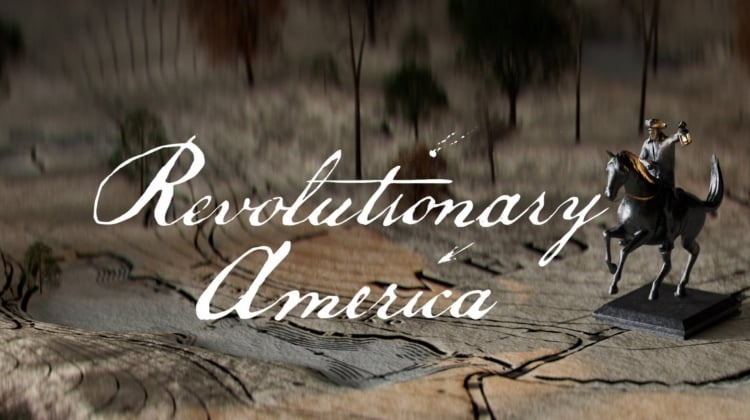
A Hillsdale documentary brings our origin story to life.
As the United States of America celebrated the 250th anniversary this past weekend of our Declaration of Independence, a Cato Institute/Morning Consult poll revealed that nearly half of Americans – 46% – and 61% of Gen Z Americans don’t know why. A new, feature-length documentary from Hillsdale Studios – a branch of Hillsdale College – offers those Americans a desperately-needed education in our founding. It tells “the greatest of all the political stories of freedom ever,” as Hillsdale President Larry Arnn states in his short introduction.
A master class in narrative history and civic renewal, Revolutionary America tells that tale – a human story fraught with missteps, but nevertheless a stirring, sobering reminder that our ancestors risked their “lives, fortunes, and sacred honor” to fight a War for Independence against all odds, and in victory formed a stable, lasting republic.
Released just ahead of our nation’s semiquincentennial, Revolutionary America, narrated by Tom Selleck, delivers a beautifully crafted, robustly defended chronicle of the American founding even as America’s radical Left, which controls the Democrat Party, takes every opportunity to trash our country’s “entire existence” as “a crime.” The film rejects contemporary revisionism to center on the American Revolution as a principled endeavor born of reflection and unmatched moral courage.
The documentary opens with Arrn noting that the American Republic is the longest-enduring free republic in human history. Yet, human beings are inherently predisposed to forget the heavy cost of their liberties. To combat this historical amnesia, the film expertly traces the roots of the conflict back to the French and Indian War, demonstrating that the path to 1776 was paved not by an unruly mob, but by Englishmen fiercely defending their historic and natural rights.
For generations, the colonies thrived under a policy of “salutary neglect.” However, as the documentary illustrates, the staggering debt incurred by Great Britain during its global triumphs over France changed the imperial calculus. Parliament’s subsequent attempts to micromanage and tax the colonies—most notably through the “dumbest act” of the Stamp Act of 1765—shattered the existing partnership. The film highlights the psychological shift this caused among the colonists: having fought as equals alongside British regulars, Americans suddenly found themselves treated as “second-class citizens” barred from expanding westward into lands they had shed blood to secure.
One of the documentary’s greatest strengths is its nuanced exploration of the internal tensions that defined early American resistance. Rather than painting the founding generation as a monolithic entity, the film relies on the insights of historical experts such as Arnn, Eric Metaxas, and Michael Knowles to illustrate the delicate balance between the rule of law and radical action.
The contrast between the Adams cousins serves as a brilliant narrative device. The film highlights the immense courage of John Adams, who risked his own popularity to defend the British regulars involved in the Boston Massacre of 1770. His insistence on due process and the rule of law stands as a timeless testament to American character. Conversely, the documentary captures the vital street-level energy of Samuel Adams and the Sons of Liberty, who understood that British corruption—exemplified by the cynical corporate bailout of the East India Company via the Tea Act of 1773—demanded a bold, unmistakable defense of property and liberty. When British retaliation came in the form of the draconian Coercive Acts, closing Boston’s port and dissolving its free government, it backfired completely. Instead of isolating Massachusetts, it forged an unprecedented, unbreakable union among the thirteen colonies.
The documentary hits its cinematic and emotional peak as it charts the outbreak of armed hostilities. The meticulously detailed sequence covering April 1775 brings the fabled rides of Paul Revere, William Dawes, and Samuel Prescott to life. When the British regulars met Captain John Parker’s thin line of seventy Minutemen on the mist-shrouded green of Lexington, the stakes became absolute.
The film captures the agonizing weight of the choices made by these ordinary farmers and laborers. As the narrative moves to the North Bridge at Concord, the documentary reminds the viewer of the profound gravity of firing upon a British regular—an act equivalent to treason, carrying the penalty of death. Yet, animated by the conviction that they were free men and not slaves, the colonists pushed the empire’s finest soldiers into a retreating gauntlet all the way back to Boston. Subsequent clashes, like the heroic, ammunition-starved defense at the Battle of Bunker Hill, proved that Washington’s emerging Continental Army possessed a spirit and enthusiasm unmatched by professional mercenaries. --->READ MORE HERE and WATCH THE VIDEO BELOW:
If you like what you see, please "Like" and/or Follow us on FACEBOOK here, GETTR here, and TWITTER here.

No comments:
Post a Comment