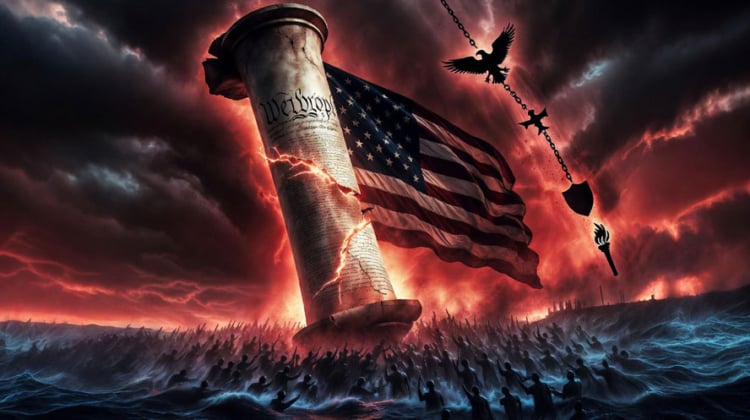
The Supreme Court has committed a grievous moral and legal error in Trump v. Barbara, the landmark case on birthright citizenship. In holding that the 14th Amendment confers automatic citizenship on virtually all children born on American soil, the court has severely vitiated the sanctity of American citizenship — in this “America 250” celebration year, no less. Moreover, on a prosaic level, the court’s majority botched the basic constitutional question.
As this column has explained, the 14th Amendment’s Citizenship Clause was, per its principal author, Sen. Jacob Howard (R-Mich.), “simply declaratory of … the law of the land already.” As for “the law of the land already,” that was the Civil Rights Act of 1866, ratified by Congress two years prior to the 14th Amendment. That statute deliberately withheld blanket birthright citizenship for the children of those who are “subject to any foreign power.”
Thus, the Senate Judiciary Committee chairman at the time, Sen. Lyman Trumbull (R-Ill.), confidently stated during the amendment’s ratification debate that “subject to the jurisdiction,” the legally relevant 14th Amendment Citizenship Clause language, meant those “not owing allegiance to anybody else.” This is why American Indians, whose allegiances in the 19th century were to their tribes, were not covered; it was not until the Indian Citizenship Act of 1924 that these children were granted blanket birthright citizenship. And if American Indians’ children were not automatically covered, then illegal aliens’ children certainly were not.
This is consistent with the prevailing 19th-century definition of citizenship, which was, as law professor Richard A. Epstein wrote recently for The Wall Street Journal, “an exchange of protection by the sovereign for loyalty of the citizens.” Justice Samuel Alito’s Barbara dissent cogently explicates this allegiance-based conception of citizenship, and Justice Clarence Thomas’s separate dissent is a masterclass in history.
It is shameful that Chief Justice John Roberts and Justice Amy Coney Barrett constitutionalized this fraught issue, rejecting Justice Brett Kavanaugh’s middle-ground statutory overture and thus removing the question of birthright citizenship — and all that it now entails, such as the execrable practice of “birth tourism” — from our normal democratic politics. To that extent, Roberts and Barrett have indeed given us a new Roe v. Wade. Under a standard reading of Barbara, the case must be overturned, or a new constitutional amendment passed, in order to preserve the sanctity of citizenship.
But what if the standard reading of Barbara is wrong? President Donald Trump responded to the court’s decision by calling on Congress to act. Most commentators dismissed this out of hand as a paroxysm of rage from an aggrieved party. But the president, it turns out, is actually grasping at an important point. Congress can, and should, act by declaring both illegal aliens and so-called birth tourists to be the functional legal equivalent of modern-day foreign army invaders.
There are four distinct clauses of the Constitution that reference invasion. And while the Supreme Court has never legally defined an “invasion,” law professor Josh Blackman has explained, in surveying the four clauses, that the “Constitution affords Congress, the president, and the states the power to declare an invasion — every branch except the judiciary.” Indeed, in recent years, the state of Texas under Gov. Greg Abbott has done exactly this. --->READ MORE HERE
 |
| AFP via Getty Images |
“All persons born or naturalized in the United States, and subject to the jurisdiction thereof, are citizens of the United States and of the State wherein they reside,” states the Fourteenth Amendment.
But are those whose parents are here temporarily as tourists or illegally because they have snuck across the border or overstayed a visa really “subject to the jurisdiction thereof”?
To the Supreme Court, yes.
The bench ruled in a 5-4 decision that the clause grants unrestricted citizenship to virtually all individuals born on American soil. Practically speaking, the only newborns excepted are those of foreign diplomats.
The ruling voids President Trump’s executive order barring citizenship to children born of parents present illegally or on a lawful but temporary basis. That includes as many as 250,000 babies a year.
Conceived in the aftermath of the Civil War, the citizenship clause was written to ensure that freed slaves and their children counted as citizens. It was not written to enable “birth tourism” or the barbarous “surrogacy networks.” These schemes cater to foreigners specifically to produce American citizens — or worse, to sneak in children of hostile foreigners.
Justice Ketanji Brown Jackson used hip-hop slang in her opinion favoring this travesty of a ruling. The creators of the Fourteenth Amendment “understood the assignment,” she wrote, referring to a song by the rapper Tay Money. The “assignment,” in Jackson’s view, appears to be to import as many new Democratic voters as possible, since the Left can’t seem to win with the native-born population.
Justice Clarence Thomas has a better understanding of the citizenship clause. He notes that it gives lustre to the idea of American citizenship. Unfortunately, as he adds in his dissenting opinion, the court’s ruling “devalues” that very citizenship.
The Supreme Court’s ruling runs against the prevailing sentiments of most Americans. A May Harvard/Harris poll shows 56% of the country favors the deportation of all illegal immigrants. Some thinkers who believe America should be allowed to protect its own borders are predicting the end of America as we know it. “If your ruling requires you to suicide your civilization,” White House adviser Stephen Miller told Fox News, “your reading of the Constitution is wrong.” --->READ MORE HERE
If you like what you see, please "Like" and/or Follow us on FACEBOOK here, GETTR here, and TWITTER here.

No comments:
Post a Comment