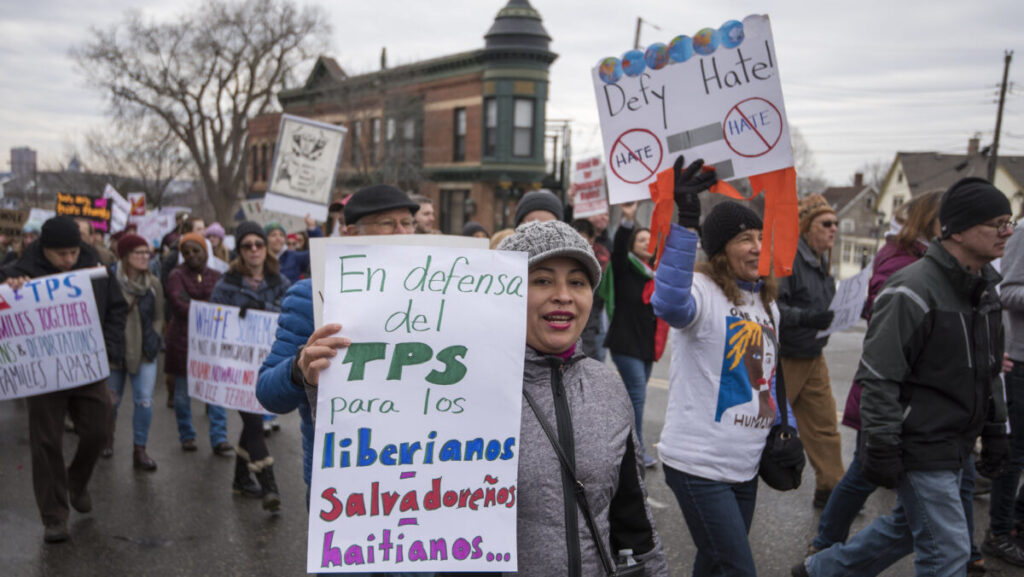
 |
| Fibonacci Blue/Flickr/CC BY 2.0 |
‘Temporary Protected Status’ has drifted far from the finite relief Congress envisioned into a programmatic and political circus.
In 1982, a staffer for House Speaker Tip O’Neill called Social Security the “third rail of American politics.” Today, that title belongs to Temporary Protected Status (TPS) — a program so politically charged that administrations from both parties have repeatedly extended it rather than confront its structural failures. But the Trump administration could finally fix this broken program with a few moves that will simplify ongoing legal battles.Created under the Immigration Act of 1990, TPS was designed as a narrow authority to respond to qualifying events abroad — armed conflict, famine, or natural disaster. It was never meant to confer semi-permanent status, or even legal immigration status at all, as the Congressional Research Service has noted.
The statute allows DHS to designate a country for TPS when “extraordinary and temporary conditions” prevent safe return. Designations must last between 6 and 18 months, with renewals in the same range. But the law is silent on how long a designation should last once conditions improve — a silence that has allowed TPS to become a revolving door of indefinite extensions for some, while other citizens of those countries are deported back amid those same conditions.
Former DHS secretaries agree: TPS is a tool for short–term emergencies. It cannot function when designations last decades — a point underscored by then‑Homeland Security Secretary Kirstjen Nielsen, who noted in 2018, that “to pretend that conditions continue to exist [based on events] 20 years ago is a fiction.”
TPS has drifted far from the finite relief Congress envisioned into a programmatic and political circus.
Opportunity in October
In October, the number of people actually protected by TPS as Congress codified it will potentially fall to zero for the first time since 1991, when El Salvador first received the benefit in response to its ongoing civil war. (That designation ended in 1994, and former beneficiaries were granted Deferred Enforced Departure (DED) — a temporary, non‑statutory protection often mischaracterized as equivalent to TPS — until 1995. By 2001, those who still hadn’t departed the United States would again find themselves eligible after a devastating earthquake triggered a new TPS designation.)
That interval — the space between the last expiring designation and the next qualifying event — is the only moment when Congress could act without disrupting anyone’s existing protection. It should use that window to examine whether the program can be restored to its original purpose. And if it cannot make meaningful structural changes, it should end the program altogether (those in genuine need of asylum would still be able to seek it via other legal avenues). As Milton Friedman observed, “nothing is so permanent as a temporary government program.”
TPS has also become a textbook case of Congress ceding its authority to the executive, writing the courts out of the tent by statute, only for the judiciary to shove its nose back under it through aggressive interpretations of the Administrative Procedure Act (APA) — a post‑World War II law that lets judges review agency decisions even when Congress bars them from reviewing the substance. Each branch has found the arrangement convenient: administrations use repeated TPS extensions and redesignations as a way to avoid taking enforcement action, because ending relief makes an administration look like it’s stripping “protection” from vulnerable people, even though most beneficiaries were already living here when the original qualifying event occurred. Congress avoids confronting the program’s structural failures, while the courts use the APA.
Trump Takes Action
Say what you will about the Trump administration, but during both its first and second term, it has at least been willing to act on the decades-old elephant in the tent. Unlike prior administrations — which complained about the problem only to ignore it — Trump’s first administration attempted to end several long-running designations, though it delayed doing so until 2018. Three lawsuits were then filed against the U.S. in California and New York covering Sudan, Nicaragua, Haiti, El Salvador, Nepal, and Honduras. The Biden-Harris administration not only settled the litigation, but expanded TPS to cover a record 17 countries and an estimated 1.4 million individuals. --->READ MORE HERE

No comments:
Post a Comment