
The ISIS flag flies again in Raqqa, thanks to the man who drove them out a decade ago.
No one ever thought this day would come: On Wednesday, Jan. 21, 2026, the flag of the Islamic State (ISIS) flew once again over Raqqa, the Syrian city that once served as its capital.It was around ten years ago now that ISIS controlled a territory in Iraq and Syria that was larger than Britain. Given Barack Obama’s indifference (which is the best face one can put on his behavior) to its continued presence and even expansion, the ISIS caliphate looked as if it was here to stay. Then, however, came Donald J. Trump.
In a major speech on counterterrorism in August 2016, Trump pledged that “my administration will aggressively pursue joint and coalition military operations to crush and destroy ISIS.” The promise was made, and the promise was kept. Within a matter of months after his inauguration, the ISIS caliphate was no more.
And that wasn’t all. Trump said we could not only could we not allow ISIS’s evils to continue, but “nor can we let the hateful ideology of Radical Islam – its oppression of women, gays, children, and nonbelievers – be allowed to reside or spread within our own countries. We will defeat Radical Islamic Terrorism, just as we have defeated every threat we have faced in every age before.”
As part of that effort, in June 2017, President Trump called out Qatar: “The nation of Qatar, unfortunately, has historically been a funder of terrorism at a very high level. And in the wake of that conference, nations came together and spoke to me about confronting Qatar over its behavior. So we had a decision to make: Do we take the easy road or do we finally take a hard but necessary action. We have to stop the funding of terrorism. I decided along with Secretary of State Rex Tillerson, our great generals and military people, the time had come to call on Qatar to end its funding. They have to end that funding. And its extremist ideology in terms of funding. I want to call on all other nations to stop immediately supporting terrorism.”
Qatar paid no attention. On October 7, 2023, top Hamas leaders were in Doha, watching video of Hamas’ massacre of Israelis and glorifying Allah for the carnage. Nevertheless, when Trump two years later forced Israel to stop pursuing its goal of destroying Hamas utterly and ending its ongoing threat against Israeli civilians, he praised Qatar’s role in bringing about this spurious peace: “Qatar was a tremendous help to getting this done. I hope people can realize that. It was very tough and very dangerous for Qatar. They were very brave.” He even provided Qatar a guarantee of its security in case of attack.
None of this has ever been explained. Trump has never made reference to his 2017 statement about Qatar funding terrorism. Nor has he explained how his wholehearted embrace of Syrian President Ahmed al-Sharaa, a former al-Qaeda leader who has shown not a single concrete sign of having genuinely changed his beliefs or goals, squares with his previously stated determination to fight “radical Islamic terrorism.” He doesn’t speak about that anymore, either --->READ MORE HERE
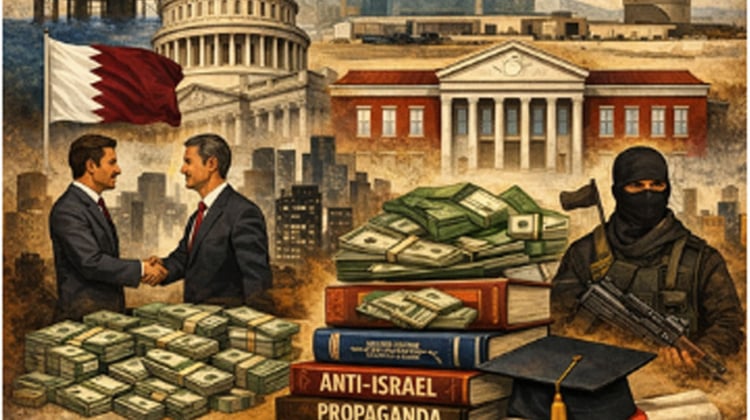
How much influence does the deep-pocketed Gulf country hold in America?
Fabulously rich from the sale of its natural gas — it has the third largest gas reserves in the world, after Russia and Iran — the Emirate of Qatar has perfected the art of winning influence through what is demurely called “soft power,” that is, the kind of power that not armies, but only money can buy. Since 2012, Qatar has spent $72 million for Washington lobbyists, which is more than any other country has spent in that time, in order to help make its case in the corridors of Congressional power. When some Congressmen accuse Qatar of “harboring senior officials of Hamas,” which it does, Qatar rolls out other congressmen, who have received briefings and money from those K Street lobbyists, who remind their colleagues that Qatar allows the United States to maintain its largest military base in the Middle East — the Al-Udeid Airbase — and invests so very much in American securities. Shouldn’t those facts outweigh all other considerations?Qatari money also helps to mold young American minds in those universities that Doha chooses to support quite extravagantly. The money comes with strings attached, of course. Any sums from Qatar given to universities go to support faculty members who are sympathetic to the Emirate itself, or to “Palestine,” or to the “religion of peace.” Qatari money goes to pay the salaries of those teaching courses about “the faith of Islam,” or the political evolution of the Gulf states, or on “Al-Andalus and the Birth of ‘Convivencia,’” or — absolutely de rigueur — a course on the “Israel-Palestine conflict,” and woe betide any faculty member who, having received Qatari support (as by holding a chair that Doha has endowed), dares in his lectures to be less than admiring of Islam, the “religion of peace,” or even worse, to be even slightly understanding of the Jewish state. The students’ minds are thus filled with the belief that Islam is quite admirable and only “Islamophobia” explains the reluctance of some in the West to be enthusiastic about the adherents of that religion. And those students are provided with a view of a long-suffering “Palestine” and a preternaturally wicked Israel that the ghost of Edward Said could not have bettered.
More on deep-pocketed Qatar and how it uses its money to influence Americans can be found here: “US Education Department’s New Database Reveals Qatar Ranks as Top Foreign Funder of American Universities,” by Corey Walker, Algemeiner, January 8, 2026:
Qatar is the single largest foreign source of funding to American colleges and universities, according to a newly launched public database from the US Department of Education that reveals the scope of overseas influence in US higher education.
The federal dashboard shows Qatar has provided $6.6 billion in gifts and contracts to US universities, more than any other foreign government or entity, outpacing the next highest contributions from Germany ($4.4 billion), England ($4.3 billion), China ($4.1 billion), Canada ($4 billion), and Saudi Arabia ($3.9 billion).
Of the schools that received money from Qatar, Cornell University topped the list with $2.3 billion, followed by Carnegie Mellon University ($1 billion), Texas A&M University ($992.8 million), and Georgetown University ($971.1 million).
It would be fascinating to know what courses on Islam and the Middle East have been or are now being taught at those four universities, and about the publications of the professors teaching them. Perhaps AIPAC would like to look into this. --->READ MORE HERE

No comments:
Post a Comment