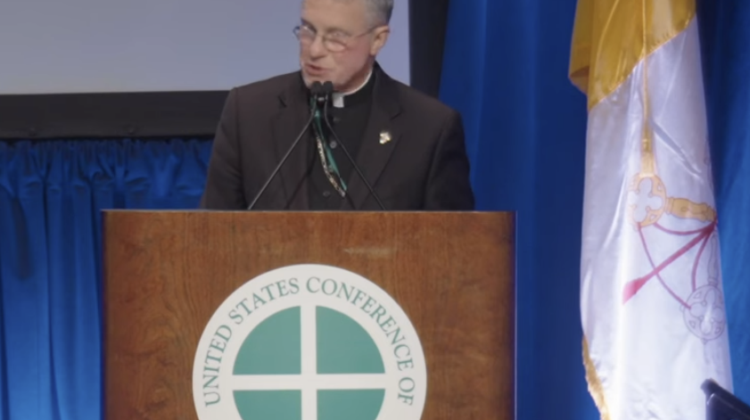
“I think it tarnishes the image of the United States in our world.":
Chaplains do not make policy. That should be obvious. And yet here we are.
Archbishop Timothy Broglio of the Archdiocese for the Military Services spoke in a Jan. 18 interview with the BBC about the morality of a possible U.S. military operation to take Greenland.BBC Presenter Edward Stourton mentioned in the interview that Trump, speaking about his foreign policy, recently told The New York Times that he doesn’t need international law and that he has his “own morality,” as a constraint to his power.Commenting on this “own morality” quote, Archbishop Broglio said, “I must say I’m a little bit concerned because, I mean, we do have international law, and we do have obviously moral principles that should guide all of us, and perhaps some of the rhetoric is more concerning than some of the actions, although even some of the actions have left room for concern, I believe.”Stourton later asked whether Archbishop Broglio could “conceive of any circumstances in which an American military operation to take Greenland fulfill the criteria of a just war.”Archbishop Broglio replied, “I cannot see any circumstances that it would. Greenland is a territory of Denmark — Denmark is an ally, it’s part of NATO, it does not seem really reasonable that we would, that the United States would attack and occupy a friendly nation.”Stourton asked Archbishop Broglio about his reaction to the White House’s statement that it has not ruled out military force and that the administration employs rhetoric that “clearly seems designed to intimidate.”Archbishop Broglio answered, “I think it tarnishes the image of the United States in our world, because traditionally, we’ve responded to situations of oppression, or situations of – that’s not to say those weren’t sometimes in national interest, but this is certainly very difficult to justify.”The archbishop, who recently concluded a three-year term as president of the United States Conference of Catholic Bishops, also commented on soldiers’ conscience rights.Stourton reflected on how difficult it would be to be a soldier who refuses to comply with an order involving a military operation in Greenland and asked about the archbishop’s perspective on that situation.“I am obviously worried because they could be put in a situation where they’re being ordered to do something which is morally questionable,” Archbishop Broglio said, “and, it would be very difficult for a soldier or marine or a sailor to, by himself, to disobey an order such as that, but strictly speaking, he or she would be within the realm of their own conscience, it would be morally acceptable to disobey that order, but that’s perhaps putting that individual in an untenable situation, and that’s my concern.” --->READ MORE HERE
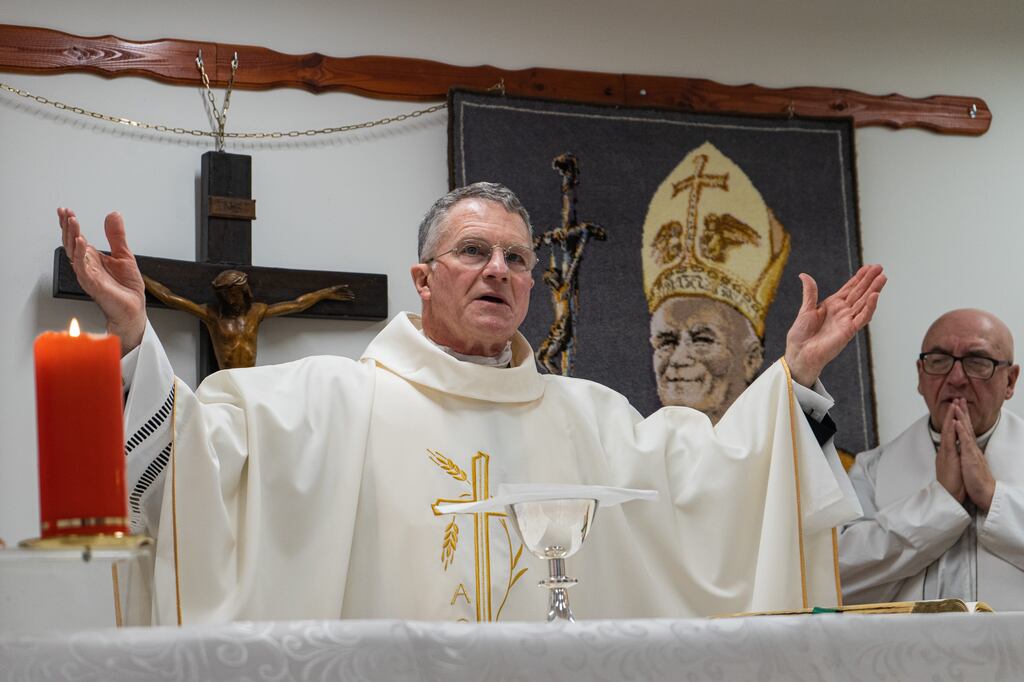 |
| Spc. Anthony X. Sanchez/U.S. Army |
The Catholic archbishop responsible for U.S. military personnel said it is “morally acceptable” for service members to disobey an order if it is against their own conscience, as the Trump administration weighs possible troop deployments to Minneapolis, and the use of force to seize Greenland.
Timothy Broglio — who has served as the archbishop for the military services since 2007 — admitted in a BBC interview on Sunday that he was worried about the troops in his pastoral care “because they could be put in a situation where they’re being ordered to do something which is morally questionable.”
“It would be very difficult for a soldier or a Marine or a sailor to, by himself, to disobey an order … but strictly speaking, he or she would be, within the realm of their own conscience, it would be morally acceptable to disobey that order,” he said.
He went on to note, however, that such an isolated act of conscience would be “perhaps putting that individual in an untenable situation — and that’s my concern."
Asked about President Donald Trump’s effort to annex Greenland, the autonomous Danish territory, Broglio echoed the condemnation voiced by the upper echelon of the Catholic church over the administration’s foreign policy.
“It does not seem really reasonable that the United States would attack and occupy a friendly nation,” he said. “I think it tarnishes the image of the United States in our world.”
Each service member swears an oath of enlistment to “support” and “defend” the constitution, not the commander in chief. Under U.S. military law, troops are required to disobey orders that are “manifestly” or “patently” unlawful, though such cases are legally complex. Brenner Fissell, vice president of the National Institute of Military Justice and professor of law at Villanova, emphasized the system is legal, not theological.
“The United States law does not track Catholic ethics,” Fissell said in an interview with Military Times. “There is a concept called conscientious objection, which is when you are opposed morally to war, but the United States does not recognize selective conscientious objections which is when you identify specific wars or deployments you don’t want to participate in.”
The distinction, Fissell said, carries consequences. --->READ MORE HERE
If you like what you see, please "Like" and/or Follow us on FACEBOOK here, GETTR here, and TWITTER here.

No comments:
Post a Comment