
Europe’s immigration problems are not so difficult to fix. But they must be fixed quickly before the continent changes out of recognition
In military history, there are instances in which one side unleashes a completely new weapon or form of combat, leaving the adversary so entirely off guard that they are unable to muster any effective defense. The Eurasian rider nomads are an example; their archers stunned the Europeans with their ability to shoot accurately from the back of a galloping horse, an assault method never seen before. Their incredibly agile hit-and-run mounted troops fired off flurries of arrows while attacking at high speed, and then, in a maneuver called the “Parthian shot,” they continued to shoot backwards over their shoulders as they sped away.The longbow upended medieval combat by adding unparalleled lethal range; the Byzantine use of Greek fire introduced shock and awe into naval battles; the British use of tanks in the First World War brought mobility and firepower to static trench warfare. These are the black swans of combat—forms of attack that you can’t prepare for, because you can’t imagine them. You must then wrap your mind around what just happened, regroup, and alter your defensive and offensive arsenal. If you can’t manage that fast enough, you’re going down.
Europe is presently under attack from just such an unexpected, black-swan form of warfare. The undercover invaders are wreaking havoc, upending the economies, undermining civil security with hitherto unseen levels of crime, splitting domestic politics, degrading the education systems, gridlocking the courts, and altering the cherished cultural practices of their host nations. While also plotting terrorist attacks, building ISIS cells, and unleashing a wave of sexual assault. European governments are struggling even to grasp what is happening, let alone formulate an effective response.
When Europe Opened the Immigration Floodgates
The initial error of the Europeans was to fall for the illusion, in 2014, that the mass of arriving persons were primarily migrants and refugees. It was the height of the Syrian crisis, and in a combination of soft-heartedness and pragmatism, the Europeans assumed that the people streaming across their borders must be Syrians. Spinning the fantasy forward, they imagined these would mostly be nice, middle-class Syrian families, with a preponderance of medical doctors among them. They would integrate easily. It would be a perfect fit. As soon transpired, they weren’t mostly Syrian, and they weren’t mostly families or middle class. The majority were uneducated single younger men from Pakistan, Afghanistan, and—as the floodgates opened—from territories beyond. By 2024, there were 11 million refugees (excluding illegal immigrants) from 147 countries.
The normal circumstance is that migrants and refugees come to your country because they need to leave their original homeland. They appreciate the sanctuary and try to be pleasant, building new lives within your physical and social boundaries. Some initial difficulties are to be expected; the newcomers, after all, are unfamiliar with the language and with local customs and practices, their professional qualifications may not be recognized, or they may not have any locally employable skills, and multiple practical matters must be handled.
They may be shocked and traumatized by the circumstances of their departure. Dependent on the kindness of strangers and the assistance of a foreign bureaucracy, you expect them to be generally cooperative, willing to learn and adjust, and appreciative of the money, help, and sympathy they are receiving. And in previous European experience, that was exactly how things went, which is why they can’t be blamed too much for missing the early warning signs indicating that they were dealing with something entirely new.
Consider the Bosnian refugees, for example. Like the current migrants and refugees, they too were Muslim. Arriving abruptly in 1992, fleeing the incredibly bloody and brutal ethnic cleansing and massacres of the Balkan Wars, they, too, were traumatized. Mostly from conservative rural areas, modern Western city life was an adjustment. Their adamant plan was to return to the farms and homes they had left behind. Still, as the conflict continued, they began to put down roots and, ultimately, over 90 percent of them stayed and settled in their European countries of refuge—primarily Germany, Austria, Sweden, and Denmark. Their current unemployment rate is lower than that of the domestic population, including women.
They have maintained their identity and can be termed a “mixing bowl” success. They have a well-organized and vibrant subculture, with cultural centers, mosques, restaurants, clubs, volunteer aid organizations, connections with the “homeland,” and active community networks that maintain Bosnian cultural, religious, and social traditions while living constructively and comfortably in Austrian society. There was never pressure from the public for the Bosnian refugees to be repatriated; on the contrary, they received widespread sympathy and support. Many ordinary families volunteered to host them in their own homes, as they later also did with the Ukrainians. The current population of Ukrainians is also generally doing well—learning German, dispersing into the general population, and within a short time, finding employment.
Indigenous society, caught by surprise and hamstrung by its guilt over past colonialism and Germany’s fascism, plus an entrenched liberal self-image of noble ubertolerance, is unable to react. It hasn’t even properly understood what is happening.
I know this is controversial, so let’s first look at the math in a non-European context. In Israel, the extreme orthodox Haredi segment of the Jewish population holds a vision of the proper and desirable social order that is at odds with the country’s modern, progressive, mainstream society. They believe in gender segregation, reject secular and scientific learning, and consider the study of Torah to be the only worthwhile activity. Most of their men eschew wage-earning professions and live instead on government subsidies and on money earned by their wives. The wives believe that financially supporting the husband’s lifelong full-time Torah study by working, birthing, and raising as many children as possible is the fulfillment of a woman’s role in the divine order. The Haredim disapprove of the state of Israel as an entity and vigorously oppose the recent attempts to include them in the military draft. Though disengaged from their nation, for tactical reasons, they maintain high voter turnout, voting as a bloc and as instructed by their rabbinical leadership. This makes them a critical factor in coalition building and lends them considerable weight. It’s a clever strategy. No need to fight, no need for the men to slog away at boring jobs. They need only industriously impregnate their women.
Currently, the Haredi population accounts for about 21 percent of Israel’s Jewish population. At their rate of 6.7 children per woman, projections place them near or over 50 percent of the Jewish Israeli population by the end of the century. They make no secret of their wish to impose strict religious rules of behavior on the rest of the population, and by their numbers, they will be able to do that. Their triumph will, alas, be short-lived. Israel will have a population half of which is pacifist, its males economically unproductive and, with their sedentary scholarly lifestyle, not physically fit, its females pregnant, lactating, and overworked; it won’t make them very competitive in a neighborhood dominated by hyperactive, aggressive Arab males and their equally procreation-inclined wives. The Haredim seem on course to win control of Israel, briefly, until they lose it all to the Arabs. And the secular Israeli state is hastening this outcome by paying bonuses for each additional child. This program failed to incentivize its modern citizens and ended up benefiting only the minority that is poised to bring the house down.
Now we turn to Europe. Let’s stay with demographics. To sustain a human population, you need a fertility rate of 2.1 children per couple. Not a single European country currently reaches that minimum number. This is a big problem, and Europeans are aware of it. But their concern is an odd one, focusing on the arguably least important consequence. They worry only that there won’t be enough younger working people to cover the pensions of their aging population. Shouldn’t they be asking who will carry forward their civilization, represent and defend their values, build on their scientific and industrial accomplishments, enjoy the music, art, theater, and fashion that represent their roots and were developed over many centuries, and create more of this for the future, and celebrate their traditions and beliefs? Are they content to write all of that off, as long as someone, anyone, is there to pay into the pension fund? (Spoiler alert: that’s not working out either).
The effort to conquer Western civilization was twice repulsed at the Gates of Vienna, but now, aggressors have realized that the prize can be won so much more easily, that entry and conquest can be so much simpler. Instead of frontally attacking your target’s fortified walls, maneuver yourself inside and then leverage the vulnerabilities of your adversary to paralyze his defense. In this case, two vulnerabilities are key: first, the European mindset, a mixture of guilt and smugly prideful masochistic liberalism. Second, their modern lifestyle is not family-conducive. The combination of many single parents and dual-career couples, a belief in personal self-fulfillment, and in female equality creates great practical difficulties for the rearing of one, let alone several, children. Those are fine and excellent values, except that Western European modernity failed to develop in parallel some effective new ways also to accommodate the human and societal basics of family and reproduction. --->READ MORE HERE
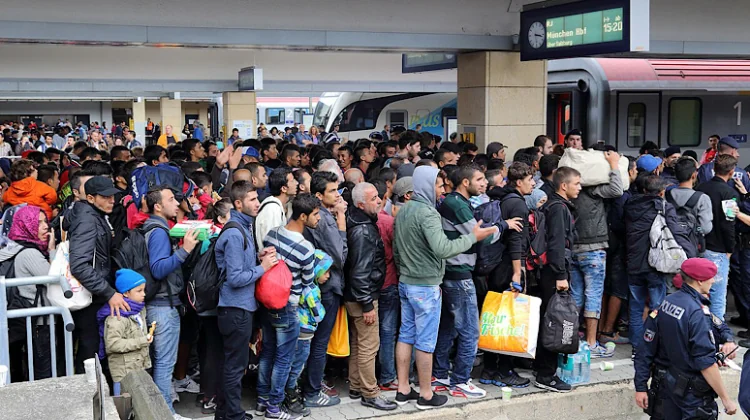
The rapid decline of a great city.
They said I was wrong about the Islamization of the West – and I now realize that I was, indeed, wrong.
Let me be clear. I wasn’t wrong in warning, for the last quarter century, that the mass immigration of Muslims into Western Europe would gradually give rise to larger and more numerous and more isolated sharia-run enclaves, to higher crime statistics and ever more violent crime, to snowballing government expenditures on newcomers (and their progeny) that would eat up more and more of the welfare-state budget, and to ever-greater appeasement that would steadily erode Western liberty and result ultimately in utter capitulation to Islam. In response to such warnings, I, along with others who offered the same bleak message, was dismissed and demonized by politicians, journalists, and academics who insisted that such concerns were absurd – that people like me were engaged in gross exaggeration, were displaying wholesale ignorance, or were venting sheer bigotry. Over time, these critics insisted, Muslims would integrate perfectly well into European society, with the children and grandchildren of the original immigrants becoming , like the descendants of the Europeans who emigrated to America a century or more ago, patriotic, freedom-loving citizens, valuable contributors to the economy, guarantors of lasting freedom and prosperity, and role models for future newcomers.
On that little matter, I’m sorry to say, the years have proven me right, and more and more observers are acknowledging it. The sad truth is that the Western European leaders who, over the last couple of generations, welcomed Muslims into their countries in massive numbers initiated a process whereby – unless extensive and dramatic action is taken very soon – those countries, like the Maghreb and most of the Levant before them, will be swallowed up into the Islamic world.
No, I wasn’t wrong about that, as much as I wish I had been. What I was wrong about is this: in the autumn of 2018, I wrote a piece for FrontPage in which I favorably compared Vienna – which I was then visiting for the very first time – to other German-speaking cities with which I was acquainted. To be sure, I was then, and still am, very fond of several of those cities, notably Munich and Berlin. But I found that while Germans today make a career out of distancing themselves indiscriminately from their nation’s history and of embracing a European identity by conspicuously flying the EU flag rather than the German tricolor, Viennese shops, taverns, and restaurants proudly displayed old paintings of their famous forebears along with other fond reminders of the city’s storied culture. Plainly related to this contrast was another difference: while German cities were increasingly overrun with Muslims, whom the natives reflexively, if baselessly, celebrated as a way of showing that they’d thrown over their great-grandparents’ racism (Hamburg, in my experience, had been especially unsettling in this regard), Vienna struck me as being “a city whose people cherish their culture and history” – except for that disagreeable period between 1938 and 1945 – and who were “definitely not on board with the project by other Western European countries to surrender to the imams.” This, I wrote, was “something to cheer.”
Well, that was, as I say, 2018. Based on what I saw, I thought that Vienna might very well have dodged the Islamic bullet. So impressed was I, in fact, by what I experienced in Vienna that I decided it might well be my very favorite of all the cities I’d seen in Europe – which was saying a great deal, given that the list included London, Paris, Rome, wonderful Copenhagen (where I’d stayed, by that point, about a dozen times), and my beloved Amsterdam (to which I’ve probably flown at least fifty times over the years, spending, all told, at least a full year of my life there). I was so fond of Vienna that I booked another trip in 2019, which proved equally delightful. After that, I decided that Vienna would thenceforth be my annual autumn destination. While the other capitals of Western Europe fell to the invaders, I’d visit the holdout. Who could ask for anything more?
Alas, then came COVID. After that, my partner was hospitalized (not with COVID) for much of a year. Somewhere in there I worked in a quick trip – my first – to Budapest, where an old friend lives. And then I got sick, and during the last year my travels have all been domestic and for medical reasons. Six years, then, have come and gone, and I haven’t been back to Vienna. But I now know that when I thought, back in 2018, that the powers that be Vienna, and in Austria generally, were strong and savvy enough to ensure their people’s protection from the Islamic hordes, I was wrong – extremely, tragically wrong.
I know this because I’ve just received an update of sorts in the form of a brief video. It’s by the Hungarian politician Barna Pál Zsigmond. The son of a mechanical engineer and a chemist, he studied mathematics and physics and earned a degree in law and political science before serving in the National Assembly. He’s also worked in the private sector. And he’s highly presentable and very well-spoken in English. Quite an impressive résumé – but because he’s a member of Victor Orban’s own party, Fidesz, which has resisted immense pressure from the EU to open Hungary’s borders to Muslim immigration (indeed, the Hungarian government chooses to pay a daily penalty of €1 million for violating the EU’s asylum rules rather than alter its policies), Barna Pál is the kind of figure who is persona non grata in the corridors of power in Brussels. --->READ MORE HERE

No comments:
Post a Comment